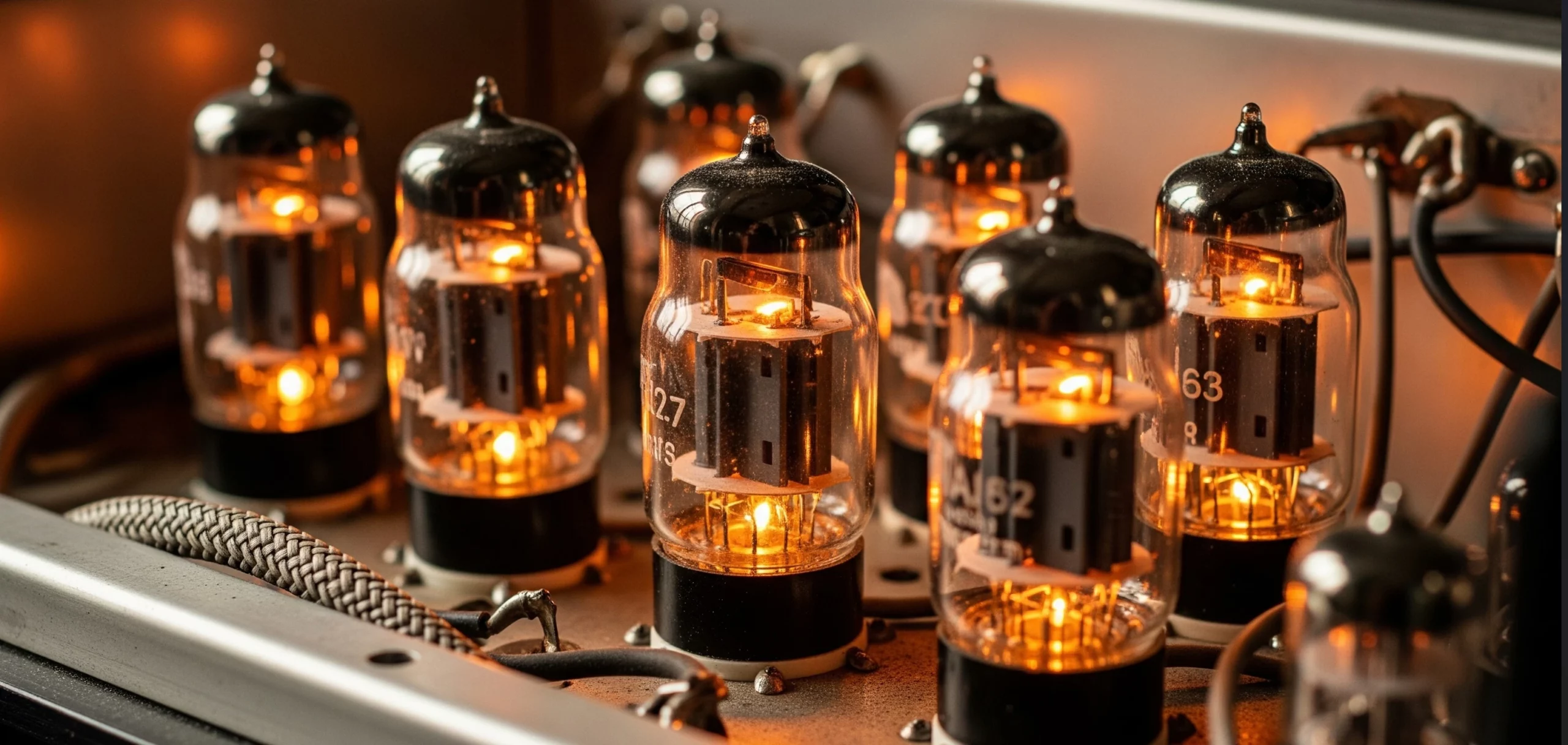
From the dawn of postwar electronics, two components emerged as cornerstones in the design of audio amplifiers: the 12AX7 and 12AU7 double-triode vacuum tubes.
These small glass cylinders, with their nine pins and orange glow, became the sonic heart of countless guitar amplifiers and hi-fi systems. Their development by giants like RCA and GE was no accident; they offered reliability and manufacturing consistency that allowed engineers to design circuits with unprecedented flexibility in an extremely compact format. Each tube houses two independent triode sections, an ingenious design that optimizes both space and cost.
The enduring presence of these tubes in modern audio is due to their electrical characteristics—which are as distinct as they are complementary—that have made them indispensable for shaping the character of sound for decades. The 12AX7, with its high gain, is the ideal choice for preamp stages, where a weak signal needs a good initial boost, while also adding that harmonic warmth that defines the “tube essence.” On the other hand, its sister tube, the 12AU7, offers more modest gain but superior linearity and current-carrying capacity, making it perfect for tasks that require cleaner and more controlled signal transmission, such as the power stages.
In Practice: Profit vs. Transparency
The crux of the matter lies in how these tubes behave under stress. The 12AX7, with its gain factor of approximately 100, is designed to color the sound. In a guitar amplifier, it is primarily responsible for the warm, harmonically rich distortion that musicians love. When pushed, it saturates in a musically pleasing way, shaping the tone before it reaches the power amp stage.
In contrast, the 12AU7, with a gain of around 20, remains stable over a wider operating range. This makes it the preferred choice for phase-in stages in push-pull amplifiers or as a buffer in effects loops, where the priority is to preserve signal fidelity without adding grain.
Although both share the same pin configuration and can be interchanged in some circuits, the result is drastically different: replacing a 12AX7 with a 12AU7 will tame the amplifier, reducing distortion and producing a cleaner sound. Doing the opposite would cause a considerable increase in gain, which could overload the circuit if it is not designed to handle it.
Distant Cousins and the High-Fidelity Specialist
Within this family of tubes, the 12AT7 occupies an interesting middle ground. With a gain of around 60, it offers a balance between the aggressiveness of the 12AX7 and the clarity of the 12AU7. This versatility has made it very popular for driving reverb tanks in classic Fender amplifiers or acting as a phase inverter, where it provides a wider dynamic range than a 12AX7 without the pronounced drop in gain seen in a 12AU7.
But if we look beyond the immediate family, we find the 6H30, a Russian-made dual triode nicknamed the “Super Tube.” This component, highly prized in high-end audio, is in a league of its own. Its design prioritizes extreme linearity, ultra-low distortion, and high current capacity—qualities ideal for high-fidelity preamplifiers that strive for absolute transparency. However, its pristine sound and unique electrical requirements make it unsuitable for traditional guitar amplifiers, whose appeal lies precisely in the coloration and nonlinear distortion that the 6H30 avoids at all costs. To put it simply, it’s a precision tool for audiophiles, not a paintbrush for rockers.
Noise and Heat: The Inherent Physics of Valve Noise
The very operation of a vacuum valve is a dance with heat. The cathode must reach temperatures above 800 °C to emit electrons, a thermionic process that inevitably produces noise.
There are two main causes of this noise. On the one hand, there is “shot noise,” caused by the random emission of individual electrons. On the other hand, there is “flicker noise” or “1/f noise,” which dominates at low frequencies and is related to imperfections in the cathode materials.
The heat that powers the valve also accelerates its degradation and exacerbates these phenomena. Engineers must therefore strike a delicate balance. For example, by adjusting the anode current (Ia). Each type of valve has an optimal operating point where total noise is minimized.
For a 12AX7, this point is around 0.4–0.6 mA, while a high-current tube such as the 6H30 requires more than 5 mA to perform at its best. Even the filament voltage plays a role; a slight reduction can be beneficial for low-current tubes but detrimental for high-current ones. It is this meticulous management of operating parameters that allows a clean sound to be extracted from an inherently noisy component.