
We recently learned about a new OLED technology that emits sound from each pixel on the panel, and now another very interesting one has emerged. The Japanese company Sensia Technology has developed a system in which the electronic fabric itself is responsible for emitting sound.
This project, which has its roots in research begun in 2018 at Japan's National Institute of Advanced Industrial Science and Technology (AIST), has now come to fruition as the first portable speaker made entirely from a thin, lightweight electronic fabric.
How does this electronic fabric produce sound?
This invention operates differently from magnetic methods, instead utilizing electrostatic architecture. Instead of a magnet moving a paper or plastic cone, Sensia’s design incorporates conductive fibers arranged like a capacitor: two flexible layers separated by an ultra-thin dielectric film.
When an audio signal is applied, the electric field between these layers is altered, causing the fabric to vibrate and subtly displace the air. The result of this physical process is sound that emanates evenly across the entire surface of the material, eliminating the need for drivers located at specific points.
Furthermore, since there is no specific source of noise, dead zones are eliminated, resulting in a more natural and refined sound.
Specifications and Home Use Options
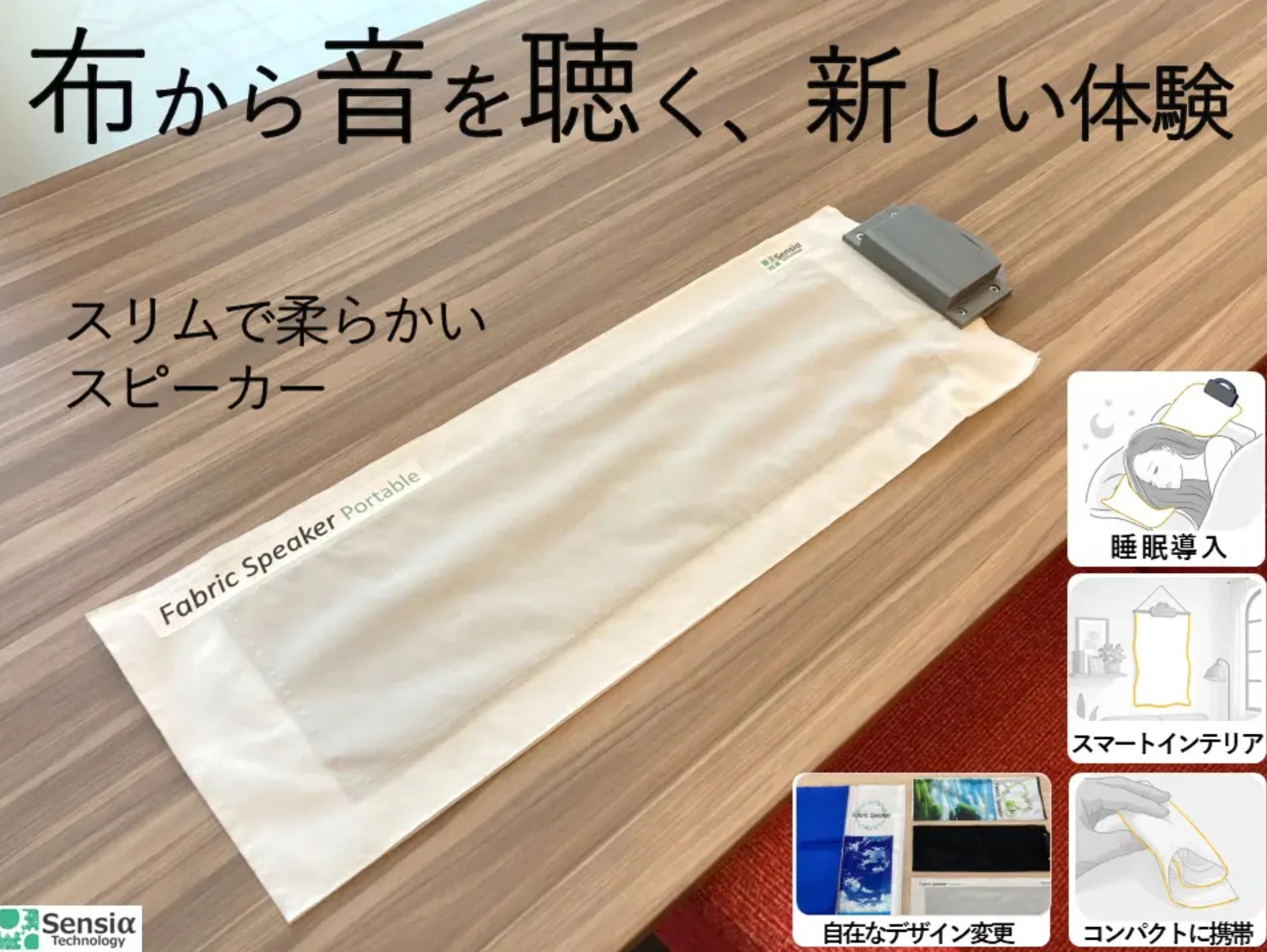
For this system to work in a real-world environment, the fabric cannot function on its own. A small plastic module, attached to one of the edges, houses the power supply, the wireless connectivity circuits, and the control electronics needed to modulate the signal.
According to the technical specifications released, this device is capable of reaching sound pressure levels of around 68 decibels when used alone, a figure that rises to 71 decibels when used in combination with other devices.
Although the company has declined to disclose any details about frequency ranges or distortion percentages, it positions its creation as a new way to listen to ambient or personal audio. Its flexible design allows it to be hung on the wall like a decorative tapestry or discreetly placed under sheets and other household textiles, blending into the furnishings without taking up any physical space.
For now, Sensia’s fabric speaker remains a niche concept, but if this technology manages to gain a foothold and become more affordable, it could pave the way for a new generation of integrated systems where audio no longer requires external devices but is instead an intrinsic part of the materials that surround us every day.