Sound becomes dangerous above 85 decibels (dB) with prolonged exposure, and above 120 dB it can damage your hearing instantly. But the number that really matters isn’t just how loud it is, it’s how long: hearing damage is a dose, level times time. At 85 dB your ears can take about 8 hours; at 100 dB -a nightclub- only 15 minutes.
This guide gives you the exact figures for how many decibels are dangerous, the safe listening time table (from NIOSH and the WHO), the well-known 60/60 rule, and how to measure the real decibels reaching your ears with your phone so you don’t overdo it without noticing.
How many decibels are dangerous?
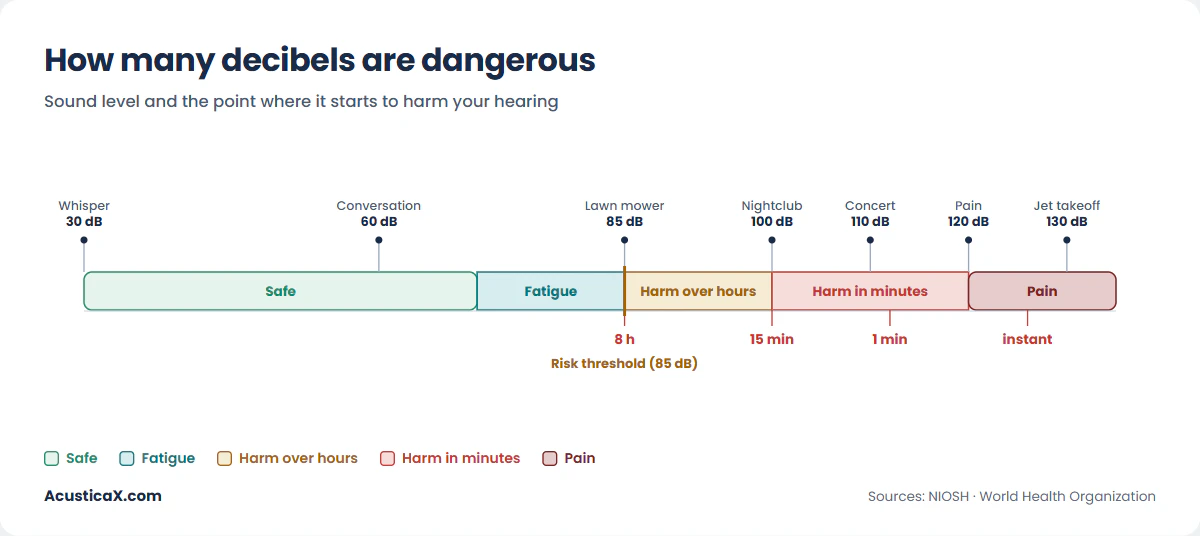
Any sound above 85 dB(A) can damage your hearing if you’re exposed long enough; below 70 dB there’s no risk, however constant it is. What decides whether it harms you is the mix of loudness and duration. Here are the ranges that matter:
- Up to 70 dB – safe. Normal conversation sits around 60 dB; light traffic, 70. No harm, no matter how long it lasts.
- 70–85 dB – fatigue. Listening fatigue sets in. Risk rises slowly, and only with very long exposure.
- 85 dB – the threshold. The recommended health limit (heavy traffic, a lawn mower). A few hours straight already start to do harm.
- 100 dB – danger in minutes. A nightclub, a power drill or a strong hand dryer. Your ears last about a quarter of an hour.
- 120 dB – threshold of pain. A nearby siren or a front-row concert. Damage can be immediate.
- 130–140 dB – instant damage. A jet taking off or a gunshot. A single exposure is enough to injure your ears.
Why is it so serious? Inside your ear, tiny hair cells turn sound into nerve signals, and they don’t grow back. Loud noise tires them first -that’s the muffled feeling or ringing as you leave a concert- and, if the overdose repeats, it kills them: at that point the loss is permanent. That temporary warning (what audiologists call a temporary threshold shift) is the sign you’ve had too big a dose.
Safe listening time: the decibel-to-minutes table
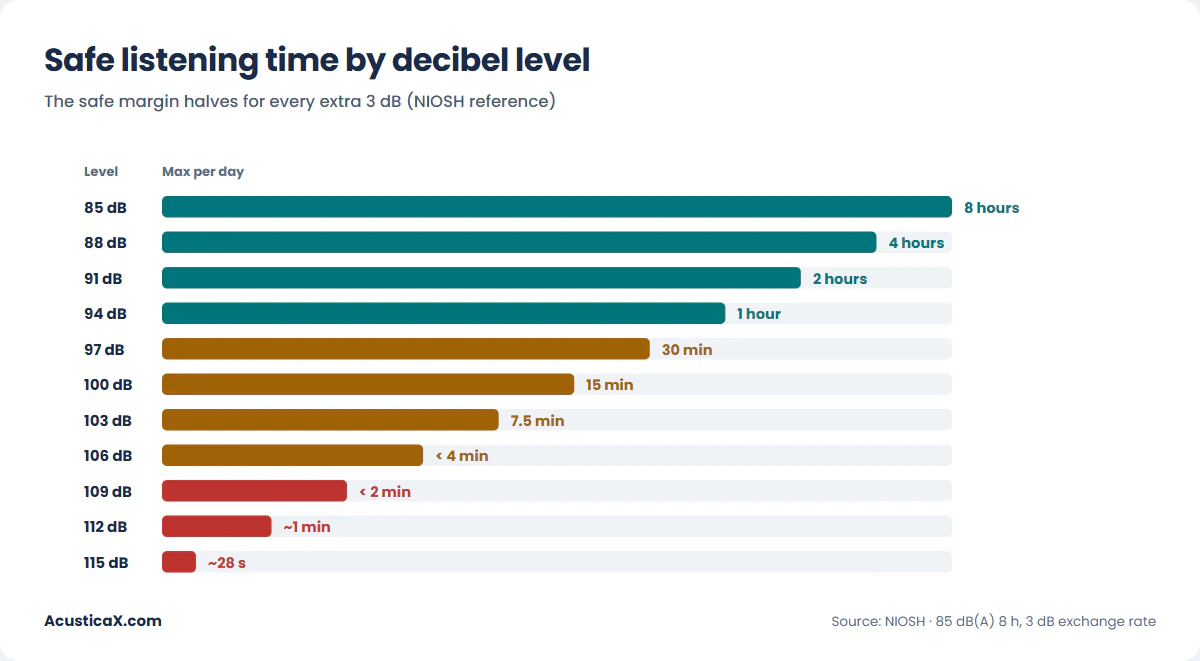
Safe exposure time halves for every extra 3 dB. That’s the NIOSH reference, the US occupational-health institute: 85 dB for 8 hours and, from there, every 3 dB cuts the time in half. At 100 dB you have 15 minutes; at 112 dB -a rock concert in the pit- barely a minute.
| Level | Example | Max per day |
|---|---|---|
| 85 dB | Heavy traffic, lawn mower | 8 hours |
| 88 dB | Shop vacuum | 4 hours |
| 91 dB | Motorbike accelerating | 2 hours |
| 94 dB | Angle grinder | 1 hour |
| 97 dB | Concert (stands) | 30 minutes |
| 100 dB | Nightclub, power drill | 15 minutes |
| 103 dB | – | 7.5 minutes |
| 106 dB | – | under 4 minutes |
| 109 dB | – | under 2 minutes |
| 112 dB | Concert (pit) | ~1 minute |
| 115 dB | Nearby siren | ~28 seconds |
You’ll see different figures around, and it’s not a mistake. The legal workplace limit (OSHA) allows 90 dB for 8 hours with a laxer 5 dB exchange rate. NIOSH uses 85 dB and 3 dB because it protects health, not output. Use the latter as your reference: over a working lifetime, 85 dB carries an 8% added risk of hearing loss versus 25% at 90 dB.
Music and leisure: the WHO reference (80 dB, 40 hours)
For leisure -headphones, concerts, gaming- the World Health Organization sets a different reference: an adult can safely listen at 80 dB for up to 40 hours a week (75 dB for children). Push it to 90 dB and that weekly budget drops to just 4 hours, and a 100 dB concert uses it up in 15 minutes. Over a billion young people are currently at risk of hearing loss from unsafe listening, mostly through headphones.
The 60/60 rule (and when it falls short)
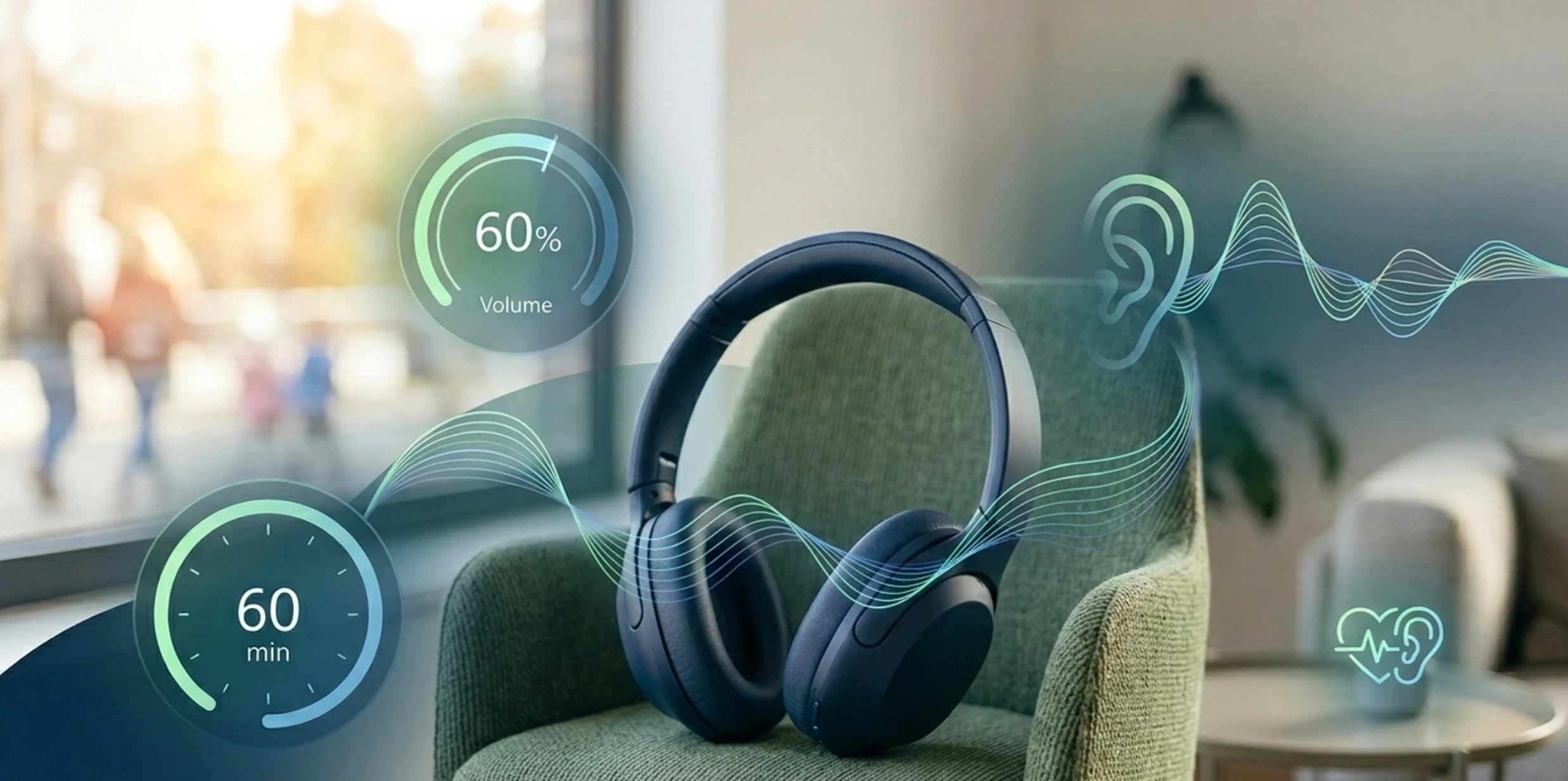
The 60/60 rule is the simplest way not to overdo headphones: listen at no more than 60% of maximum volume and take a break every 60 minutes. It’s a recognised audiology guideline and works well as a quick rule when you can’t measure.
Its limit is that 60% doesn’t mean the same decibels on every device. On a powerful phone with well-isolating earphones, that 60% can top 85 dB; on another it may stay at 70. So if you want to get it right, measure the real level reaching your ears instead of trusting a percentage.
How to protect your hearing without losing quality
Protecting your hearing isn’t listening worse, it’s listening smart. Four measures that work:
- Measure what reaches you. The online sound level meter turns your phone into a decibel meter and shows whether you’re above 85 dB, plus the safe time at that level.
- Give your ears a rest. After a loud stretch -a concert, the gym- some quiet lets your ears recover. It matters as much as turning it down.
- Use earplugs at concerts and clubs. Musician’s earplugs lower the level without smearing the sound, unlike foam ones. At 100-110 dB, they turn 15 minutes of headroom into several hours.
- Watch for the signs. Ringing (tinnitus) or a muffled feeling after music means you overdid it. If in doubt, check your ears with the online hearing test and compare over time.
FAQ
At how many decibels does damage start?
Above 85 dB(A) with prolonged exposure, and instantly above 120 dB. Between 70 and 85 dB there’s no permanent damage, but there is listening fatigue if the noise is constant.
How long can I listen to loud music?
It depends on the level: about 8 hours at 85 dB, 1 hour at 94 dB and only 15 minutes at 100 dB (a nightclub). The rule: every extra 3 dB, half the safe time.
How many decibels is a nightclub or a concert?
A nightclub sits around 100 dB and a concert can reach 110–120 dB in the front rows. At those levels safe time is minutes, which is why your ears ring afterwards.
Is 85 dB dangerous?
It’s the threshold: safe for about 8 hours, but harmful with longer exposure, day after day. It’s the level of heavy traffic or a lawn mower.
At how many decibels does it hurt?
The threshold of pain is around 120 dB. Beyond that, damage can be instant, with no need for prolonged exposure.
How many decibels is too loud for neighbours?
As a nuisance, 30–40 dB at night already makes sleep hard. What’s actionable depends on local noise ordinances -usually set between 30 and 55 dB by zone and time of day- not a single threshold.
Can hearing damage be reversed?
The fatigue from a one-off loud spell recovers with rest. But loss from repeated exposure is cumulative and permanent: it can’t be cured, only prevented.
This guide is for general information and doesn’t replace a professional hearing check. Phone-microphone measurements are approximate. If you have persistent ringing, a muffled feeling or hearing loss, see a specialist.