The short answer to FLAC vs MP3 is this: with a 320 kbps MP3, most people cannot tell the lossy file apart from the FLAC in a blind test; with an MP3 at 128 kbps or below, they can, and easily. What decides whether you hear it is not the format label but three measurable things: the MP3’s bitrate, your playback chain, and whether you listen blind with the levels matched.
Almost everything written about the difference between FLAC and MP3 blurs two separate questions: «are they technically different?» (yes – one is lossless, the other lossy) and «will I notice, in my living room, with my music?» (rarely, if the MP3 is a good one). This guide keeps them apart, gives the numbers no forum bothers to publish, and hands you two tools to test it yourself instead of trusting a stranger online: a blind test and a fake-FLAC detector.
What each format is: FLAC, MP3 and WAV in 30 seconds
FLAC is a lossless format: it stores a bit-for-bit copy of the original audio and compresses it like a ZIP, throwing nothing away; on playback it reconstructs 100 % of the signal. MP3 is a lossy format: it shrinks the file by discarding information a psychoacoustic model judges inaudible, and that information never comes back. WAV is the uncompressed audio straight off the CD (PCM, 1,411 kbps): it sounds identical to a FLAC because it holds the same data, but it takes up almost twice the space.
In numbers, a four-minute song is about 40 MB as WAV, 20-28 MB as FLAC, 9.6 MB as a 320 kbps MP3 and 3.8 MB as a 128 kbps MP3. FLAC gives you the whole original at a little over half the size; MP3 gives you something smaller in exchange for discarding data. That is the entire size story.
| Format | Type | Typical bitrate | Size (4 min) | Discards data? |
|---|---|---|---|---|
| FLAC | Lossless | 700-1,000 kbps | 20-28 MB | No: bit-for-bit copy of the original |
| WAV | Uncompressed (PCM) | 1,411 kbps (CD) | ~40 MB | No, but nearly twice the size of a FLAC |
| MP3 320 | Lossy | 320 kbps | ~9.6 MB | Yes, but below the audible threshold |
| MP3 128 | Lossy | 128 kbps | ~3.8 MB | Yes, and often audibly |
FLAC vs MP3: can you hear the difference?
In a properly run blind test, almost nobody can tell a FLAC from a 320 kbps MP3, and that result has held for more than twenty years in the listening tests of the Hydrogenaudio community, the technical reference on audio compression. The reason is that a high-bitrate MP3 is transparent: it discards data, but it chooses to discard what falls below the ear’s masking threshold, so the signal that reaches you is indistinguishable from the original for most people. At 128 kbps the story changes: there the MP3 trims treble and detail, and the difference is audible without any expensive gear.
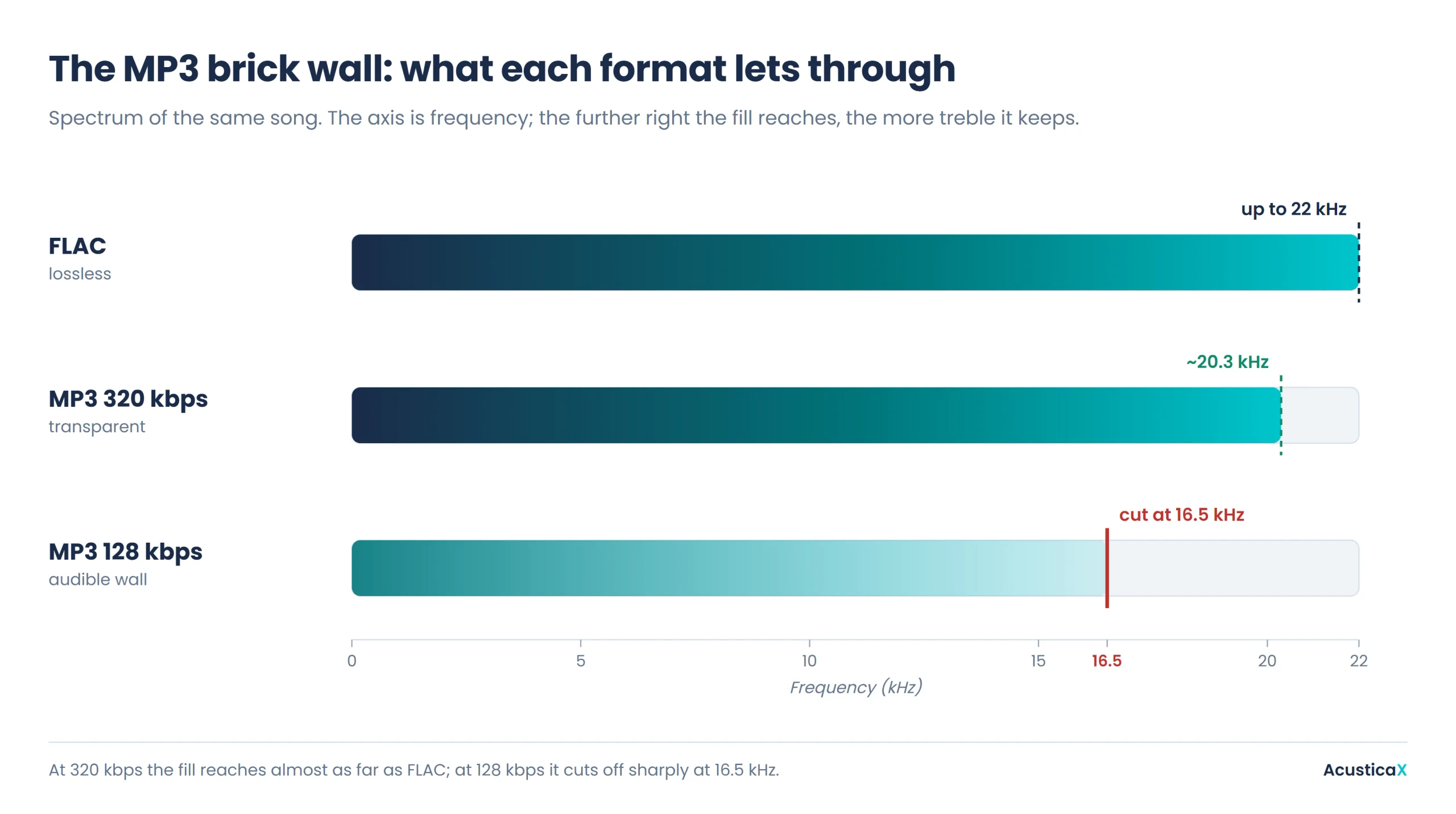
So the real question is not «FLAC or MP3», but what bitrate the MP3 is. The reference MP3 encoder (LAME) applies a lowpass filter that rises with the bitrate: at 320 kbps it lets through up to about 20.1–20.6 kHz – the edge of human hearing – while at 128 kbps it cuts at roughly 16.5 kHz. That 16.5 kHz brick wall is exactly what makes a weak MP3 sound «dull», and it is what lets you catch a fake FLAC further down.
| MP3 setting (LAME) | Bitrate | Frequency ceiling (lowpass) | Transparent vs FLAC? |
|---|---|---|---|
| 128 kbps (-V5) | ~128 kbps | ~16.5 kHz | No: the treble cut is audible |
| 190 kbps (-V2, «standard») | ~190 kbps | ~19 kHz | Almost always |
| 320 kbps («insane») | 320 kbps | 20.1-20.6 kHz | Yes for almost all listeners |
| FLAC | 700-1,000 kbps | No ceiling (up to Nyquist) | It is the reference |
Why a 320 kbps MP3 is almost indistinguishable from FLAC
A 320 kbps MP3 is transparent because it does not erase sound bluntly – it exploits a real limitation of the ear: masking. When a loud note plays, your ear stops perceiving nearby sounds in frequency and time that fall below a certain threshold; the MP3 encoder computes that threshold and spends its bits only on what you will actually hear, dropping what would be covered up anyway. At 320 kbps it has bits to spare, which is why the result is, for almost everyone, impossible to separate from the original.
This is the place to dismantle the most repeated cliché in forums and AI Overviews: «you only hear it with expensive gear.» It is half true. Good gear helps, but what really decides is method. Plenty of people «hear» huge differences until you hide the label: once they don’t know which file is playing, their hit rate falls to chance. Their gear isn’t bad; they were hearing the expectation, not the sound. That is why the only honest way to answer the question is blind.
When you do hear the difference between FLAC and MP3
The difference between FLAC and MP3 becomes audible in five specific situations, and none of them is just «having good ears». They are worth knowing because they are the only cases where paying for lossless changes anything real.
- Low bitrate (128 kbps or below). The most common case and the most audible. The 16.5 kHz cut takes the shimmer off cymbals and the air out of voices; on complex passages you get metallic artefacts. No blind test needed here.
- The source was already compressed. A FLAC made from an MP3 recovers nothing: you inherit the 16.5 kHz ceiling and take up four times the space on top. It is a fake FLAC, and it can be detected (below).
- You are going to edit or archive. If you plan to trim, EQ or re-encode, every MP3 pass stacks up losses. For editing or storing your master library, lossless is the right choice even if you never hear the difference on playback.
- You listen over Bluetooth. Bluetooth re-compresses the audio with its own codec (SBC, AAC, aptX, LDAC…), always below the 1,411 kbps of a CD, so a FLAC sent over Bluetooth stops being lossless in transit. If the whole chain matters to you, see who actually needs lossless audio before chasing formats.
- Revealing gear and room. Resolving headphones, a decent DAC and a quiet room make subtle separation or treble cues easier to catch. They raise the odds of noticing something, but they don’t turn a 320 kbps MP3 into something else: they only narrow the margin.
MP4 is not the same as MP3
MP4 is not an audio format but a container that usually holds H.264 video and AAC audio inside. When someone compares «MP3 vs MP4» for music they almost always mean MP3 vs AAC (the audio codec of Apple Music, YouTube and .m4a files). AAC is a more modern lossy codec than MP3 and, at the same bitrate, tends to sound slightly better; but the honest comparison is still lossless (FLAC/ALAC) against lossy (MP3/AAC), not a format against a container.
Test it yourself: the blind test (ABX)
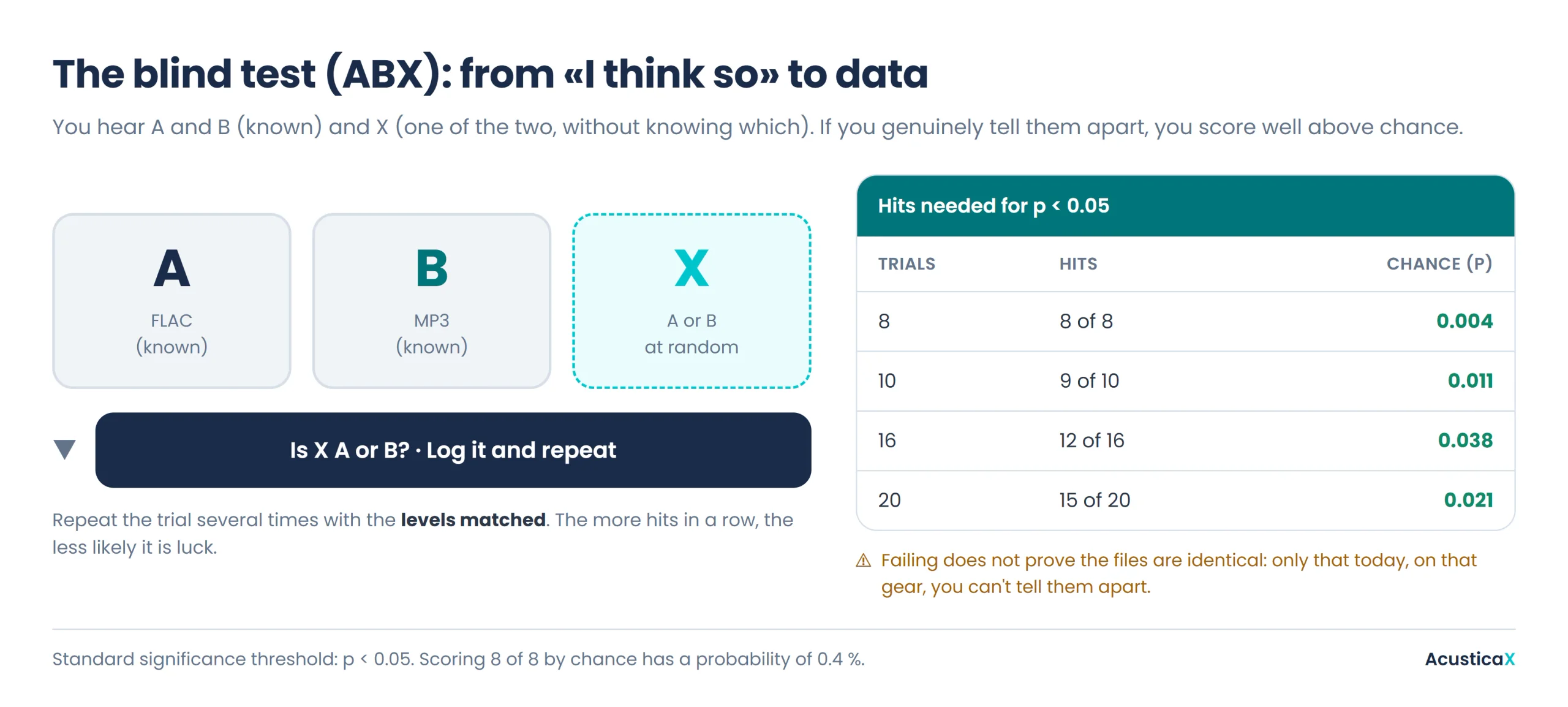
The only way to know whether you can tell a FLAC from an MP3 is a blind test with statistics, and it is called ABX. The program lets you hear A (a known file), B (the other known file) and X (one of the two at random, without telling you which), and you decide whether X is A or B. You repeat it several times. If you genuinely hear a difference, you will score well above chance; if you don’t, your hits will hover around 50 %. With our in-browser blind ABX test you can load your two files, match the level and settle a flac vs mp3 blind test in five minutes, with nothing uploaded to any server.
The statistics are what separate «I hear it» from «I think I hear it». By coin flip, scoring 8 out of 8 has a probability of 0.4 %: if you manage it, you almost certainly hear something real. The table shows how many hits you need for the result to be significant (p < 0.05, the standard threshold). And mind the opposite trap: failing does not prove the files are identical, only that you, today, on that gear, cannot tell them apart.
| Number of trials | Hits needed | Probability of reaching it by chance (p) |
|---|---|---|
| 8 | 8 of 8 | 0.004 |
| 10 | 9 of 10 | 0.011 |
| 16 | 12 of 16 | 0.038 |
| 20 | 15 of 20 | 0.021 |
What if your FLAC is an MP3 in disguise?
A downloaded FLAC can be a fraud: a 128 kbps MP3 re-encoded to FLAC to fake quality. The file weighs like a lossless one, but inside it carries the 16.5 kHz brick wall of the MP3 it came from, because the treble that was thrown away does not return when you compress again. That leaves a visible fingerprint in the spectrum: a horizontal line where the sound cuts off abruptly, instead of fading up to 20 kHz as a real recording would.
You don’t have to take the seller’s word – you look. Our fake-FLAC detector analyses the file’s spectrum in your own browser and tells you where it cuts off, with nothing uploaded. If a «FLAC» cuts at 16 kHz, it is an MP3 in a tuxedo; if it runs clean past 20 kHz, it looks genuine. It is the same number that explains why 320 is transparent, used in reverse: as forensic proof of origin.
So which should you use: FLAC, MP3 or both?
The honest recommendation is to use both, each for its job. Keep your master library in FLAC: it is the whole original, good for archiving, editing and re-encoding without stacking losses, and storage is cheap today. For carrying music on your phone or in the car, a 320 kbps MP3 (or a 256 kbps AAC) is perfectly transparent and fits three times over; you are not losing anything audible by doing it.
The expensive mistake is not choosing MP3 over FLAC – it is tolerating low bitrates and dodgy sources. A 128 kbps MP3 does sound worse; a FLAC re-encoded from that MP3 is worse still, because it also deceives you. So is FLAC worth it? For your archive, yes; for casual listening off a good 320 kbps MP3, the difference is not something you’ll hear. Get the MP3 to 320 and make sure the FLAC is genuine, and the format war stops mattering to you.
Frequently asked questions
Does FLAC actually sound better than MP3?
Technically yes: FLAC keeps 100 % of the original audio, while MP3 discards data. In practice, at 320 kbps most people cannot tell them apart in a blind test, so «sounds better» becomes «is identical to your ear». FLAC’s real advantage is not casual listening but editing, archiving and not depending on the MP3 being well encoded.
Can you hear the difference between FLAC and MP3 at 320 kbps?
For the vast majority of listeners, no – and twenty-plus years of Hydrogenaudio blind tests confirm it. A 320 kbps MP3 is transparent: it discards only what the ear misses through masking and passes treble up to about 20 kHz. If someone claims to hear it, the only valid proof is a blind ABX test with matched levels; many of those differences vanish when you don’t know which file is playing.
Why do audiophiles prefer FLAC?
Partly for good reasons – it is the exact original, ideal for archiving and editing – and partly for peace of mind: knowing nothing was thrown away. It also sidesteps bad encodes and fake files. What it rarely buys is an audible improvement over a clean 320 kbps MP3 on casual listening; the value is in provenance and future-proofing, not in a sound your ear can pick out blind.
Is FLAC 100% lossless?
Yes: FLAC compresses like a ZIP and decompresses to audio that is bit-for-bit identical to the original. The catch is not the format but the source: if the FLAC was made from an MP3, it will be mathematically lossless relative to that MP3, but it inherits everything the MP3 had already thrown away. That is why it pays to check the spectrum before trusting the file extension.
What are the downsides of FLAC?
Size, compatibility and re-compression. A FLAC is two to three times larger than a transparent MP3, some players and cars still don’t read it, and over Bluetooth it gets re-compressed to a lossy codec anyway. None of these is about sound quality – on a wired chain a FLAC is flawless – but they are why lossless isn’t automatically the right pick for portable listening.
Is MP4 the same as MP3?
No. MP3 is an audio codec; MP4 is a container that usually holds video and AAC audio inside. When people say «MP3 vs MP4» for music, they almost always mean MP3 vs AAC (.m4a files). AAC is a more efficient lossy format than MP3, but it is still lossy: for lossless quality you need FLAC or ALAC.