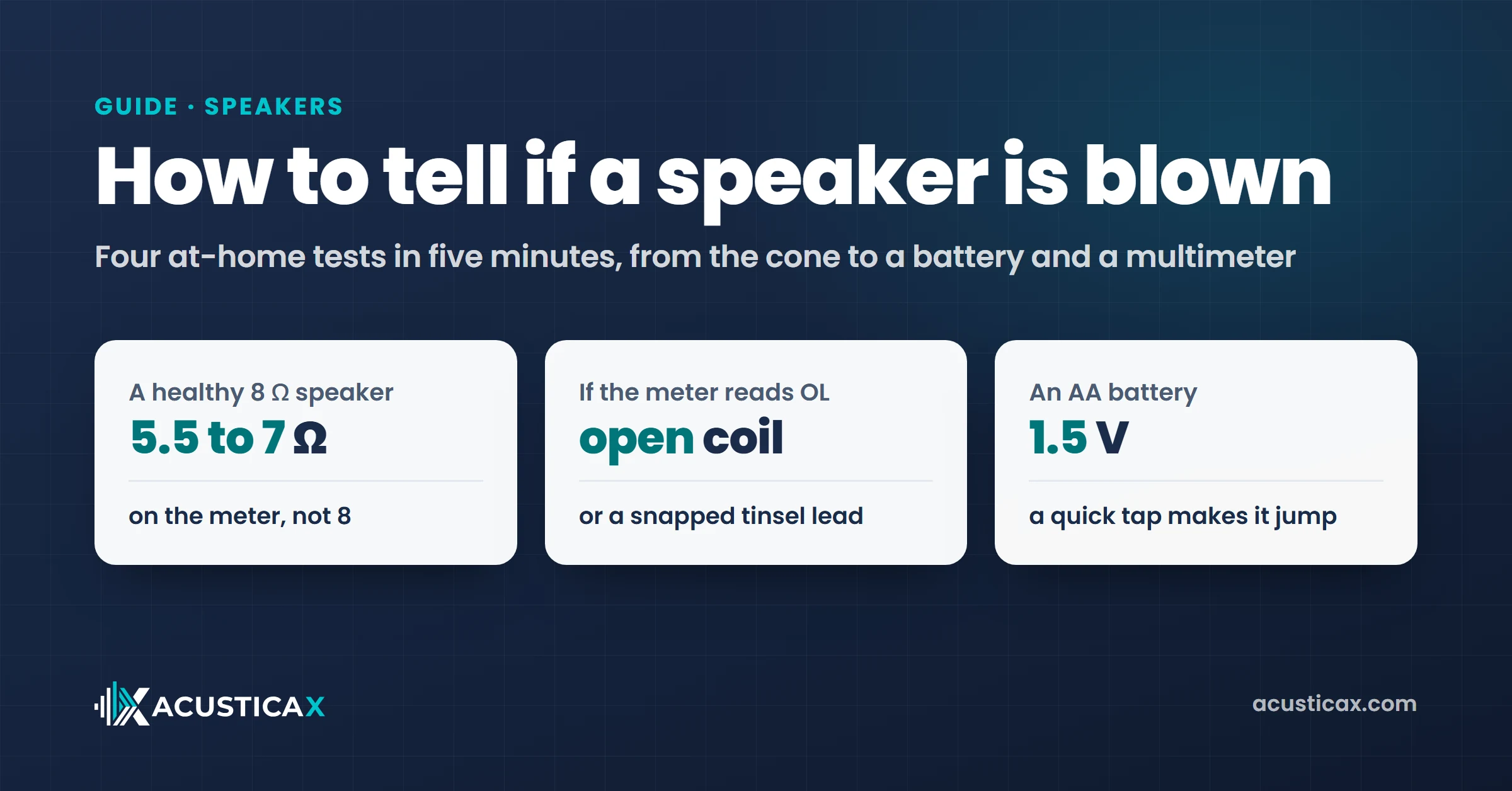
You can tell if a speaker is blown in about five minutes, with four simple checks and no repair shop. Start with the free one, crossing the speaker wires at the amp, and finish with a cheap multimeter; in between, look at the cone, push it gently with your fingers and tap the terminals with a 1.5 V battery. A healthy 8 ohm speaker reads somewhere between 5.5 and 7 ohms, and if the meter shows OL right at the driver, the voice coil or one of its lead wires has broken.
These tests don’t catch everything, so it helps to know their limits up front. When it only sounds rough at high volume, it’s almost certainly fine and what you’re hearing is distortion, which has a different fix. And if it passes all four but still makes a strange noise, the likely suspect is something rattling nearby, or a fault you can only track down by listening carefully.
How to tell if a speaker is blown, from the easiest test to the most reliable
The four checks are crossing the wires, looking at and pushing the cone, the battery tap and the multimeter. They go from least to most effort, and the fault often gives itself away before you reach the last one.
| Test | What you need | Time | What it tells you |
|---|---|---|---|
| Cross the wires at the amp | Nothing | 1 minute | Whether the fault follows the speaker (and its wire) or stays with the amp or source |
| Look at the cone and push it | Your fingers | 1 minute | A torn surround, a cracked cone, or a voice coil that rubs or sticks |
| Tap it with a battery | An AA cell and two wires | 30 seconds | Whether the coil conducts and moves the cone, and which terminal is positive |
| Measure it with a multimeter | A basic multimeter | 2 minutes | Whether the coil is intact, open or shorted |
There’s a reason for the order. If crossing the wires sends the fault to the other speaker, the culprit sits upstream, in the amp or the source, and you can skip the rest. The battery and the meter work as a pair. One shows whether the cone moves, and the other tells you the state of the voice coil, the winding of copper wire that drives the cone every time current flows through it.
One safety note before you start. If it has a built-in amplifier, like a soundbar, a powered subwoofer or active monitors, don’t open it while it’s plugged in, and even unplugged, keep your fingers off the amp board, because the power supply capacitors hold a charge for a while. On Bluetooth models, the battery is what needs care. And if you’re not comfortable with a screwdriver, take it to a technician.
Start by crossing the wires at the amp
Switch the amp off, cross the two speaker wires at its outputs (left into right and right into left), switch it back on and play a song you know at a moderate level. A fault that still comes from the same box belongs to that speaker or its wire. If it has moved to the other one, it starts upstream, in that amp channel or the source.
Before you move anything, rule out the obvious, such as a balance control turned to one side, a loose binding post or a stray strand that could touch the next terminal. With a tube amp, never switch it on without the speakers connected, because the output transformer suffers with no load. In a car, the head unit’s balance and fader tell you which speaker is at fault; to know whether it’s the driver or the channel, measure it at the harness, as explained below.
Look at the cone, then push it
Take the grille off and inspect the driver in good light, because plenty of failures are visible. The surround, the soft ring that joins the diaphragm to the frame, or basket, is the first part to go with age. If it’s foam and it’s cracked, peeling or crumbles under your finger, you’ve found the problem. The cone itself shouldn’t have tears or loose patches, and the two braided wires running from the terminals, the tinsel leads, shouldn’t look blackened or broken. A dent in the dust cap, the dome in the middle, is almost always cosmetic and doesn’t change the sound.
Then comes the push test. Spread the fingertips of both hands around the cone, away from the center, and press it in a few millimeters, evenly. Let it back out slowly. A good one travels in and out smoothly and silently, then settles where it started. A gritty, scraping feel is voice coil rub, the winding catching in the magnet gap, often because heat has warped it, though a knock or debris can do it too. A stiff cone that won’t budge may have its voice coil stuck in the gap. One that sits crooked or sunken points to a tired surround or spider, the corrugated ring that keeps the cone centered from behind.
A big subwoofer takes more effort to move, and that’s normal; what matters is a smooth stroke. Never press on a tweeter, the small unit that handles the treble, since its dome is thin enough to dent with a fingertip. Your nose helps too. A whiff of burnt varnish or plastic near the magnet gives away a coil that has overheated.
To hear the rub rather than feel it, play a low-frequency sweep from the online tone generator at low volume and listen for scraping. It tends to show up in the deepest bass, where the cone travels furthest.
What is the lifespan of a speaker?
The magnet and the coil can last for decades; the foam surround is what gives out first, typically after 10 to 20 years, sooner in hot, humid rooms. Cigarette smoke breaks foam down much faster, as Canadian speaker maker Axiom points out. Rubber surrounds and modern treated foams hold up a lot longer, and a rotten surround doesn’t mean the driver is finished, because a refoam kit or a repair shop will sort it out.
How to test a speaker with a battery
With an AA cell and two short wires, you’ll know in thirty seconds whether the voice coil conducts. Tap the cell across the terminals for an instant, positive to the red (+) post and negative to the black. If all is well, the cone jumps outward with a pop. If nothing moves, either current isn’t reaching the coil, because it has opened up or a tinsel lead has snapped, or the coil is stuck. A scraping noise as you let go gives away the rub.
Keep it to a tap, well under a second. At 1.5 volts the driver sees less than a watt, a little more on a 2 ohm sub, which can’t hurt it in a moment, but holding the contact only heats the coil for no reason.
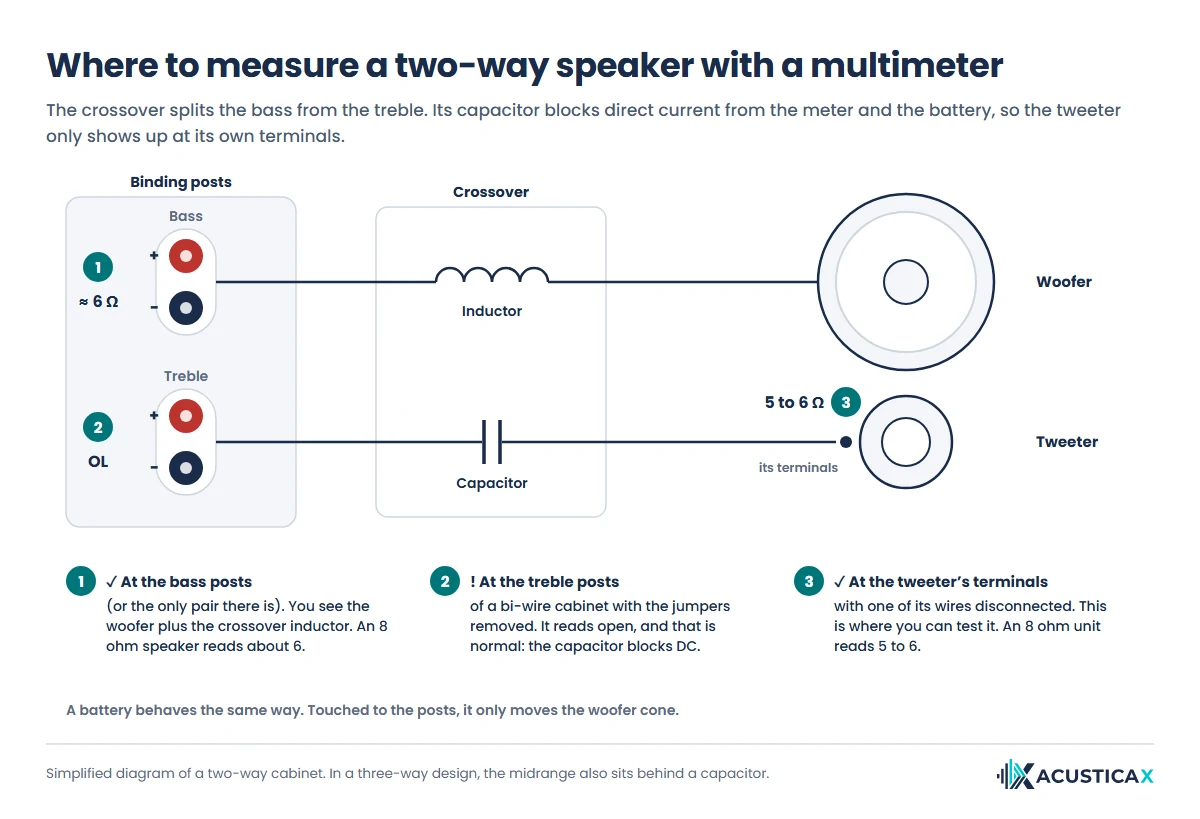
In a cabinet with a crossover, the battery only moves the woofer, the big driver. The tweeter sits behind a capacitor that blocks direct current, so it stays still even when it’s perfectly healthy (more on where to measure it below). The same trick works on a passive subwoofer, and it’s the quickest way to check one without hooking it up to an amp.
Checking speaker polarity with a battery
The same tap tells you which terminal is which. By convention, when the cell’s positive end touches the terminal marked +, the cone moves out; if it pulls in, the driver is marked the other way round or the cabinet’s internal wiring is crossed. Both cones in a stereo pair should move the same way. When one pushes out and the other pulls in, the bass partly cancels and the vocals drift away from the center.
There’s one famous exception. JBL used the opposite convention for decades, so many of its older drivers pull the cone in when you put positive on red. If you’re restoring a vintage pair from the seventies or eighties, check each one with this trick rather than trusting the colors. And if, when you disconnect a tweeter, the crossover’s positive wire goes to its negative terminal, leave it, because plenty of crossovers wire it that way on purpose. A multimeter is no help with polarity, since it reads the same in both directions.
Can you test a speaker with a 9 volt battery?
On a large woofer, yes, as long as it’s a very quick tap, and some techs use a half-dead one so the jump is gentler. A small driver only needs the 1.5 V cell, and a tweeter should never see a 9 V battery at all, because it would push several watts into a coil wound from very fine wire. Don’t put any battery on a ribbon tweeter, and don’t trust the meter there or on a piezo either, since one with a transformer shows close to zero and a healthy piezo shows open. Those are best checked by playing something quietly.
How to test a speaker with a multimeter
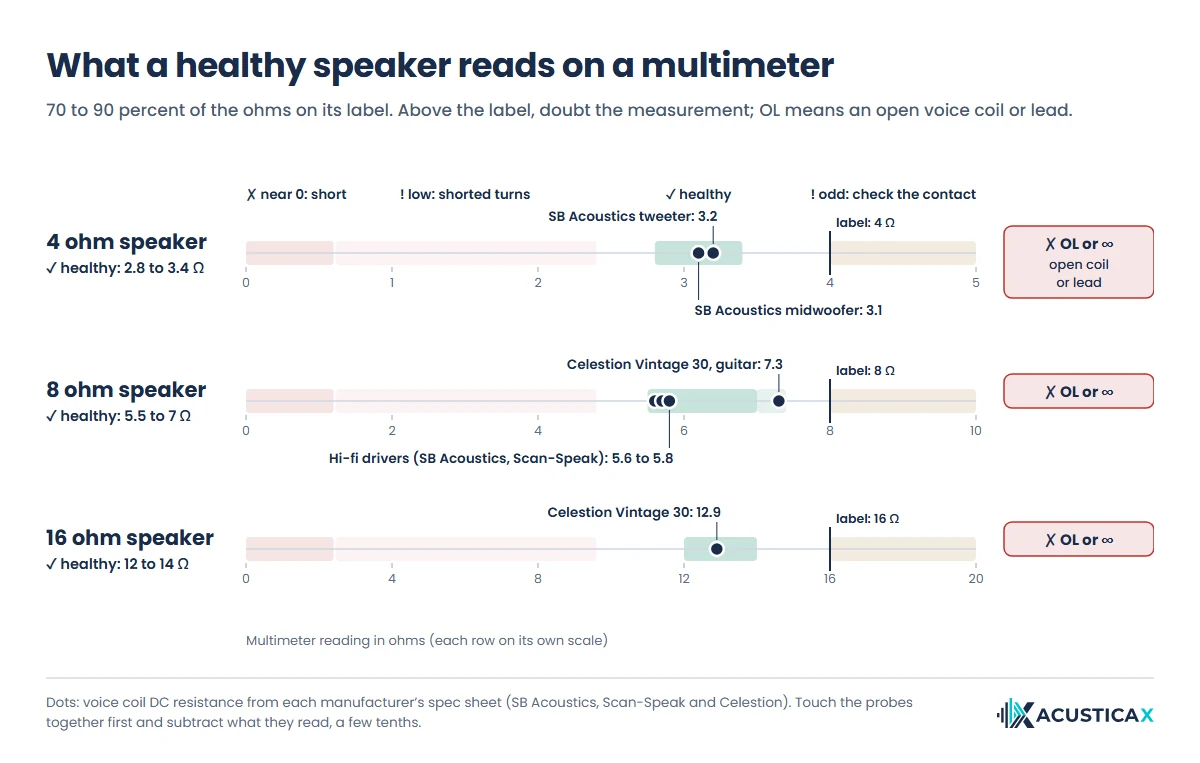
A healthy driver reads a little less than its label, 70 to 90 percent of its rated impedance, which works out to about 3 ohms for a 4 ohm unit and 5.5 to 7 for an 8 ohm one. To measure it, disconnect it from the amp, set the multimeter to its lowest resistance range (the 200 Ω position on a manual-ranging meter) and touch the probes together first. Whatever shows up, typically a few tenths of an ohm, is the resistance of the test leads, and you subtract it. Then put one probe on each terminal; it doesn’t matter which goes where.
| Rated impedance | Healthy reading | Examples from spec sheets |
|---|---|---|
| 4 ohms | 2.8 to 3.4 Ω | SB Acoustics SB17NRX2C35-4 midwoofer: 3.1 · SB Acoustics SB26STAC-C000-4 tweeter: 3.2 |
| 8 ohms | 5.5 to 7 Ω (up to 7.3 on some guitar speakers) | SB Acoustics SB17NRX2C35-8 midwoofer: 5.7 · Scan-Speak 18W/8531G00: 5.8 · Scan-Speak D2608/913000 tweeter: 5.6 · Celestion Vintage 30: 7.3 |
| 16 ohms | 12 to 14 Ω | Celestion Vintage 30, 16 ohm version: 12.9 |
British maker Celestion, best known for its guitar speakers, reckons they read 75 to 85 percent of their nominal impedance, although its own 8 ohm Vintage 30 reaches 7.3. Hi-fi drivers tend to sit lower, closer to 70 percent, and 6 ohm models, common from some European brands, land between 4.2 and 5.1.
The most reliable reference, though, is the other cabinet in the pair, because two identical speakers should read almost the same. It also keeps you from panicking over towers with two woofers, which are sometimes sold as 8 ohm models and read quite a bit less at the posts.
Here’s what each kind of reading tells you.
- Within range. The coil is intact. Any bad sound left is mechanical (a rub, the surround) or comes from elsewhere in the chain.
- OL, or a 1 on the left of the display. An open circuit, as long as you’re measuring at the driver itself. The coil has burned through or a tinsel lead has broken.
- Far too low, like an 8 ohm driver reading 2. Shorted turns. Heat has melted the insulation on the wire, so the current takes a shortcut.
- Close to zero. A short in the coil or the cable. If you measure without disconnecting, you’re also reading whatever sits behind it, and on a tube amp that’s the output transformer, which reads next to nothing.
- A number that jumps around as you move the cone by hand. A tinsel lead about to snap.
Continuity mode, the one that beeps, only tells you there’s a path for current. It rules out an open coil but can’t tell a healthy winding from a shorted one, so stick to the resistance setting.
What should an 8 ohm speaker read?
Somewhere between 5.5 and 7 ohms, because a multimeter measures with direct current and music is alternating current. The display only shows the resistance of the wire. With music, two more things happen. At the bass note where the cone resonates, its own motion pushes back against the current, and toward the treble the coiled wire behaves like an electrical inductor that resists more and more. The 8 ohms on the label is a practical figure for pairing it with an amp, and the IEC 60268-5 standard requires the impedance not to dip below 80 percent of that number across its working range.
Since the meter reading is the lowest point of that whole curve, it normally lands below the label. If an 8 ohm unit reads 8 or more, a long cable or a crossover inductor won’t explain it, since they only add a few tenths, so check the contact first. Clean the terminals, press the probes firmly and subtract what they read together. If it stays high or won’t settle, suspect a solder joint or a tinsel lead coming loose.
Testing the woofer and tweeter in a two-way speaker
In these cabinets, the binding posts on the back don’t go straight to the drivers. They feed a crossover, which splits the bass from the treble. Measure there and the meter sees the woofer plus one of the crossover’s inductors, which adds a little, but not the tweeter, because it sits behind a capacitor that blocks direct current from the meter and the battery alike. To test it, you have to reach its own terminals and disconnect one of its two wires.
There, a healthy 8 ohm dome tweeter reads 5 to 6 ohms, and a 4 ohm one about 3. Piezo tweeters are a different animal. They work with a crystal, so the meter sees an open circuit even when they play perfectly.
If the cabinet has two pairs of posts for bi-wiring and you remove the jumpers, the high-frequency pair will read open. That’s normal, thanks to the same capacitor, and it doesn’t mean the tweeter is dead. The midrange in a three-way design behaves the same way.
Dual voice coil subs and car speakers
Dual voice coil (DVC) subs have two sets of terminals. Remove any jumpers and measure each winding on its own; both should read the same, about 3 ohms each on a dual 4 ohm sub. Then put one probe on each, and after that between each terminal and the metal frame. Both should read open, because the windings are insulated from each other and from the frame. Continuity means they’ve touched inside, which is what car audio installers call a shorted sub.
To check whether a car speaker is blown, you don’t have to pull the door panels. With the head unit unplugged, each pair of wires in its harness runs to one speaker, and the reading includes the car’s wiring, which adds very little. Most are rated at 4 ohms, so a healthy one reads about 3; some brands make them 2 or 3 ohms, and it’s worth checking the label. Watch out for premium factory systems (Bose, Harman Kardon, JBL and the like) with a separate amplifier, because there the harness carries the amp’s inputs rather than the speakers, and the number tells you nothing.
What your results mean
Taken together, the four tests nearly always point to a single cause, and each cause has its own next step.
| What you see | Most likely | Next step |
|---|---|---|
| No sound, the battery doesn’t move it and the meter reads OL at the driver | Open voice coil or snapped tinsel lead | Check the leads; if they’re fine, recone it (new cone and coil) or replace it |
| Sounds harsh, scrapes when pushed, reads normal | Rubbing voice coil | Recone or replace |
| Reads far too low or close to zero | Shorted turns or a short | Make sure you’re not measuring through the amp; if it repeats, recone or replace |
| Cracked surround or sagging cone | Worn surround or spider | Refoam kit or repair shop |
| Crossing the wires sends the fault to the other speaker | Amp or source | Check that amp channel |
| Bass plays but the treble is gone | Tweeter or its side of the crossover | Measure the tweeter at its own terminals |
| The reading jumps when you move the cone | Tinsel lead about to break | Repair shop |
| Reads fine, jumps with the battery, only sounds bad when loud | Distortion, not a fault | Turn down the volume and the bass boost |
| Passes all four and still sounds odd | Something rattling nearby, or a fault you can only hear | Diagnosis by ear |
If the trouble only shows up when you turn it up, it almost always has a fix that doesn’t involve new parts, and that’s covered in the guide to why a speaker sounds distorted.
Still not happy after all four tests? A guided test for when a speaker sounds bad plays sweeps and test tones, asks what you hear and gives you a likely cause in a couple of minutes. If you already have a multimeter reading, it tells you what that means too.
FAQ
Will a blown speaker still work?
Sometimes. A rubbing or partly damaged voice coil still plays, just with a buzz or a rasp at any volume. With an open winding it plays nothing at all, and the multimeter reads OL. A torn surround lets it keep going, but the bass turns flabby and distorted.
What does a blown out speaker look like?
Often it looks fine. When it doesn’t, the signs are a cracked or crumbling foam surround, a torn cone or one sitting off-center or sunken, blackened tinsel leads or a burnt smell near the magnet. A dented dust cap on its own is just cosmetic.
How many ohms should a speaker read?
A little less than its rating, roughly 3 ohms for a 4 ohm model, 5.5 to 7 for an 8 ohm one and 12 to 14 for a 16 ohm one. OL points to an open coil, and close to zero to a short.
How to tell which is positive and negative on a speaker with a multimeter?
You can’t with the ohms setting, because the coil reads the same both ways. Use a 1.5 V battery instead. Touch it across the terminals, and when the cone moves outward, the one connected to the battery’s positive end is the positive terminal. Older JBL drivers are the exception, since they follow the opposite convention.
How to tell if a tweeter is blown?
If the woofer plays but the cymbals and the sibilance in vocals have vanished, suspect the tweeter. Disconnect one of its wires and measure it at its own terminals; OL means it’s gone, unless it’s a piezo. You won’t see it from the cabinet’s binding posts, because the crossover capacitor hides it.
How to tell if a subwoofer is blown without hooking it up?
Push the cone evenly with both hands; it should glide in and out without a sound. Then tap its terminals with a 1.5 V battery, and it should jump. Finally measure it, and a 4 ohm sub should read about 3 ohms. A scrape, no movement or OL all point to damage. On a powered sub, unplug it and keep your fingers off the amp board.
How do you test a speaker to see if it works?
Play a track you know at a moderate level and compare it with its partner; if they sound the same, it works. To rule out hidden damage, push the cone gently to check it moves without scraping, and play a bass sweep quietly. For a Bluetooth speaker or a stereo soundbar, a left and right channel test track does the job.
How can you tell if a phone speaker is blown?
Take off the case and the screen protector, check that the grille isn’t clogged with lint and play something at medium volume. If headphones sound clean and the phone itself crackles, the speaker is at fault. On an iPhone, the check Apple suggests is to drag the Ringtone and Alerts slider back and forth a few times in Settings, under Sounds & Haptics; if you hear nothing, or the speaker button on the slider is dimmed, it might need service. Samsung phones have their own test in the Samsung Members app, under Support and then Phone diagnostics. And if it got wet, eject the water from the speaker with sound first, since a waterlogged one plays muffled and tends to recover once it dries.