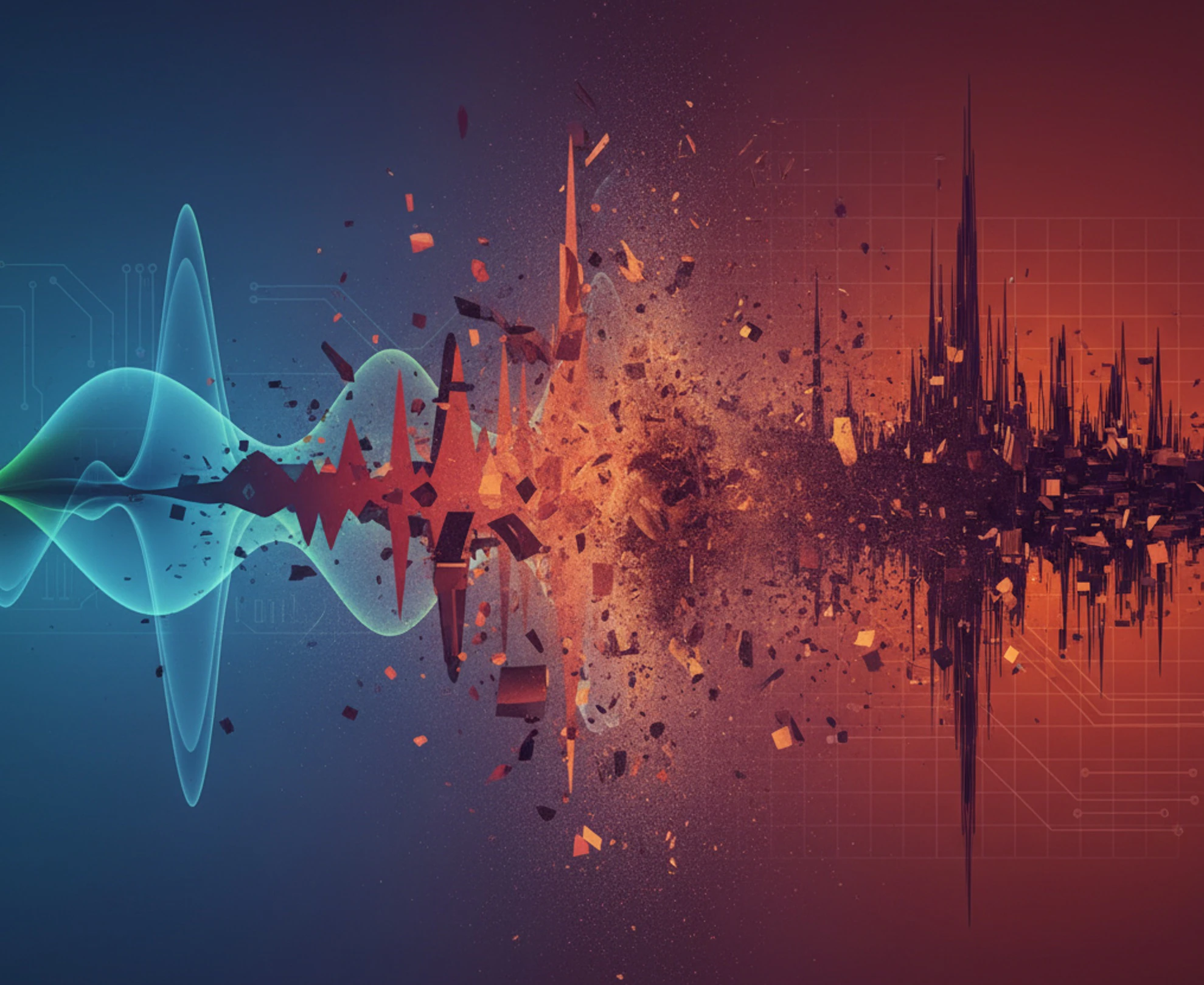
When a sound system doesn't perform as it should and the music sounds "muddy" or congested, many people blame the original recording or harmonic distortion. However, the culprit is often a more technical and unpleasant phenomenon: intermodulation (IM). This problem arises when different audio frequencies, instead of coexisting peacefully, collide within an audio system. This interaction causes them to mix and give rise to new frequencies—"phantom" tones that simply did not exist in the original track. These unwanted effects are the essence of Intermodulation Distortion (IMD).
Details on Intermodulation Distortion
The major drawback of these new frequencies is that they lack any harmonic relationship to the original content. The result is a sound that listeners often describe as harsh, grainy, or muddy. Even at low levels, IMD can mask details and detract from the overall clarity of the performance.
Our auditory system is particularly sensitive to these artificial byproducts, which makes intermodulation especially annoying. It is very different from harmonic distortion, which—because it is mathematically related to the original note—can sometimes be perceived as “warmth.” IMD, on the other hand, is simply noise.
This audio distortion occurs whenever a signal passes through a nonlinear component—that is, any part of the audio chain that fails to reproduce the signal with perfect accuracy. This ranges from amplifiers and speakers to digital processors. When two or more tones encounter this nonlinearity, problematic sum and difference tones are produced.
For example, if 19 kHz and 20 kHz (both at the upper limit of human hearing) are input simultaneously, a poor-quality system will reproduce those two tones and may also add a 1 kHz tone (the difference: 20–19). That 1 kHz is a very audible frequency, right in the midrange, and its presence is completely artificial. Other, more complex frequencies will also appear, cluttering the spectrum and reducing the fidelity of the original material.
Where Is This Bug Hiding, and How Can You Avoid It?
Identifying the sources of intermodulation is the first step toward achieving a clean sound. Amplifiers are the usual suspects; if they are pushed too hard (overloaded) or if their circuit design is flawed, they will begin to mix signals.
The same is true of speakers and transducers—especially cheap or poorly aligned drivers—which can exhibit nonlinear behavior when cranked up to high volumes.
But it's also important to check the digital software, since certain software algorithms (such as low-quality audio plugins, compressors, or sample-rate converters) can introduce these artifacts, especially if excessive dynamic range compression is applied.
Even wireless systems (such as microphones) are not immune; nearby radio-frequency interference can creep into the receiver and corrupt the audio signal before it reaches the mixing console.
The key to high-quality audio reproduction lies in addressing these issues. It is essential to use high-quality components—amplifiers, converters (DACs), and well-designed speakers—that maintain linearity. Properly managing the gain structure to prevent amplifier clipping is vital. And, in digital processing, choosing phase-linear tools helps prevent the occurrence of IMD.