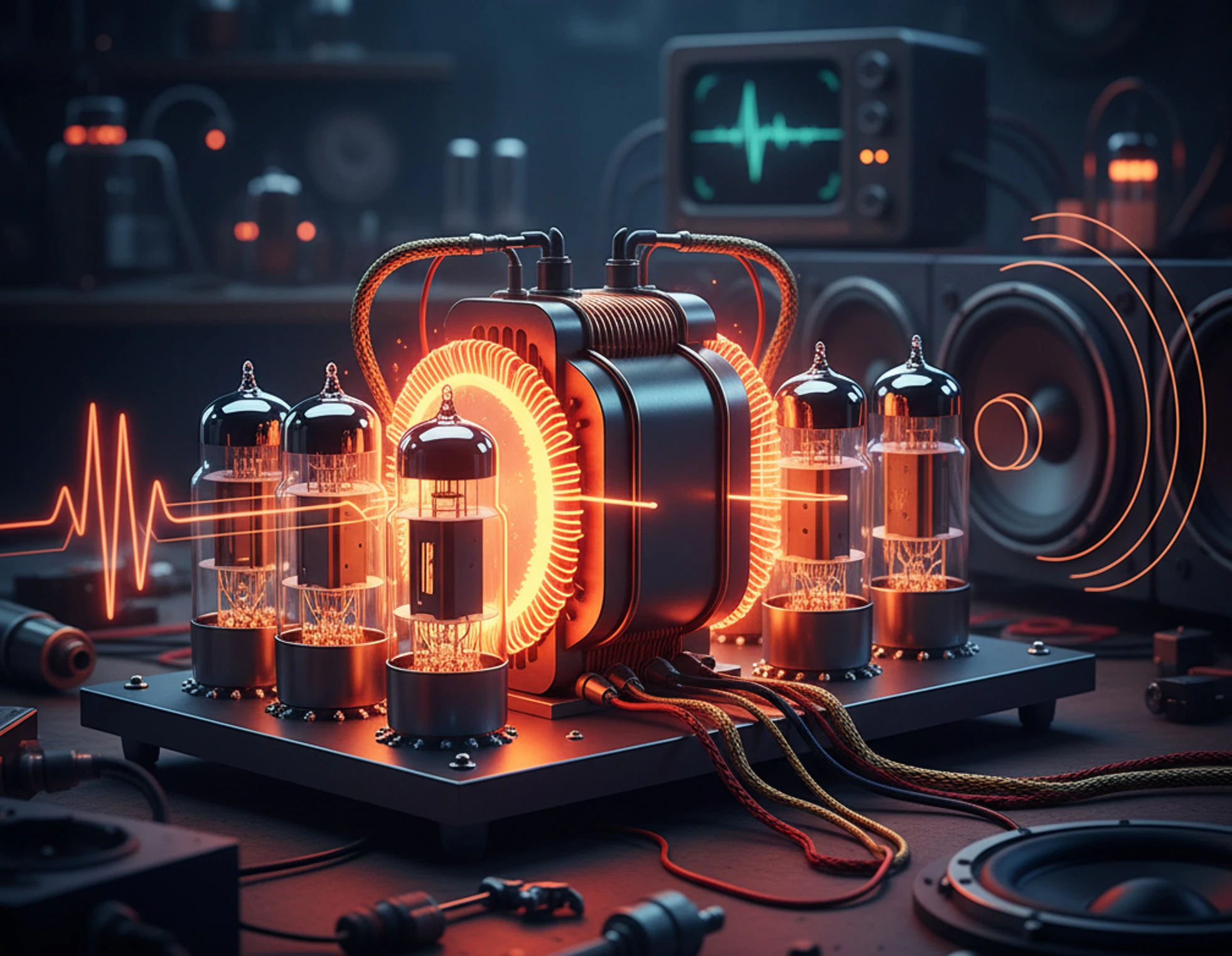
Unlike semiconductor designs, tube amplifiers cannot drive speakers without an output transformer. Vacuum tubes operate with plate resistances measured in the thousands of ohms; speakers, on the other hand, have impedances in the range of a few ohms. Connecting the two directly would prevent power from being transferred efficiently, and the signal would suffer serious distortion.
The transformer adjusts the voltage and current between the signals emitted by the tubes and those required to drive the speaker coil, while also isolating the high-voltage DC present at the anodes.
Vacuum tubes naturally produce high-voltage signals but with low current; speakers require the opposite—current levels capable of driving their moving mass with control. The transformer reduces the output voltage and increases the current available to the load, allowing electrical energy to be efficiently converted into mechanical motion. At the same time, it prevents hundreds of volts of DC from reaching the speaker, which would damage the voice coil and jeopardize both the transducer and the safety of the entire system.
This dual function—impedance matching and isolation—explains why the output transformer is an essential technical requirement in tube amplifiers.
Output Transformer Factors That Affect the Performance of a Tube Amplifier
Designing an output transformer involves, in practice, dealing with several conflicting constraints. To support low frequencies, a high primary inductance is required, which usually results in large cores and windings with many turns.
To preserve the high frequencies, it is necessary to minimize the leakage inductance and parasitic capacitance between windings, which is achieved through interleaving techniques and strict control of the coil geometry.
The core material—ranging from silicon steel to amorphous alloys—each option results in differences in saturation, losses, and magnetic noise, and thus affects the linearity of the response. The conductor gauge, winding voltage, and insulation all influence the transformer’s ability to handle power without overheating, which affects its long-term reliability.
What happens when the design fails?
A poorly designed transformer can limit the sound extension at both ends of the spectrum. Insufficient primary inductance attenuates the bass; high leakage or significant internal capacitance smothers the treble and distorts transients.
Core saturation during high-excursion passages introduces low-frequency distortion, while imbalances in the windings cause unwanted harmonics and intermodulation.
Furthermore, the phase shift caused by poor interleaving blurs the positioning of the signals within the soundstage and reduces clarity. In other words, no matter how carefully designed the circuits powering the tubes may be, a subpar transformer can result in a colored tone and limited dynamics.
What are the benefits of a good output transformer?
When a transformer is manufactured with care, it delivers deep, controlled bass; full-bodied mids; and clear highs without harshness. A good design allows for a wide frequency response and low distortion, while maintaining the temporal coherence necessary for the music to retain its transients and crisp sound.
Audiophiles and Hi-Fi equipment designers agree that this component is usually the most expensive and the one that requires the most hours of work and testing; they also recognize that it is a determining factor in the final character of the device.
For anyone who builds or repairs a tube amplifier, understanding the limitations and strengths of the transformer is essential. It’s not enough to simply choose “good tubes”; you must select a transformer capable of meeting the demands of the entire system. Selecting the right materials, paying close attention to the winding technique, and planning for thermal management are steps that pay off in terms of sound quality. And yes, you can really tell the difference. A well-made transformer lets you hear what’s actually there, without imposing its own signature too much.