Here is the reference decibel chart, running from 0 dB (the faintest sound you can hear) to 140 dB (a firecracker at arm’s length, where the damage is instant): a whisper sits around 20 dB, a conversation 60, a vacuum cleaner 70, a nightclub 100, and the front row of a concert 110. But there are two things almost no chart explains, and they completely change how you read those numbers.
First: the scale isn’t linear. Every +10 dB sounds “twice as loud” to your ear, yet it carries ten times the sound energy; 100 dB isn’t “a bit more” than 60, it’s about sixteen times as loud and ten thousand times the energy. Second: a decibel figure means nothing without a distance. The same jet reads 150 dB at 25 metres and 100 dB at 305. Below you’ll find the full chart, the two traps explained, and how to measure the real decibel levels in your home with a phone.
The full decibel chart, from 0 to 140 dB
This is the decibel scale with one example per 10 dB step. The values are approximate, taken at a normal listening distance and in dB(A) -the weighting that mimics the human ear-; the real figure climbs as you move toward the source and falls as you move away.
| Level | Example sounds | What it feels like |
|---|---|---|
| 0 dB | Threshold of hearing | The faintest sound a healthy ear can detect |
| 10 dB | Calm breathing | Barely audible |
| 20 dB | Whisper at one metre, rustling leaves | Very quiet |
| 30 dB | Bedroom at night, quiet countryside | You can hear a clock ticking |
| 40 dB | Library, modern refrigerator, rural area | Quiet; can bother light sleepers |
| 50 dB | Light rain, quiet office | Half as loud as a conversation |
| 60 dB | Normal conversation at one metre, dishwasher | The everyday reference level |
| 70 dB | Vacuum cleaner, loud TV, city traffic | Starts to tire you after a while |
| 80 dB | Busy street, alarm clock, hair dryer | Twice as loud as 70; you must raise your voice |
| 85 dB | Heavy traffic, lawn mower, crowded restaurant | Risk threshold: safe for about 8 hours |
| 90 dB | Blender, motorcycle at 8 m, powerful hair dryer | Four times as loud as 70 |
| 100 dB | Nightclub, power drill, gas lawn mower | Eight times as loud as 70; danger in ~15 min |
| 110 dB | Front row of a concert, chainsaw, car horn at one metre | Threshold of discomfort |
| 120 dB | Nearby siren, thunderclap, jet taking off close by | Threshold of pain |
| 130 dB | Jackhammer right beside you, aircraft-carrier deck | Damage possible on the spot |
| 140 dB | Firecracker or gunshot at close range, jet at 25 m | A single exposure can injure your hearing |
Notice a pattern down the columns: the jump from one step to the next is never “small”. From 60 to 70 dB the sound already feels twice as loud, and from 60 to 100 -from a chat to a nightclub- there’s a chasm, even though the scale only moves “40 numbers”. That’s what we’ll unpack next.
What a decibel is (and why 100 isn’t “a bit more” than 60)
A decibel doesn’t measure sound on an ordinary ruler; it uses a logarithmic scale, where each step multiplies rather than adds. That’s why intuition trips you up. When you read that a hair dryer hits 90 dB and a conversation 60, the gap looks like a third; in reality the dryer puts out a thousand times more sound energy. We use this scale precisely because the ear does the same thing: it squeezes an enormous range of energies into a manageable sensation.
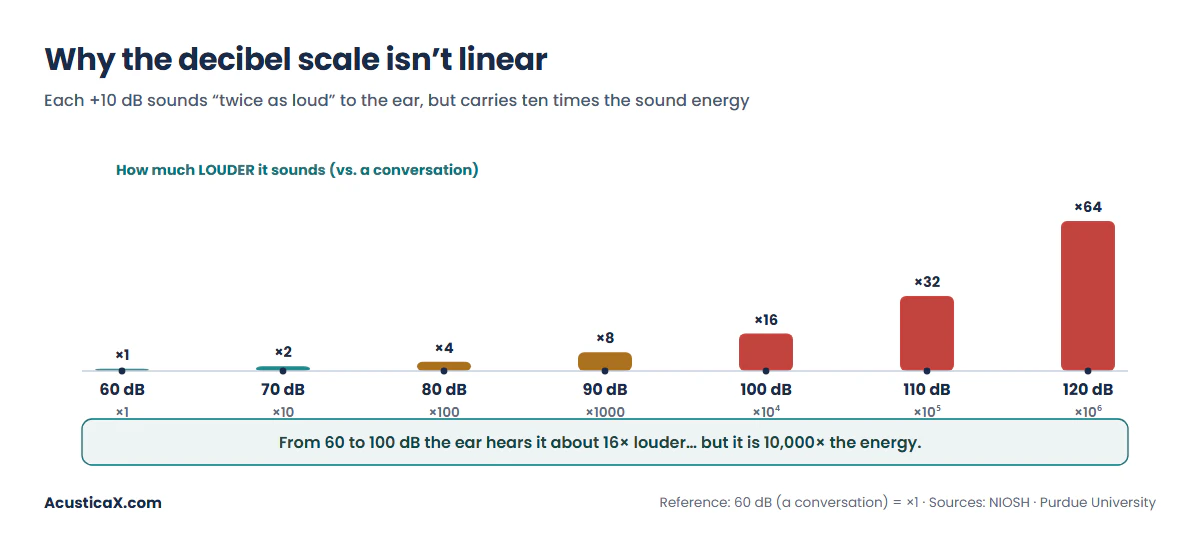
How much is twice as loud? About +10 dB
A 10 dB increase is what the ear hears as “twice as loud.” It’s a classic rule of psychoacoustics, and it lines up with Purdue University’s scale: relative to a 60 dB conversation, 70 sounds twice as loud, 80 four times, 100 about sixteen times, and 120 roughly thirty-two times. The energy, though, races ahead: every +10 dB multiplies it by ten, so those same 120 dB carry a million times the energy of the chat. This table sums up the two sides:
| Change in level | Sound energy | How the ear reads it |
|---|---|---|
| +3 dB | Double | Barely noticeable |
| +6 dB | Four times | Clearly louder |
| +10 dB | Ten times | Sounds “twice as loud” |
| +20 dB | A hundred times | About four times as loud |
| -6 dB | One quarter | What you lose by doubling the distance outdoors |
The 3 dB rule, the one that really matters for your ears
Every extra 3 dB doubles the sound energy, even though you barely notice the change. That’s why safe listening time halves for every 3 dB, the rule NIOSH and occupational limits are built on. It has a genuinely useful takeaway: when you nudge your headphones down “just a touch” and think nothing changed, if you dropped 3 dB you’re now taking in half the energy. It’s the highest-value adjustment there is for protecting your hearing without listening worse.
Why the same appliance gives different numbers: distance
A decibel level is meaningless unless you say where it was measured from. Outdoors, sound spreads over an ever-larger sphere, so it loses intensity as you move away: every time you double your distance to the source, it drops by about 6 dB. This is the inverse-square law, and it explains why the charts floating around the internet don’t agree with each other: each one measured its jet or its lawn mower at a different distance.
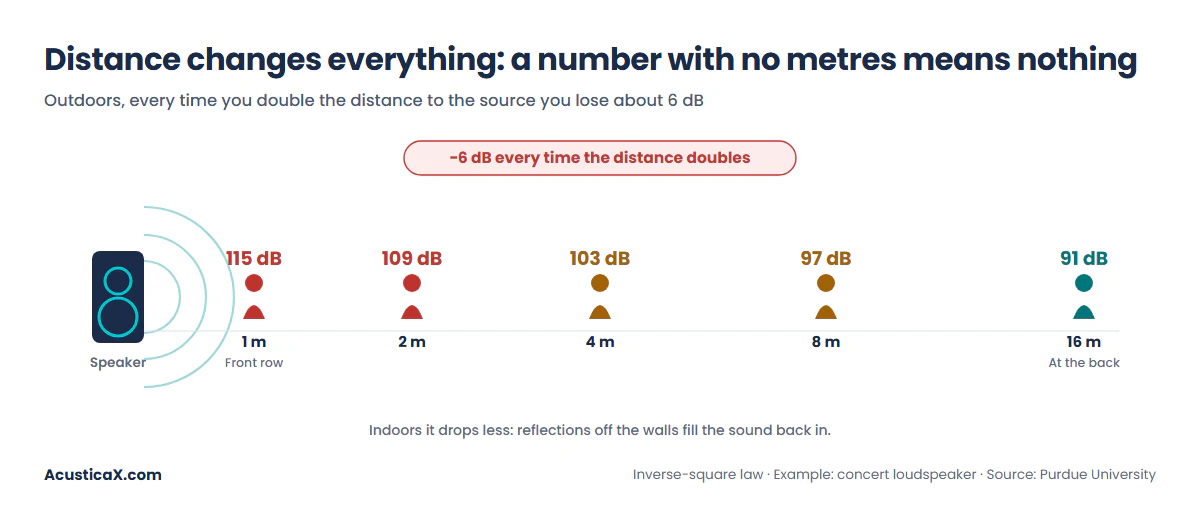
Purdue University gives the clearest example with a jet taking off: 150 dB at 25 metres and 100 dB at 305. Same aircraft, but 50 dB apart -a sound a hundred thousand times less energetic, just from stepping back. The same thing happens at a gig: a metre from the speaker stack you might have 115 dB, and in the back row 91. That’s why the front row is dangerous and the back is bearable.
Indoors the rule softens: walls reflect the sound back, so the level drops less as you move away, because the room’s reflections add to the direct wave. Even so, the lesson holds: get twice as close to a speaker and the level rises; step back and it falls. When someone tells you “a drill is 100 decibels,” the right question is: at how many metres?
dB(A), dB(C) and dB SPL: not all decibels measure the same thing
The same noise can show two different numbers depending on how it’s weighted. That’s the other reason the figures wobble. The three terms you’ll run into are these:
- dB SPL (sound pressure level) is the “raw” decibel -the physical pressure of the sound with nothing applied. It’s what a microphone picks up before any processing.
- dB(A) is the A-weighted measurement: the bass is rolled off because the ear is less sensitive to low frequencies. It’s what health standards use and what almost every chart shows, including the one above. A bass-heavy sound can read 110 dB SPL but only 100 dB(A).
- dB(C) rolls off almost nothing: it’s used for high peaks and for the bass at concerts and on sound systems, where A-weighting falls short.
For everyday use, dB(A) is all you need: it’s what legal limits, apps and this guide report. Just remember that heavy bass -a subwoofer, say- “weighs” more than its dB(A) figure suggests.
How many decibels each household appliance produces
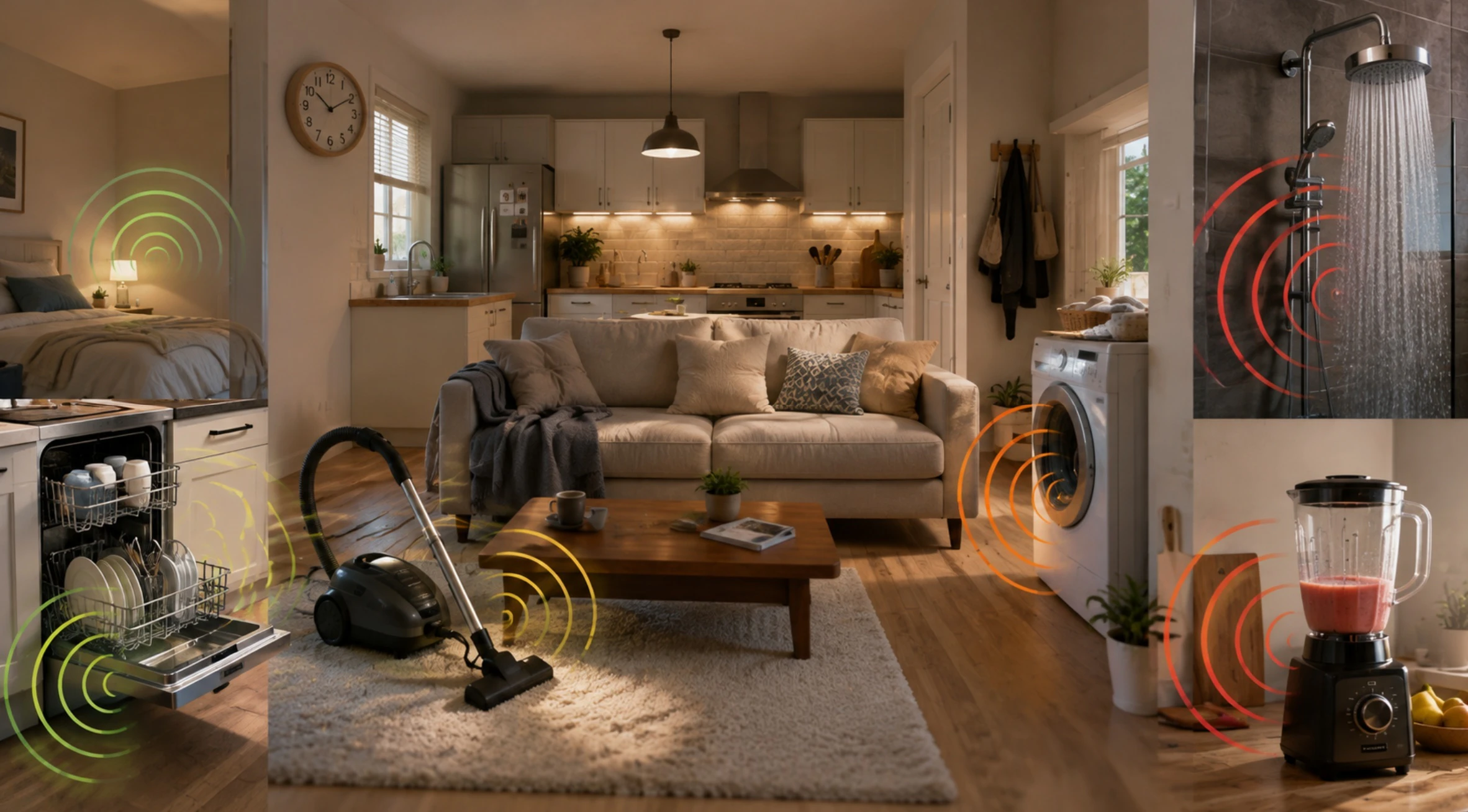
At home, almost nothing tops 80 dB except the vacuum, the hair dryer and the blender. These are the typical noise levels, measured at one metre; they vary quite a bit between models, and manufacturers usually list the figure on the spec sheet as “sound power” or “noise level”.
| Appliance | Approximate level (at 1 m) |
|---|---|
| Air conditioner (indoor unit) | 30-50 dB |
| Refrigerator | 40-45 dB |
| Dishwasher | 45-60 dB |
| Range hood | 55-65 dB |
| TV at normal volume | 55-65 dB |
| Microwave | 60-65 dB |
| Washing machine (spin cycle) | 60-75 dB |
| Vacuum cleaner | 70-80 dB |
| Hair dryer | 80-90 dB |
| Blender or food processor | 80-90 dB |
None of these harms your hearing in normal use: even if the hair dryer brushes 90 dB, you run it for a few minutes, and damage depends on the dose -level times time-, not on a short peak. The trouble starts with long exposures or with entertainment cranked all the way up, which is a separate matter.
How many decibels are dangerous?
The risk starts at 85 dB with prolonged exposure, and above 120 dB the damage can be immediate. But what decides whether a sound harms you isn’t the level alone, it’s how long you take it: at 85 dB the ear holds up for about 8 hours, and from there the safe time halves for every 3 dB, down to barely 15 minutes at 100 dB. Since it’s a topic with numbers of its own, we’ve covered it separately: here’s the guide to how many decibels are dangerous and for how long, with the NIOSH safe-exposure table and the 60/60 rule.
How to measure the decibels in your home without a professional meter
NIOSH has a trick for estimating the level with no equipment at all: pay attention to how hard you have to push your voice. If you have to raise your voice for someone a metre away to hear you, you’re at about 85 dB; if you have to shout, you’re already around 95. It’s a rough rule, but surprisingly reliable for telling whether a place has crossed the line.
For a real number you don’t need to buy a sound level meter: your phone’s microphone will do. With the online sound level meter you turn the phone into a decibel meter and see the level in dB(A) in real time, plus the safe exposure time for that level. It’s not a lab instrument -an uncalibrated phone mic is good to about ±10 dB-, but it’s more than enough to tell whether your living room is at 60 or 85. And if it’s your hearing you’re worried about, the online hearing test tells you how high a frequency you can still hear.
Frequently asked questions
What are the decibel levels for common sounds?
A whisper is about 20 dB, a conversation 60 dB, a vacuum cleaner 70 dB, heavy traffic 85 dB, a nightclub 100 dB, and the front row of a concert 110 dB. The full chart from 0 to 140 dB is at the top of this guide.
What is the 3 dB rule for sound?
Every 3 dB doubles the sound energy, even though you barely hear the change. It’s why safe listening time halves for each 3 dB above 85 dB, and why trimming the volume 3 dB is the cheapest way to cut the dose your ears take in.
Is 30 dB twice as loud as 20 dB?
Roughly, yes: a +10 dB step sounds about twice as loud to the ear, so 30 dB is perceived as around double 20 dB. But it also carries ten times the sound energy -that’s the gap between how loud something feels and how much energy it actually holds.
What does 40 decibels sound like?
40 dB is the level of a quiet library, a modern refrigerator or a rural area. It’s a low, calm level that doesn’t bother you by day, though light sleepers may notice it at night. It’s well below the risk threshold for hearing.
Is 40 dB too loud to sleep?
For most people, no -40 dB is quiet. The WHO suggests keeping a bedroom below about 30 dB at night for undisturbed sleep, so 40 dB can bother sensitive sleepers, but it’s far from a noisy room. A steady 40 dB is usually easier to sleep through than an intermittent quieter noise.
How loud is 100 dB?
100 dB is the level of a nightclub, a power drill or a gas lawn mower. It sounds about eight times as loud as a conversation, and at that level the safe margin is only about 15 minutes a day before you risk your hearing.
What would 310 decibels do to you?
Nothing -because 310 dB isn’t possible as sound in air. The loudest a sound wave can get in air is about 194 dB; beyond that it stops being a pressure wave and becomes a shock wave, like a blast. Numbers such as “310 dB” describe explosions, a different physical event, not sound you could hear.
How loud is too loud?
As a rule of thumb, if you have to raise your voice to be heard by someone a metre away, the level is around 85 dB and you’re at the risk threshold. Above that, the louder it gets the less time you can safely stay: 15 minutes at 100 dB, and instant damage above 120 dB.
The levels in this guide are indicative and vary with distance, weighting and the specific appliance. Measurements from a phone microphone are approximate. If you have persistent ringing or hearing loss, see a specialist.