
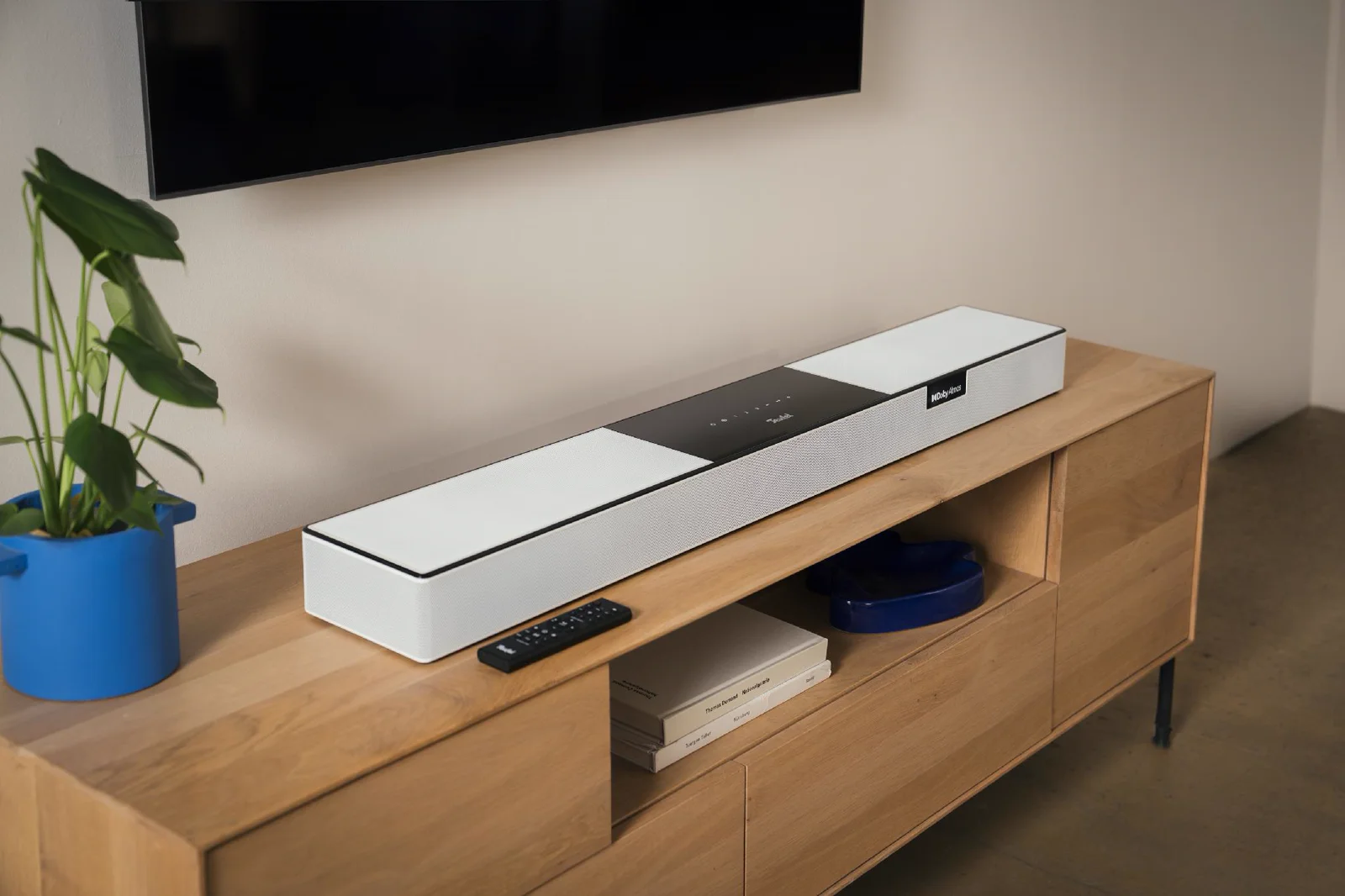
The Teufel CINEBAR PRO 2 is a 5.1.2 soundbar that only comes bundled with a subwoofer, which makes sense once you see that the bar’s frequency range starts at 150 Hz. Below that, the subwoofer does nearly all the work, including the weight of male voices, and that changes where the sub should go. Prices run from €1,199.99 to €1,649.99, depending on the subwoofer (T 8 or T 10 Mk2) and on whether you add the wireless EFFEKT 2 rear speakers that turn it into a 7.1.2 system. Teufel showed it at IFA in Berlin and put it on sale on 13 October 2026, selling it direct through its own website (its physical stores are in Germany and Austria). Its height channels do not rely on processing alone, as with so many “Dolby Atmos” soundbars, because it has two 89 mm drivers that fire at the ceiling.
Teufel sent us the press release, and we also went through the full spec sheet, the user manual, Teufel’s support FAQ and Dolby’s setup guide for this kind of soundbar. They add three caveats the press release leaves out. The subwoofer belongs at the front, near the bar, not at the back of the room, the bar has no automatic room calibration, and its height effect depends on your ceiling and walls. We have not tested it yet, so everything below comes from those sources and from our own calculations.
What has changed since the original CINEBAR PRO
Almost everything. The original CINEBAR PRO, from 2018, was a 2.1 system without Dolby Atmos, relying on virtual surround processing with optional rear speakers, while the new one is a true 5.1.2 with up-firing height drivers, eARC and AirPlay 2. Teufel’s Spanish store now lists the original as no longer available. It came with the original T 10 subwoofer, the predecessor of the T 10 Mk2 in the new sets.
| CINEBAR PRO (first generation) | CINEBAR PRO 2 | |
|---|---|---|
| Channels | 2.1 with virtual surround (Dynamore Ultra), expandable with rear speakers | 5.1.2 (7.1.2 with the EFFEKT 2) |
| Drivers | 8 (two 25 mm tweeters and six 100 mm midrange drivers) | 10 (three coaxials, each a 19 mm tweeter at the centre of a 76 mm mid/bass driver, two 76 mm side-firing drivers and two 89 mm up-firing drivers) |
| Formats | Dolby Digital and DTS | Dolby Atmos, TrueHD, Dolby Digital Plus, DTS:X and DTS-HD |
| HDMI | 2.0, four inputs and ARC | 2.1, two inputs and eARC |
| Streaming | Chromecast and Spotify Connect built in, Bluetooth 4.0 with aptX | AirPlay 2, Google Cast, Spotify Connect, TIDAL Connect and Bluetooth 5.3 (SBC and AAC) |
| Total power | 200 W RMS | 232.5 W RMS, ten Class D channels |
| Size and weight | 120 × 13.5 × 14 cm, 11.2 kg (aluminium) | 122.2 × 9.5 × 17 cm, 8.1 kg (ABS plastic) |
| Recommended room size | Up to 35 m² | Up to 50 m² |
If you own the original, bear in mind that the new bar is lower (9.5 cm compared with 13.5 cm) and a little deeper, and that it drops the headphone output, two of the four HDMI inputs and aptX Bluetooth.
Which CINEBAR PRO 2 set to buy, and what each one costs
Pick a T 10 Mk2 set if your room is large or you watch action films loud, and a 7.1.2 set if your sofa has no side wall close by, because its rear speakers do not rely on any reflection. If you want everything in white, only the T 10 Mk2 sets will do, because the Select sets always ship with a black T 8. Inside a set, the T 10 Mk2 costs €100 more than the T 8, and the EFFEKT 2 rears work out €50 cheaper than buying them later, when they cost €399.99 a pair.
| Set | Subwoofer | Rear speakers | Colours | Price |
|---|---|---|---|---|
| Select “5.1.2-Set” | T 8 (200 mm) | No | Black, or a white bar with a black T 8 | €1,199.99 |
| “5.1.2-Set” | T 10 Mk2 (250 mm) | No | All black or all white | €1,299.99 |
| Select Surround “7.1.2-Set” | T 8 (200 mm) | EFFEKT 2 | Black, or white bar and rears with a black T 8 | €1,549.99 |
| “7.1.2-Set” | T 10 Mk2 (250 mm) | EFFEKT 2 | All black or all white | €1,649.99 |
Shipping is extra, €194.99 to Ireland and €99.99 to Spain. At launch, three of the four sets (all but the Select Surround) show a code that makes it free until 31 December 2026. Teufel says the order ships within four weeks, and it gives you eight weeks to return it for free, longer than Sonos’s 30 days or the 14 days EU law requires. For a system whose Atmos effect depends so much on the ceiling, that is enough time to test it in your own room.
The T 10 Mk2 brings a driver 50 mm larger than the T 8’s, 6 Hz more extension (31 Hz at −3 dB compared with 37 Hz) and 4 dB more maximum output (115 dB at 1 m compared with 111 dB). Teufel recommends it for rooms of up to 40 m². In a mid-sized living room the T 8 should be enough, although it keeps the fixed power cable we criticised on the original T 10.
The T 10 Mk2 compared with the T 10 we reviewed
The T 10 Mk2 fixes two of the three complaints we had about the original T 10. In our Teufel T 10 review we gave it 4 out of 5 for its punchy, well-controlled bass, but we missed a crossover control on the sub itself, disliked the fixed power cable and noted that in front-firing mode the controls end up facing the floor. The Mk2 adds an adjustable low-pass filter and a detachable power cable, but according to its manual the connections still face down in front-firing mode, and it loses the T 10’s bass boost.
| T 10 (our review) | T 10 Mk2 | |
|---|---|---|
| Driver and amplifier | 250 mm aluminium, 150 W | Same |
| Low-frequency extension (−3 dB) | 33 Hz | 31 Hz |
| Maximum output | 115 dB at 1 m | Same |
| Size and weight | 35.1 × 48.3 × 38 cm, 15.6 kg | 34.1 × 45 × 38 cm, 15.5 kg |
| Crossover control | No | Yes |
| Power cable | Fixed | Detachable |
| Controls in front-firing mode | Facing the floor | Same |
| Bass boost | Yes (flat, 50 or 70 Hz) | No |
It still has an RCA input, so it can work with an AV receiver if you ever replace the soundbar. Teufel made it 3.3 cm shorter so it fits next to typical TV stands.
What your room needs for 5.1.2 to work
A flat, reflective ceiling between 2.3 and 3.66 metres high (7.5 to 12 ft), clear side walls, the bar out of any enclosed shelf, and at least 1.2 to 1.5 metres between the bar and your seat. Those are the conditions in Dolby’s setup guide for soundbars with up-firing drivers, and Teufel’s manual adds that the top and both sides of the bar must stay unobstructed. Four of the eight channels in a 5.1.2 system reach your ears after a bounce, which is why the room matters so much.
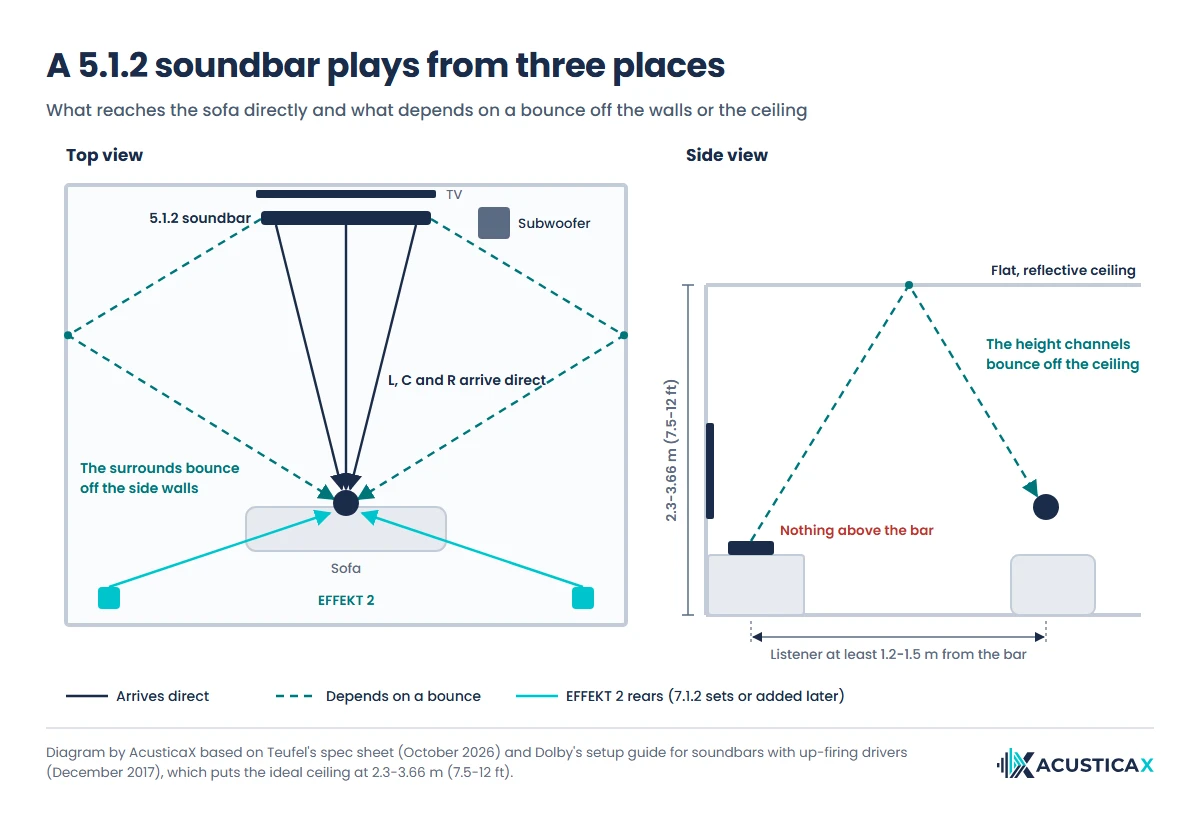
A flat, hard ceiling between 2.3 and 3.66 m
The two up-firing drivers aim the sound at the ceiling so it bounces down to you, which means the ceiling becomes part of the speaker. Dolby asks for a rigid, reflective material such as plaster, plasterboard or wood, and a flat surface, although a shallow vault still works. Popcorn finishes, chandeliers and recessed lights do no harm, but acoustic tiles do, because they absorb the reflection. Beyond that, this is our own reading of the physics. A sloped ceiling steers the reflection away from the sofa, and a very high one lengthens the path and weakens it. If you are weighing this against real ceiling speakers, our guide on how many speakers you need for Dolby Atmos compares the three ways of getting height and what each one delivers.
Keep it out of the cabinet and away from shelves
The bar belongs on top of the TV stand or on the wall, never inside an enclosed shelf. The CINEBAR PRO 2 manual says “the top, as well as the left and right sides of the device, should remain unobstructed” so the up-firing and side drivers can work, and Dolby recommends placing it in front of the screen, at or slightly above seated ear level, with no shelf or soffit above it. On a typical 40 to 50 cm TV stand it will sit below your ears, and Dolby warns against placing it so low that you look down on its top from the sofa; if that is your case, the wall bracket raises it. We simulated what happens to a soundbar in a cabinet in a separate guide, and with this one it would be worse, because the up-firing drivers would be blocked completely.
Measure the gap between your TV stand and the bottom edge of the screen before you buy. The bar is 9.5 cm tall, and if your TV sits on short feet it can cover the bottom of the picture or the remote-control sensor. If it does not fit, Teufel sells its own wall bracket for €39.99.
Your side walls act as the surround speakers
In 5.1.2 mode, the surround channels come from two 76 mm side-firing drivers aimed at the walls, so the sound reaches you after bouncing off them. Dolby asks for a clear line of sight from those drivers to the side walls, with the first reflection free of furniture or absorbent materials such as heavy curtains or a packed bookcase. In an open-plan living room, or with the sofa far from one wall, that side loses its reflection, and that is where the EFFEKT 2 make a difference, whether in a 7.1.2 set or added later. Teufel does not say whether the bar’s side-firing drivers keep handling the surrounds in 7.1.2 mode, but the rears play direct from behind you, without relying on any wall. They need no signal cable, but each one needs its own power socket.
Where should the CINEBAR PRO 2 subwoofer go? At the front, near the bar
A wireless subwoofer lets you put it anywhere, but with this soundbar it belongs at the front, near the TV. The bar’s frequency range starts at 150 Hz, so below that the subwoofer does nearly all the work, including the fundamental of most male voices, which runs from about 90 to 155 Hz according to Baken (2000). Above roughly 80 Hz your ears start to pick up where bass comes from, which is why THX set its standard crossover at 80 Hz. With the sub in a back corner, the weight of a male voice can seem to come from behind you.
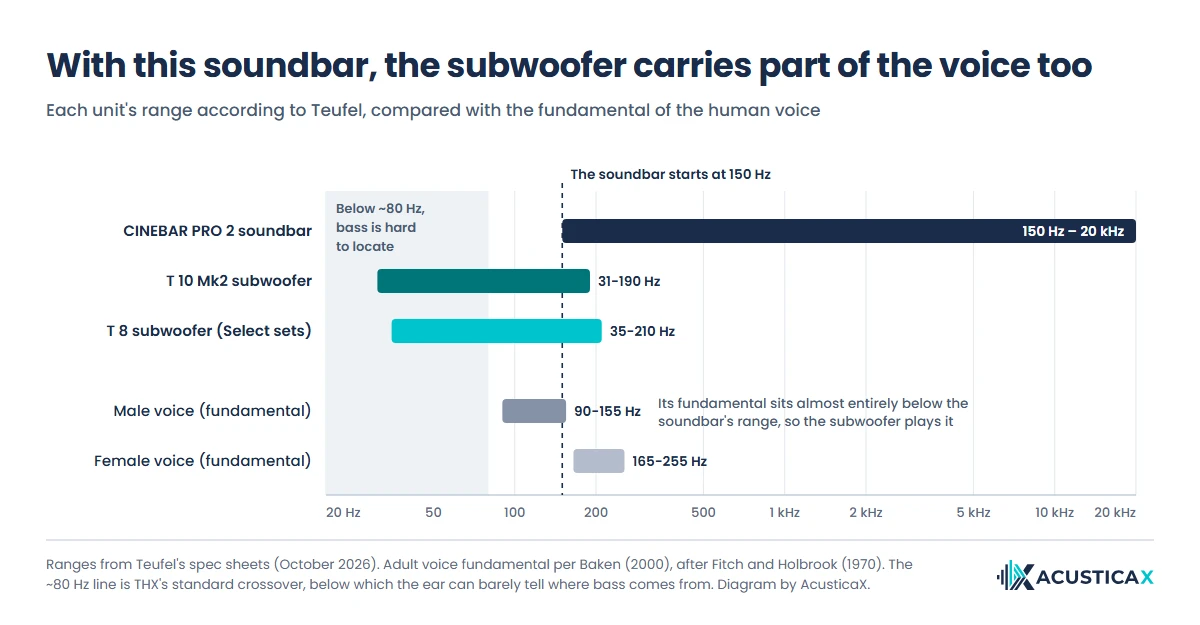
The T 10 Mk2 manual says both things. It asks you, “to the extent possible”, to set the sub up “in front of your sitting area close to the front speakers”, and then adds that “generally” it can go anywhere else, “as the human ear is unable to localise low tones”. That second rule holds with an 80 Hz crossover, the usual choice when a receiver drives separate speakers, but not with a soundbar that leaves everything below 150 Hz to the subwoofer.
Within that front area, the exact spot still changes the bass a lot because of room modes, and a corner raises the level at the cost of some notes booming while others vanish. To find the best spot without guessing, our subwoofer placement tool uses the sub crawl method. You put the subwoofer on your seat for a moment and measure with your phone at each candidate spot, and since it is wireless you only need a power socket nearby.
How to connect and set it up on day one
Connect it to your TV’s HDMI eARC port, plug a Blu-ray player into one of its HDMI inputs if you want lossless Atmos, and set distances and levels by hand, because it does not calibrate itself. The box contains the bar, the remote, the subwoofer and their power cables, but no HDMI cable.
- ARC or eARC. Atmos from Netflix, Disney+ or Prime Video travels as Dolby Digital Plus and can pass over plain ARC if your TV allows it. Atmos from a Blu-ray, carried in Dolby TrueHD, and DTS:X both need eARC, as Sony’s eARC help page explains. If your TV only has ARC, connect the player straight to one of the soundbar’s two HDMI inputs.
- Games consoles. Teufel lists 4K passthrough with HDR, Dolby Vision and 3D, but its spec sheet says nothing about 120 Hz or VRR. Until Teufel confirms it, a PS5, an Xbox Series X or a gaming PC is better connected to the TV, with the sound coming back over eARC.
- Blu-ray player on bitstream. Dolby recommends setting the audio output to bitstream and turning off secondary audio, which otherwise mixes the soundtrack down to a format without Atmos.
- Distances and levels by hand. The Speaker menu takes the distance from each speaker to your seat and, for the height channels, the distance from the bar to the ceiling. Channel levels are matched with a test tone, in 1 dB steps over ±10 dB. A sound level meter on your phone, held at your seat, lets you bring every channel to the same reading. Do not trust the phone for the subwoofer, since its microphone rolls off the bass, and set that one by ear with films.
- Lip-sync and sound modes. Audio delay goes from 0 to 200 ms if voices and lips drift apart. According to the manual, Movie is the most neutral mode, Music adds a slight bass and treble lift, and Night reduces bass and dynamics for late viewing. Dynamore and the Dolby and DTS virtualisers can be switched off, and with music it is worth trying without them.
- Music and multi-room. Over Wi-Fi it supports AirPlay 2, Google Cast, Spotify Connect, TIDAL Connect and TuneIn, and it can join AirPlay or Google Cast multi-room groups with other brands’ speakers. According to Teufel’s support FAQ, it cannot join an existing Teufel Streaming or Raumfeld system. Bluetooth (SBC and AAC) is lossy, so Wi-Fi is the better route for serious listening.
What we like and what we miss
On paper, it gets right the two things that matter most in an expensive soundbar, physical height channels and the subwoofer, and falls short on ease of setup.
- Real height, with two 89 mm up-firing drivers, plus Dolby Atmos and DTS:X.
- Three coaxial front drivers, which according to Teufel keep the stereo image stable even outside the sweet spot.
- Two HDMI 2.1 inputs as well as the eARC output, whereas the Sonos Arc Ultra has no HDMI input at all.
- A T 10 Mk2 that fixes two of the three complaints we had about the T 10, and that you can reuse with a receiver later.
And what we miss:
- Automatic room calibration.
- Confirmation of 4K at 120 Hz and VRR passthrough.
- Free shipping, which outside the launch offer costs €99.99 in Spain and €194.99 in Ireland.
- The option to buy the bar on its own, and compatibility with Teufel’s own Raumfeld multi-room system.
What we would measure in a review
We would measure the frequency response at the sofa with Dynamore on and off, the off-axis response of the coaxials, the real point where the bar hands the bass over to the subwoofer, the maximum level before its limiter steps in, and the delay between picture and sound. The level is worth checking, because the spec sheet quotes 98 dB at 1 m, and by the inverse square law that leaves about 88 to 89 dB of direct sound at a sofa 3 m away, plus whatever the room adds. That is plenty for a living room; what matters is where it starts to limit. The first four come from our room measurement tools and the sound level meter, and the delay from a sync test video. That is what we will report if it reaches our living room.
Frequently asked questions
Can you buy the CINEBAR PRO 2 without a subwoofer?
No. Teufel only sells it in sets with the T 8 or the T 10 Mk2, and with a frequency range that starts at 150 Hz, the bar would have no bass on its own. The cheapest set, the Select 5.1.2 with the T 8, costs €1,199.99.
Is the CINEBAR PRO 2’s Dolby Atmos real or virtual?
It is a Dolby Atmos soundbar with physical height channels, using two 89 mm up-firing drivers that bounce sound off the ceiling down to your seat. It can also switch on the Dolby virtualiser or DTS Virtual:X to widen the sense of space. In 5.1.2 mode the surround channels also arrive by reflection, off the side walls.
Does it work with a high or sloped ceiling?
Less well. Dolby puts the ideal ceiling between 2.3 and 3.66 metres (7.5 to 12 ft), flat and made of a reflective material, accepts a shallow vault and advises against absorbent acoustic tiles. In our view, a sloped ceiling steers the reflection away and a very high one weakens it, so it is worth testing at home within the return period.
Can you wall-mount the CINEBAR PRO 2?
Yes, with Teufel’s own wall bracket, which costs €39.99 extra. Mounted below the TV, at or slightly above seated ear level, it follows Dolby’s advice, as long as there is no shelf directly above the up-firing drivers.
Can you add the rear speakers later?
Yes. You pair the EFFEKT 2 from the soundbar’s menu, and they cost €399.99 a pair, €50 more than inside a 7.1.2 set. They are wireless, with a range of up to 15 m, but each one needs a power socket.
