

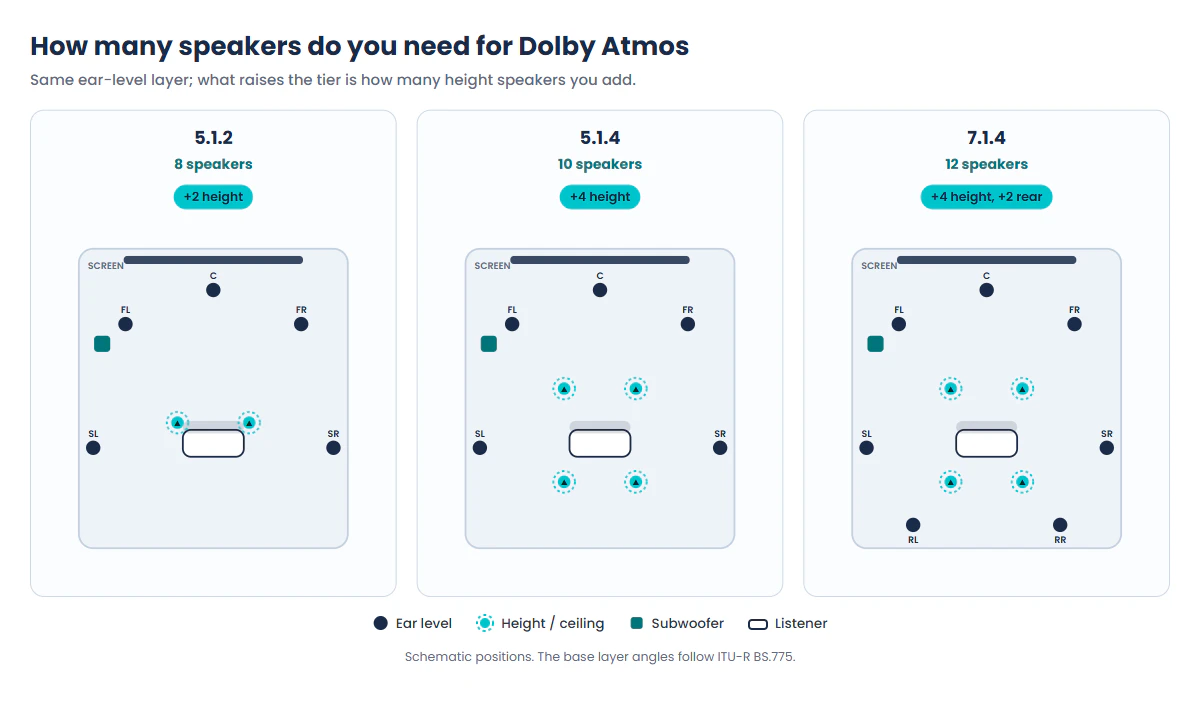
How many speakers do you need for Dolby Atmos? At least 8, a layout written as 5.1.2: five at ear level, one subwoofer and two height or ceiling speakers. That base is enough to hear the three-dimensional effect, with sounds arriving from above. A balanced setup goes up to ten speakers (a 5.1.4), and the layout most home theaters treat as the reference is twelve (a 7.1.4).
The middle “.1” is the subwoofer, so you will see the same setup described as 7 or 8 speakers depending on whether you count it. That small detail causes half the confusion floating around online. Below is the exact table for each layout, how many height speakers your room actually calls for, where they go, and how all of this differs from DTS:X.
How many speakers do you need for Dolby Atmos
The minimum for full surround with real overhead is 8 speakers (a 5.1.2), and from there you add height, not floor. Dolby writes its layouts as three numbers separated by dots. The first counts the ear-level speakers, the middle one counts subwoofers (almost always one), and the third counts the height channels, whether in-ceiling or reflected. A 5.1.2 is 5 + 1 + 2, a 7.1.4 is 7 + 1 + 4.
This is why it helps to decide whether you count the subwoofer. Plenty of guides say a 5.1.2 “has 7 speakers” (the full-range ones) while others say 8 (including the sub). Both figures describe the same gear. The table below counts the physical total, the boxes you place and wire. To choose a receiver, read the last column: those are the amplified channels you need, and the subwoofer sits apart on a line-level output because it carries its own amplifier.
| Layout | Ear level | Subwoofer | Height / ceiling | Total boxes | Receiver channels |
|---|---|---|---|---|---|
| 2.0.2 | 2 | 0 | 2 | 4 | 4 |
| 3.1.2 | 3 | 1 | 2 | 6 | 5 |
| 5.1.2 (Atmos minimum) | 5 | 1 | 2 | 8 | 7 |
| 5.1.4 (balanced) | 5 | 1 | 4 | 10 | 9 |
| 7.1.2 | 7 | 1 | 2 | 10 | 9 |
| 7.1.4 (reference) | 7 | 1 | 4 | 12 | 11 |
| 9.1.6 | 9 | 1 | 6 | 16 | 15 |
Consumer receivers today reach 7.1.4 in the mid range (from the likes of Denon, Marantz, Onkyo and Yamaha) and 9.1.6 or 11.1.4 at the high end. Dolby publishes placement guides up to 11.1.8, and custom installs with external amplification go further still, but that is no longer a living-room receiver.
What 5.1.2 means and why people read it as 7
The three numbers in a 5.1.2 are, in order, ear-level speakers, subwoofers and height speakers. The confusion comes from the subwoofer sitting in the middle and sometimes being counted as a “speaker” and sometimes not. Here is what each number puts in your room.
The first number, the ear-level speakers
The first number is the bed layer, the classic surround setup. A 5 holds the center, the two fronts and the two surrounds; a 7 adds two rear surrounds. These follow the ITU-R BS.775 recommendation (center at 0°, fronts at ±30°, surrounds at ±110°, all the same distance, tweeters at seated ear height). If you already own a home cinema, this layer is built, and our guide to how to place your 5.1 speakers covers how to dial it in.
The middle number, the subwoofer
The middle number is how many subwoofers you run, almost always one. It carries no direction (below roughly 80 Hz the ear struggles to localize the source), just the weight of the bass. A second sub, turning the 5.1.2 into a 5.2.2, does not improve Atmos as such, only how evenly the bass loads the room. This is the box some people count and others do not, which is where the endless “is it 7 or 8?” comes from.
The third number, the height speakers
The third number is what makes a system Atmos rather than a plain 5.1. These are the height channels, sound that arrives from above. They can be 2, 4 or 6, and they can be delivered in three quite different ways. This is the part most people get wrong, so it gets its own section.
The three kinds of height speaker
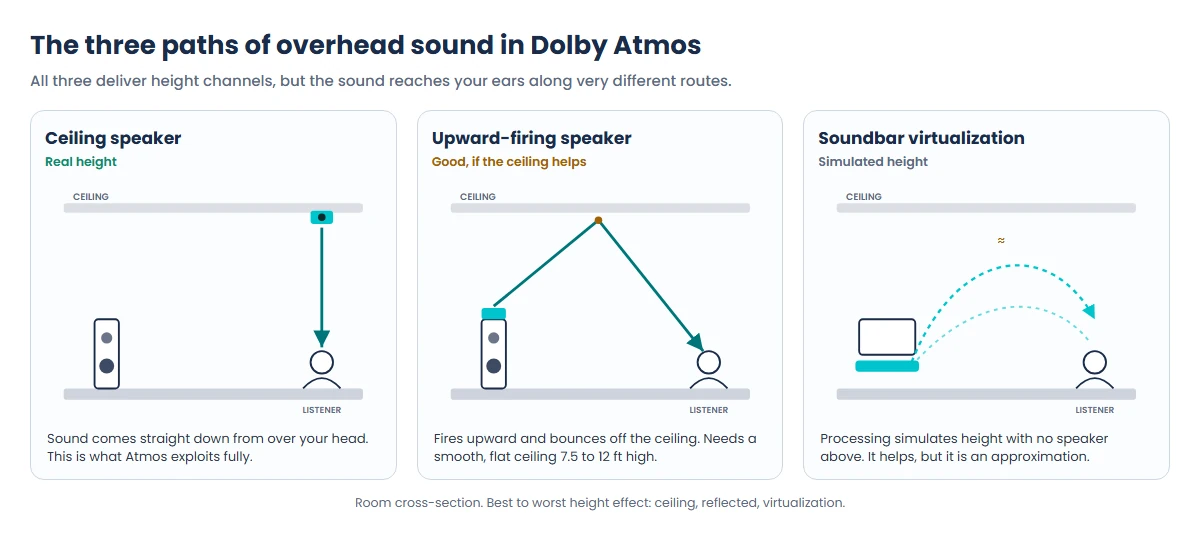
There are three ways to get the height channels, and they do not sound the same: ceiling speakers, reflected “Atmos-enabled” speakers, and a soundbar’s virtualization. That is the order, best to worst.
Ceiling speakers (the real effect)
In-ceiling or ceiling-mounted speakers reproduce height best, because the sound genuinely comes down from over your head. Dolby recommends they fire downward and that their tone matches the ear-level speakers. It is the most awkward install (you have to run cable through the ceiling) and the one that needs the most work, but it is the one Atmos exploits fully.
Upward-firing or “Atmos-enabled” speakers
Upward-firing speakers sit on top of your front speakers (or are built into them) and fire at the ceiling so the sound bounces down to your seat. They work well under one strict condition, a flat, smooth, reflective ceiling 7.5 to 12 feet (2.3 to 3.66 m) high. With high, sloped, textured or beamed ceilings the reflection scatters and the height effect fades. They are the no-drilling route, and an honest solution when you cannot mount anything in the ceiling. If they are built into the fronts, the 5.1.2 keeps its 8 channels but drops to 6 boxes.
Soundbars and height virtualization
A one-piece “Dolby Atmos” soundbar rarely has true height speakers. What most of them do is virtualization, processing that tricks the ear into placing sound overhead. It helps, and in an ordinary living room it beats nothing, but it does not reproduce physical height. It is an approximation, not a ceiling channel. If the bar carries drivers that fire upward (the good models do), then you get a real reflection, with the same ceiling dependency as above.
How many height speakers your room calls for
Room size decides the number of height channels more than budget does. In a small living room, four ceiling speakers sit so close together that their coverage overlaps and you gain no resolution; two well-placed ones sound the same. In a large or dedicated room, four spread the height evenly front to back, and there the jump is worth it.
| Your room | Sensible layout | Total boxes | Height speakers |
|---|---|---|---|
| Small living room (up to ~160 sq ft) | 5.1.2 | 8 | 2 |
| Mid-size living room (~160-270 sq ft) | 5.1.4 | 10 | 4 |
| Large room or dedicated theater | 7.1.4 | 12 | 4 |
| Very long room with several rows | 7.1.6 or higher | 14+ | 6 |
That last note saves the most money. Past a 5.1.4, the room’s acoustics pay off more than another speaker. You can work out your room modes and RT60 from its dimensions, and measure your room’s real acoustics with your phone mic, to see whether what you lack is a speaker or a treated wall. If your system is staying in a small living room, look at what to expect from surround sound in small rooms.
Where the height speakers go
Height speakers go on or near the ceiling, in front of and behind your seat, at the angles Dolby recommends in its speaker setup guides, depending on how many you install. The ear-level layer still follows ITU-R BS.775; what changes with Atmos is the layer above.
- With 2 height speakers (5.1.2): one each side, directly above the seat or slightly ahead, in a band of 65° to 100° of elevation from your seat (90° is straight overhead). Dolby calls this the “top middle” pair, the spot that spreads best with only two.
- With 4 height speakers (5.1.4 or 7.1.4): a “top front” pair around 45° to 55° of elevation and a “top rear” pair around 125° to 135°. That builds a dome of sound in front of and behind your head.
- Ceiling height: reflected speakers want 7.5 to 12 feet (2.3 to 3.66 m) and a smooth surface; in-ceiling ones fire down toward the listening area.
A common mistake is placing the height pair too far forward or hard against the front wall, so “overhead” ends up sounding “in front”. When you are torn between two positions, Dolby’s (more centered over the seat) usually beats the intuitive one. Once they are up, it is worth checking channel by channel that each speaker plays where it should.
Dolby Atmos vs DTS:X, what actually differs
Dolby Atmos and DTS:X do the same thing underneath, treating each sound as an object with a position in space rather than tying it to a fixed channel, which is why the speaker count applies to both. The difference is in how they package and decode that audio.
Objects, codecs and bit rate
Atmos encodes the objects alongside a channel bed using joint object coding (JOC) over Dolby Digital Plus for streaming, at up to about 768 kbps. For top quality on disc it uses Dolby TrueHD, lossless and up to about 18 Mbps on a UHD Blu-ray; AC-4 is Dolby’s newest codec, lossy and built for broadcast and streaming. A cinema mix can handle up to 128 audio elements across objects and channels, though a home stream groups them into far fewer. DTS:X arrived as a more flexible alternative: it does not demand a specific speaker layout and reaches very high bit rates on Blu-ray (DTS-HD Master Audio up to about 24.5 Mbps). Its practical difference is adaptive mapping, which reassigns each object to whatever speakers it finds in your room. Day to day, most content ships in Atmos and almost any modern receiver decodes both.
What happens when your content is not Atmos
Play a 5.1 film on an Atmos system and the receiver runs an upmixer (Dolby Surround or DTS Neural:X) that steers part of the signal to the height speakers to fill the dome. It is not the same as native object audio, since it invents the height from the channels it has, but it gives a convincing surround from almost any source. Either way, it helps to be clear on what surround adds over stereo.
Can you use your current speakers, and is it worth it?
They do work: to build Atmos you start from your existing 5.1 or 7.1 and only add the height speakers. The bed layer does not change, so the spend concentrates on 2 or 4 height boxes plus a receiver with free channels. Nothing gets thrown out.
If you start from scratch, the honest question is how much Atmos you will actually notice in your room. A 5.1.2 with good height speakers and a minimally treated room sounds better than a 7.1.4 crammed into an echoey box. A soundbar with virtualization makes sense when you cannot mount anything else, as long as you know the height will be a hint. And above a 5.1.4 in a normal living room, every dollar pays off more in treating the acoustics than in another speaker. Measure first, buy later.
Frequently asked questions
What do you need for Dolby Atmos?
Atmos content (streaming, a UHD Blu-ray or a console), a receiver or soundbar that decodes it and, above all, height speakers. The minimum layout with real overhead is a 5.1.2, that is 8 speakers total (5 at ear level, 1 subwoofer and 2 in-ceiling or reflected).
How many speakers do you need for Dolby Atmos as a minimum?
Eight, in a 5.1.2. A soundbar or a 3.1.2 both give you Atmos, but the soundbar usually simulates the height and the 3.1.2 has no surrounds, so the surround is incomplete. The real step up to three-dimensional sound comes with the five ear-level speakers and at least two physical height channels.
What is the difference between 5.1.2 and 7.1.4?
A 5.1.2 is 8 speakers (5 ear level, 1 subwoofer, 2 height) and a 7.1.4 is 12 (it adds 2 rear surrounds and 2 height speakers). The 7.1.4 builds a height dome front and back and covers large rooms better; in a small living room the 5.1.2 performs almost the same and is far easier to install.
Can you use Dolby Atmos with regular speakers?
Yes. Your current 5.1 or 7.1 forms the ear-level layer of an Atmos system with no changes. You only add the height speakers (in-ceiling, reflected, or an “Atmos-enabled” pair on top of the fronts) and a receiver with enough channels.
Do you need special speakers for Atmos?
Only the height ones. Any decent speaker works as a ceiling channel if it fires downward; “Atmos-enabled” speakers are special because they fire upward to bounce off the ceiling. The floor speakers (fronts, center, surrounds) are the usual ones.
Is a soundbar enough for Dolby Atmos?
It works as a way in. An Atmos soundbar decodes the format, but most simulate height through virtualization rather than reproducing it; the best ones include drivers that fire at the ceiling for a real reflection. In a normal living room it improves a lot on the TV’s stereo, though it does not match dedicated height speakers.
Which is better, 5.1 or Dolby Atmos?
Atmos adds the height dimension a 5.1 lacks, so with good material it sounds more immersive. But a well-placed 5.1 in a treated room can beat a badly installed Atmos. Height pays off once the base is sorted, not before.
Is Dolby Atmos worth it in a small room?
Yes, in a 5.1.2. In a small room, two well-placed height speakers give almost the whole effect and four barely add anything because they end up too close together. Before overspending, measure the room’s acoustics; in small spaces, bass and reflections matter more than the number of ceiling speakers.
