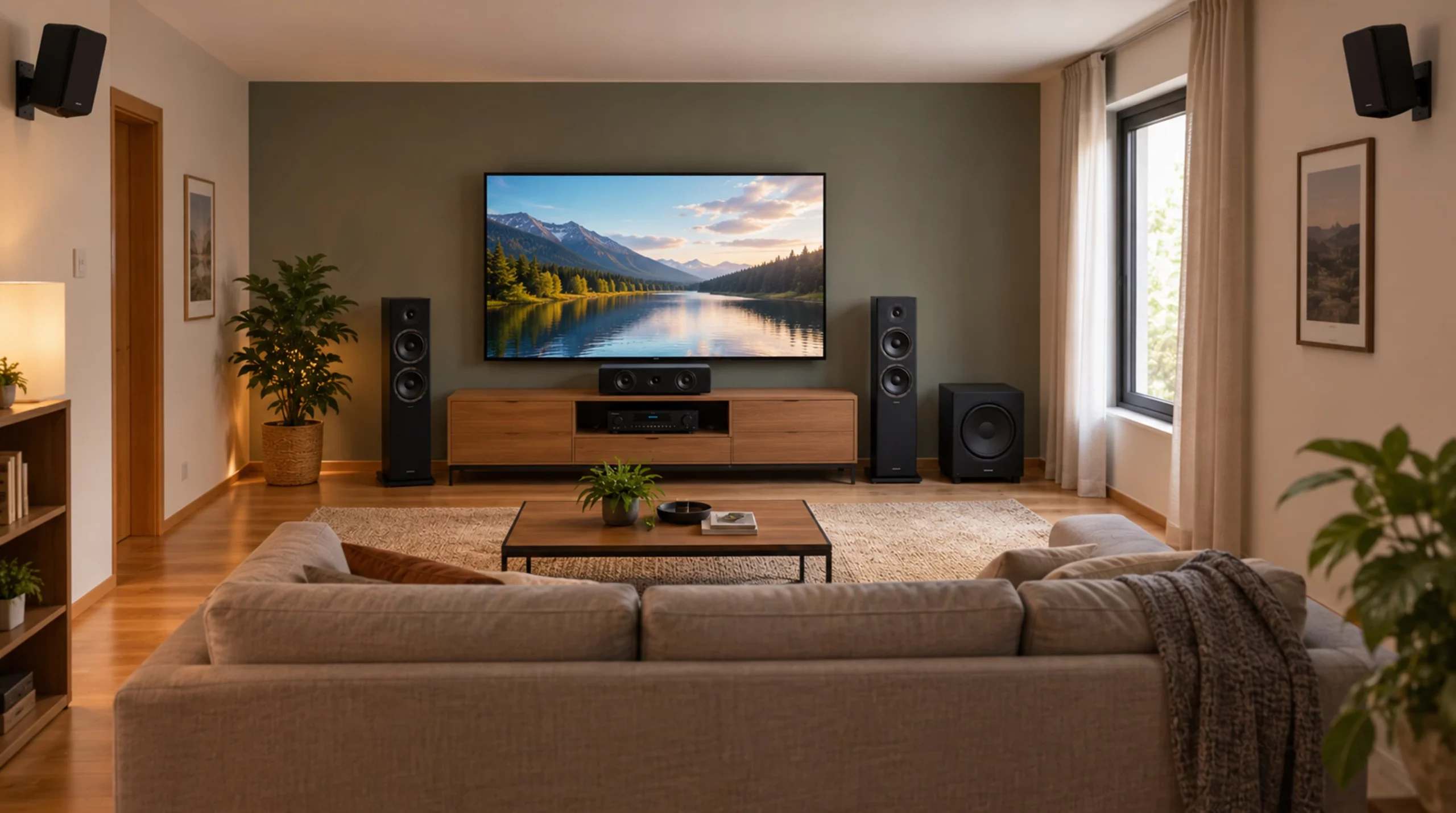
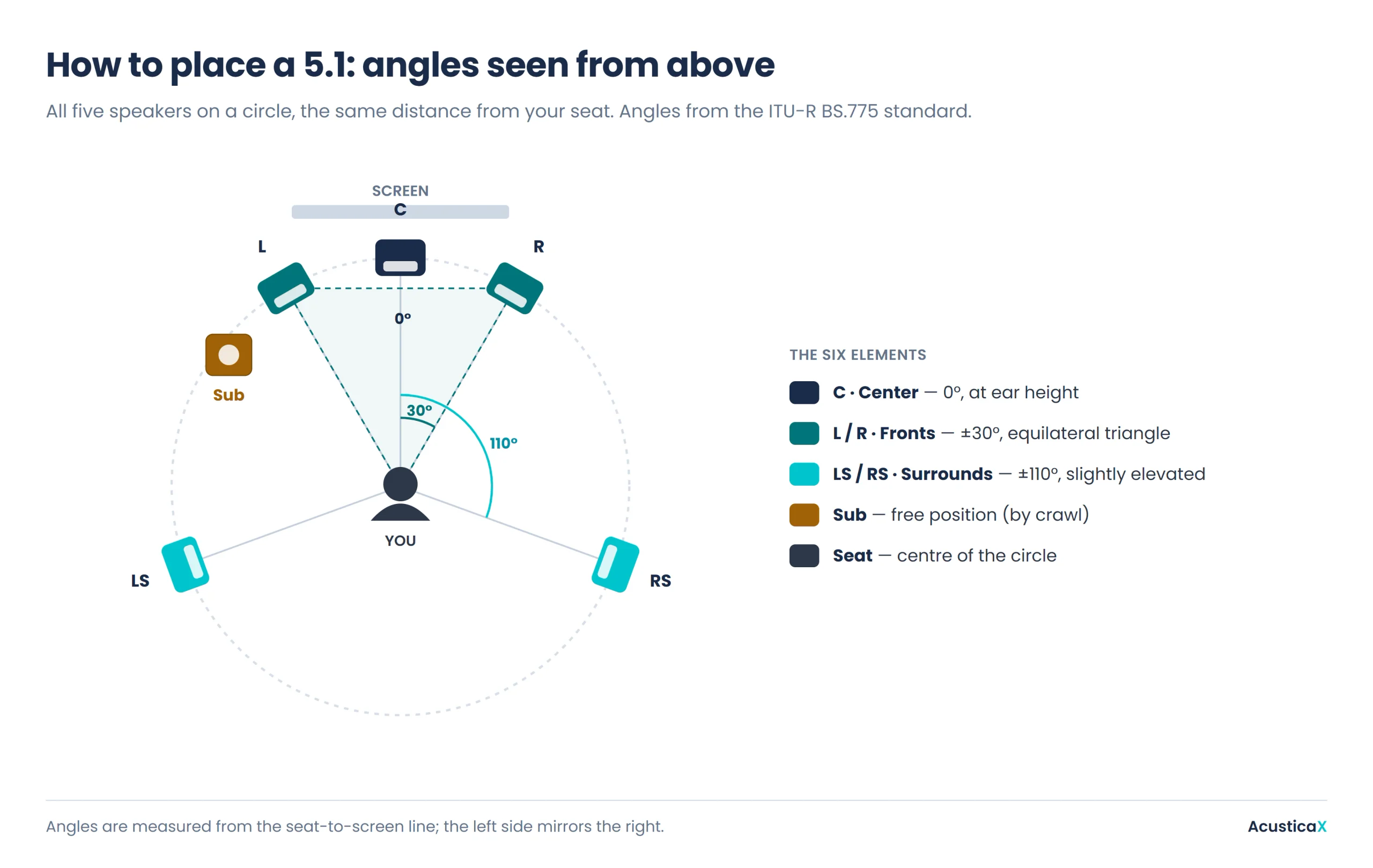
Good 5.1 speaker placement comes down to three angles and one distance: the center at 0° (straight ahead), the front speakers at ±30°, the surrounds at ±110°, all five the same distance from your sofa, with the tweeters at ear height. That is the reference layout for 5.1 (the ITU-R BS.775 Recommendation), the base Dolby and THX build their home guides on, and the subwoofer sits apart, because bass is hard to pin down.
The good news is that this layout is free: the angle matters more than the price of the speaker. A modest 5.1 surround sound setup placed correctly envelops you better than an expensive one placed badly, because what creates the surround effect is geometry, not the badge. This guide gives you the exact figures channel by channel, and what to prioritize when your living room isn’t a screening room and the sofa is jammed against the wall.
5.1 speaker placement: the map at a glance
A 5.1 system is six pieces around a single listening position: the center, the two fronts, the two surrounds and the subwoofer. The five “big” speakers sit on an imaginary circle centered on your seat, all the same distance away and aimed at it; the subwoofer breaks that rule. The table sums up where each one goes; the surround sound diagram below shows it in plan view.
| Channel | Angle (from center) | Height | Aim |
|---|---|---|---|
| Center | 0° | At ear height | Straight at the listener |
| Front left / right | ±30° | Tweeter at ear height | Slight toe-in toward the seat |
| Surround left / right | ±110° (between 100° and 120°) | ~60 cm above ear level | To the sides, slightly behind |
| Subwoofer (.1) | Free (front or corner) | On the floor | The room decides (see below) |
The front left and right speakers: ±30°
Place the fronts 30° either side of the line to the screen, so they form an equilateral triangle with you: if they are 3 meters apart, sit about 3 meters from them. The tweeters should sit at seated ear height (around 1.1-1.2 m) with a slight toe-in toward your head, which focuses the treble and locks the stereo image in place. The fronts carry the music and almost all the on-screen effects, so if you can only mount two speakers well, make it these.
The classic mistake is spreading them too wide chasing “more surround”: past ±30° the image stretches and left-to-right pans turn abrupt, jumping as they cross the middle. If your TV is large and you sit close, ±30° may feel narrow – respect it anyway, because it is the angle the content is mixed at.
The center channel: 0° and at ear height
The center goes dead ahead (0°), lined up with the screen and as close to ear height as you can manage. It is the single most important speaker for film, because it reproduces nearly all the dialogue, so a badly placed center shows up in the one thing audiences never forgive: not understanding what’s being said.
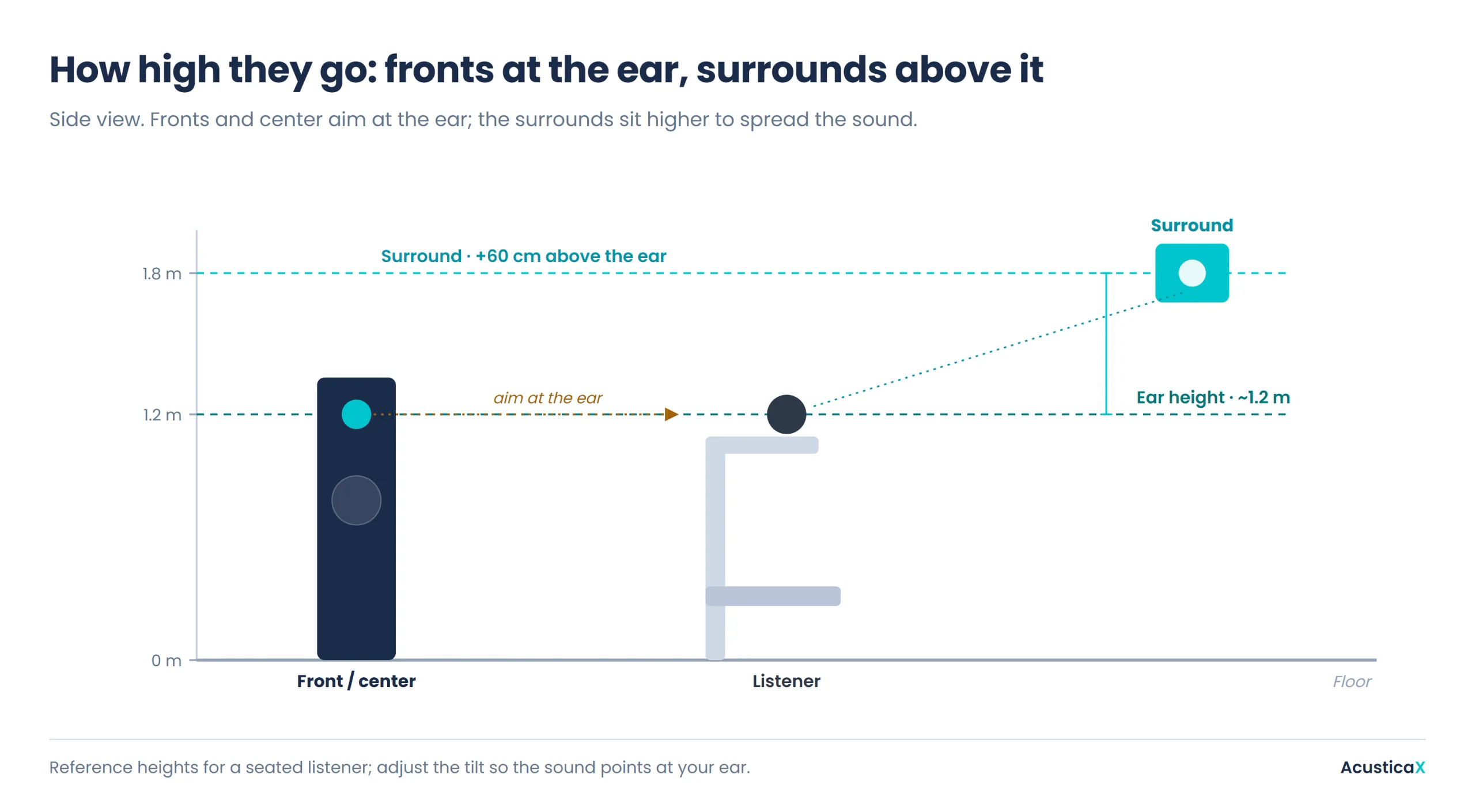
Since it almost always ends up above or below the TV, the practical rule is: if it sits below ear height, tilt it slightly up; if it sits above (wall-mounted TV), tilt it down. The aim is for the direct sound to point at your head and for the center to line up with the fronts, so a voice panning across the scene doesn’t jump in tone as it crosses the middle.
Surround speaker angles: ±110°
The surrounds go at ±110° (the ITU Recommendation allows 100° to 120°; Dolby and THX, 90° to 110°), meaning to the sides of the seat and slightly behind it – not on the back wall. And here is where they differ from the fronts: they sit elevated, about 60 cm above ear level, because their job is ambience and diffuse effects, not a precise image. Raised and opened out, they stop you from pinpointing where a sound comes from, which is exactly what breaks the illusion. Since they sit far from the receiver, theirs is the longest wire run in the system, so here’s how to hide speaker wire to the surrounds and which gauge it needs.
The most common error is treating a 5.1 like a 7.1 and sending the surrounds to the back wall behind the sofa. In a 5.1 the surrounds are side speakers. If your sofa is against the back wall and you can’t place them to the sides, mount them high on the side walls aimed at the middle of the room, or use dipole speakers: instead of aiming at you like a direct-radiating speaker, they fire to the sides in opposite phase with a null pointing at the listener, diffusing the sound and forgiving an imperfect spot. If the room is small as well, our guide to surround sound in a small room covers the angle and height to use, and why dipoles are best skipped with Dolby Atmos.
The subwoofer: the exception to the rule
The subwoofer does not follow the circle. With sustained tones below about 80 Hz (the usual bass-management crossover) localization gets erratic, but it doesn’t vanish: the sub’s own distortion and port noise give its position away. So what decides where it goes isn’t the angle but how it interacts with the room, beyond the old 80 Hz myth: depending on where you put it, room modes will give you tight, even bass or a boom that comes and goes as you shift along the sofa.
That is why you don’t place a sub by ear or by looks, but with the subwoofer crawl to find its best spot: put the sub on your listening seat, play bass, and crawl the perimeter of the room until you find where it sounds most even – that’s where the sub goes. As a starting point, the front third of the room or a corner boost the level, but the final call comes from measuring, not from the spec sheet.
Distance, speaker height and calibration
Ideally the five speakers are the same distance from your seat, so each channel reaches you at the same instant. In a real room that almost never happens, and it doesn’t matter: any modern receiver compensates with delay. Sound travels at about 343 m/s, so each extra meter is ~2.9 ms of delay; you tell the receiver each speaker’s distance (or let its calibration microphone measure it) and it aligns the timing and the levels. Physical distance stops being a problem the moment it’s calibrated.
How far should you sit? The 38% rule
There are two references for listening distance. For the picture, THX suggests sitting where the screen fills about 36–40° of your field of view (closer the larger the TV). For the sound, the 38% rule: put the sofa at roughly 38% of the room’s length from the front wall, because that’s where the peaks and dips of the room modes are least severe and bass comes out most even. The two rarely coincide in a real living room; prioritize the 38% for sound and fit the screen distance around it.
| Parameter | Reference |
|---|---|
| Front and center height | Tweeter at seated ear height (~1.1-1.2 m) |
| Surround height | ~60 cm above ear level |
| Front speaker spacing | ≈ your listening distance (equilateral triangle) |
| Subwoofer crossover | 80 Hz (THX standard) |
| Delay per distance | ~2.9 ms per meter of difference |
One honest tip: auto-calibration nails distances and levels, but it sometimes gets speaker size or the sub crossover wrong. After calibrating, check that each channel plays from the right speaker with a channel test; it’s the fastest way to catch a swapped cable or a silent surround.
When your room won’t cooperate
When you can’t honor the ideal layout, there’s an order of priority: the center and fronts first (they carry dialogue and music), then the subwoofer, and last the surrounds, which forgive an imperfect spot the most. Before you resign yourself, measure: many “placement” problems are really room modes, and for that it’s worth calculating your room’s modes and listening distance instead of moving speakers blindly. The table sums up the three most common jams.
| If your room… | Prioritise this |
|---|---|
| Sofa against the back wall | Surrounds high on the side walls, aimed at the middle; or dipole models. Don’t put them behind you. |
| Small room | Keep the fronts at ±30° even if they end up close; if the sub booms, lower its level and move it (crawl) or fix it with EQ. The crossover is not a boom control. |
| Open-plan living room | Anchor the center and fronts to the TV zone; use delay calibration for the real seat. |
And if you’re going to treat the room with panels or bass traps, measure the acoustics before buying anything: it’s the only way to know whether the problem is placement, reverberation or a mode – and to avoid spending on panels that don’t address your real issue.
5.1, 2.1 or a jump to Atmos?
A 5.1 is the classic balance: true surround with five speakers and a subwoofer, versus a 2.1 (two speakers and a sub), which sounds great for music but doesn’t wrap around you; if you’re torn between them, see the difference between stereo and surround sound. The next step up is Dolby Atmos, which adds height: a 5.1.2 is your same 5.1 plus two ceiling speakers (or modules that bounce sound off the ceiling). The speaker angles you’ve already set on the horizontal plane don’t change when you move to Atmos; you only add the ones overhead, with their own codec and speaker rules. If you’re still unsure whether a 5.1 beats a soundbar for you, start by nailing these five – they’re the base everything else is built on.
Once the speakers are in place, the next step is to tune the whole room: calibrate and optimize your home theater to get the most out of the placement you’ve just done.
Frequently asked questions
Where should 5.1 surround speakers be placed?
On a circle centered on your seat: the center at 0° (straight ahead), the fronts at ±30° forming an equilateral triangle with you, and the surrounds at ±110°, to the sides and slightly elevated. All five the same distance away with tweeters at ear height; the subwoofer sits apart, wherever the bass sounds most even. That is the ITU-R BS.775 reference layout.
What is the ideal height for surround speakers?
About 60 cm above seated ear level, because surrounds are meant to create diffuse ambience rather than a pinpoint image; raising them stops you from locating the speaker. The fronts and center are the opposite: their tweeters go at ear height (roughly 1.1-1.2 m). Front speaker height is what most affects how clear voices sound.
How far apart should home theater speakers be?
All five ideally the same distance from the seat. For the fronts, the reference is the equilateral triangle: space them roughly as far apart as you sit from them (sit 3 m away, space them about 3 m). When the distances don’t come out equal, the receiver evens them with delay (around 2.9 ms per meter of difference), so there’s no need to obsess over the centimeter.
What’s the difference between 5.1 and stereo?
Stereo (2.0) uses two speakers and creates an image in front of you; 5.1 adds a center to anchor dialogue, two surrounds for side ambience and a subwoofer for bass, so the sound wraps around you. For music, good stereo can be enough; for film, 5.1 separates voices, effects and ambience into different channels, and that shows in intelligibility and envelopment.
Is 2.1 or 5.1 better?
It depends on use and space. For music, or in a small room where you can’t place speakers behind you, a 2.1 (two fronts and a subwoofer) is simpler and sounds very good. For film and TV, 5.1 clearly wins because the center improves dialogue and the surrounds create envelopment a 2.1 can’t. If in doubt, the deciding factor is whether you can place the surrounds well.
Should I upgrade from 5.1 to Dolby Atmos (5.1.2)?
Atmos is a 5.1 (or larger) with added height: it adds ceiling speakers so sound also comes from above (a 5.1.2 is five + sub + two height). If immersion is your priority and you can install ceiling speakers, Atmos adds an extra layer; if not, a well-placed 5.1 is still a complete surround system and the base Atmos builds on. Get the horizontal plane right first.