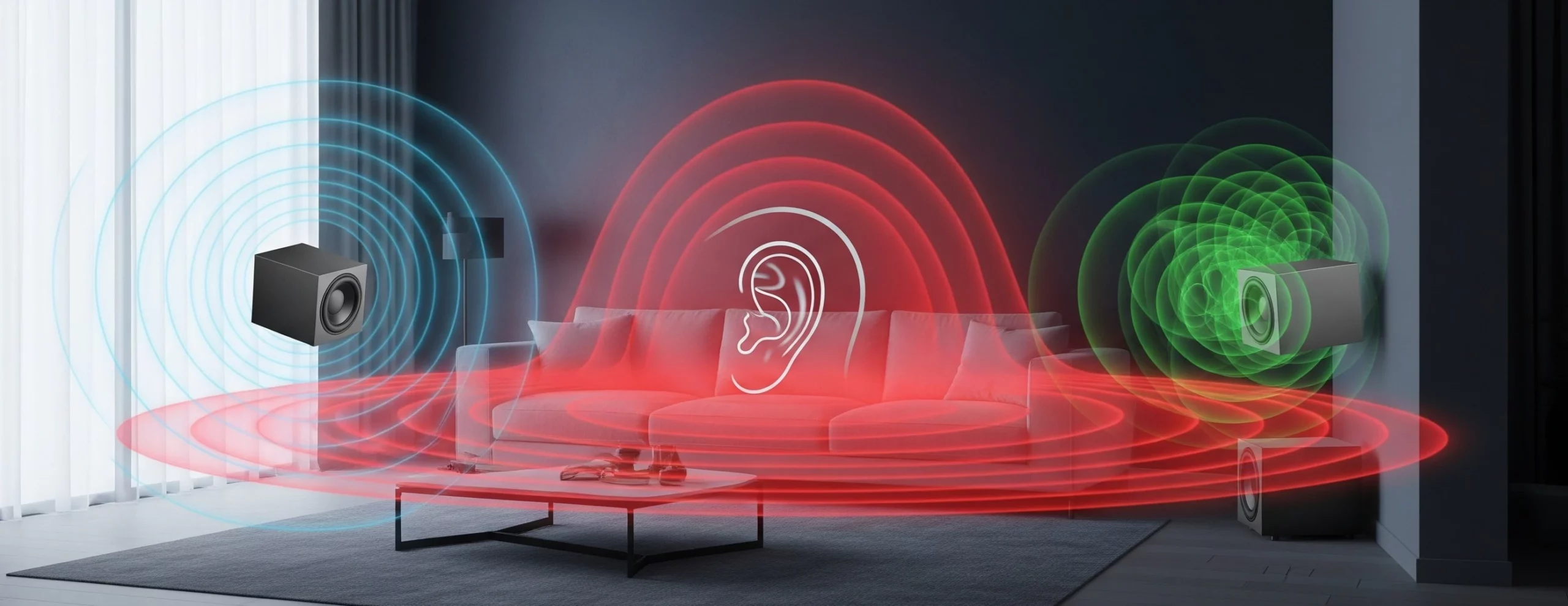
This is a common question among those setting up a sound system: Does the subwoofer’s location matter when it comes to perceiving where the bass is coming from? The standard explanation points to the THX standards for movie theaters in the early 1980s, which set a crossover frequency around 80 Hz. That figure became established as a practice for separating the main speakers from the subwoofer to reduce the leakage of directional signals toward the bass frequencies. However, when psychoacoustic tests and real-world room conditions are examined, the answer is that below a certain threshold, we cannot perceive the direction.
Quick Summary: Below 80 Hz, bass localization becomes virtually imperceptible. The best subwoofer placement depends on your room acoustics: place it along the front wall away from corners, or use the subwoofer crawl method (placing the sub on your couch and finding the spot on the floor with the cleanest bass response)
Experimental studies using pure tones under controlled conditions (including anechoic chambers) show that listeners are able to discriminate the direction of single-frequency signals up to about 60–70 Hz with angular resolutions on the order of 10°.
Below that band, localization based on a sustained tone becomes erratic; at 40–50 Hz, lateralization judgments tend to be random even when the sources are clearly separated in space. However, when the signal contains slightly more bandwidth—such as low-frequency noise in third-octave bands, or events with transients and harmonics—the brain has more cues to work with: the perception of laterality can persist much lower down, down to about 30 Hz under favorable conditions.
Where to put the subwoofer: the best position in a normal living room
If you want a starting point that works without measuring anything, this is it: the subwoofer on the front wall, either in line with your main speakers or shifted somewhat towards the centre, sitting on the floor and pulled twenty to thirty centimetres away from the wall. In most domestic living rooms that position gives balanced bass, without the artificial reinforcement of a corner or the loss of level you get by stranding it in the middle of the room.
When the room allows you to choose, the order of preference usually runs like this. First, the front wall offset to one side, avoiding the exact centre: the geometric centre of the wall coincides with the point where the room’s width mode reaches its maximum, and a subwoofer sitting there excites it with all its energy. Second, the side wall at roughly one third of the room’s length, which is one of the positions that distributes pressure most evenly between seats. Third, behind the listening position, which works better than popular belief suggests and which we cover further down. And last of all the corner, which delivers the most output and distributes it worst.
Two conditions do not depend on the room at all and are worth respecting every time. The first is the port: if your subwoofer vents at the rear, the minimum distance to the wall is set by that port rather than by how the room looks. Leave at least twice its diameter, which with a ten-centimetre port means twenty centimetres of clearance as a minimum. Any closer and the air leaves at too high a velocity, producing a chuffing noise that is easily mistaken for driver distortion. The second is the floor: a subwoofer benefits from floor boundary reinforcement, and lifting it off the ground loses that without gaining anything.
It is worth understanding why the corner is so tempting and such a bad idea at the same time. By loading the driver against three surfaces at once, it can add six to nine decibels of reinforcement, which instantly cures the feeling that a system lacks weight. The problem is that this reinforcement is not flat: it excites every one of the room’s modes simultaneously, and the result is that some notes boom, others disappear, and the difference between one seat and the next becomes enormous. You gain quantity and lose control.
Beyond this point no general rule holds, because the optimal position depends on your room’s dimensions, on where you sit and on what stands in between. What follows explains what physically happens to bass inside a closed room, why the ear behaves the way it does below 80 Hz, and how to find your own best position without guessing.
What mechanisms does the ear use to determine where the bass is coming from?
At low frequencies, where the head barely attenuates the sound, interaural level differences (ILD) lose their effectiveness as a directional cue. Instead, the auditory system relies on interaural time differences (ITD), which are derived from the fine temporal structure of the signal—the cycle-to-cycle oscillations within the audible band—and, in broadband signals, from the envelope.
Sensitivity to these fine-structure ITDs is surprisingly good in the range of a few hundred hertz; just noticeable differences (JNDs) can correspond to tens of microseconds. Even so, this mechanism degrades above approximately 1–1.5 kHz, when phase can no longer be tracked accurately, and is also compromised by reverberation and room modes.
In an actual room or space, standing waves and peaks and troughs in the frequency response affect the binaural signals reaching the ears, thereby reducing the reliability of bass localization even in frequency ranges where, in the absence of a room, detection would be possible. For this reason, subwoofer placement is not just a matter of directivity: it affects the frequency response, local peaks and dips, and how the listener perceives the overall mix.
Where to Place the Subwoofer: Practical Setup Guide
From a design perspective, the 80 Hz cutoff frequency adopted by many systems is not an absolute psychoacoustic limit, but rather an engineering compromise intended to reduce the directionality of bass from the subwoofer and minimize interaction with the room.
If the goal is for the low-frequency energy from the subwoofer to blend seamlessly with the main speakers, setting the crossover around 80 Hz is usually effective. However, for music playback—which features transients, harmonics, and a wide frequency range—the crossover frequency can be set lower; therefore, the choice of crossover frequency, physical placement, and acoustic treatment must be evaluated together.
For audiophiles and technicians, this means that the nature of the music, the size and geometry of the room, and the listening objective (spatial accuracy versus uniform volume) determine the decisions. In rooms with dominant low-frequency modes, a poorly placed subwoofer can complicate the perception of lateralization and muddy the mix; on the other hand, a well-calibrated array of subwoofers typically reduces nulls and distributes energy more effectively.
All things considered, the best location for the subwoofer depends more on the room and the type of signal.
It’s best to start by placing it in front of the main speakers, avoiding placing it directly in the corner as much as possible because, although the sound level increases there, it also tends to accentuate modes and produce muddy bass; moving it slightly toward the center of the front wall usually results in a more balanced response.
If you have two or more subwoofers, it’s best to space them out to average out the modes and reduce nulls; with a single subwoofer, use the “subwoofer crawl” method: place the subwoofer temporarily at your listening position (on the sofa or couch), play a bass sweep, and crawl around the room until you find the spot where the response is most uniform, then place the subwoofer in the closest symmetrical position.
Adjust the phase and crossover (60–80 Hz as a starting point) so that the subwoofer’s signal arrival time matches that of the speakers, and use measurements and equalization to smooth out peaks and dips at the listening position; This minimizes local cancellations and results in a more coherent and stable bass image.
The subwoofer crawl method, step by step
If you want to know how to find the best spot for your subwoofer without guessing, there’s a method installers have been using for decades called the subwoofer crawl: place the subwoofer on your seat, at ear level, play music with sustained bass, and crawl around the perimeter of the room. Wherever the bass sounds best, that’s where the subwoofer should go. The logic is simple: bass behaves the same in both directions, so the spot where you hear it best is the spot where the speaker will sound best.
The tedious part is comparing positions from memory, because by the time you get up and reach the next corner, you’ve already forgotten how the previous spot sounded. That’s why we created the subwoofer placement tool: the computer plays the bass tones, and your phone measures the level at each point, so at the end, you have a ranking with numbers instead of just an impression.
These measurements make more sense if you know what to expect, being able to calculate the room’s own modes, which explain why the bass accumulates in some areas and disappears in others.
The questions everyone asks about placement
Can I put the subwoofer behind the couch?
Yes, and in some rooms it is actually the best spot, whatever the usual advice says. The classic objection is that you would localise the bass, but below 80 Hz that does not happen with normal music content, so the real problem is different: pushed against the rear wall with your head half a metre away, you are sitting exactly where pressure builds up, and the bass turns heavy and uneven.
The condition for it to work is leaving 25 to 35 centimetres between the subwoofer and the wall, and not pressing it against the backrest. If you can also offset it sideways from the centre line of the sofa, better still: you reduce excitation of the room’s length mode.
What does rule this position out is running a crossover above 100 Hz or listening to a lot of melodic double bass, because there you would start hearing where it comes from.
What about putting it in a corner?
It is the position that delivers the most output and distributes it worst. A corner loads the subwoofer against three surfaces at once and can add 6 to 9 decibels of reinforcementsystem falls short. The price is that it excitesevery room mode simultaneously: some notes boom and others vanish, and the difference between seats grows enormously.
If there is nowhere else, pull it at least 15 to 20 centimetres away from each of the two walls rather than wedging it fully in, and trim its level two or three decibels below wh. It does not fix the problem, but it softens it.
How far from the wall should it be?
Between 20 and 30 centimetres as a general rule. bass gets artificially reinforced and definitionsuffers; too far out, in the middle of the room, you lose boundary reinforcement and need far more power for the same level.
There is one exception that matters: if the subwoofer has a rear port, the minimum distance is set by that port, not by aesthetics. Leave at least twice the port diameteith a 10-centimetre port, that means 20 centimetresminimum. Closer than that and the high-velocity air produces an audible chuffing that is easily mistaken for distortion.
On the floor or raised?
On the floor, with no practical exceptions. A subwoofer benefits from floor boundary reinforcement, and lifting it loses that without gaining anything. On top of that, most dond measured sitting on the floor.
If yours is a downward-firing design, with the drit is mandatory: that gap between cone and floor ispart of the design and raising it throws the whole thing off.
Feet and decouplers are a different matter. On floating wooden floors or in a flat, rubber isolators or a decoupling pad reduce the vibration you transmit into the structure, whthe neighbours without changing what you hear.
Can I tuck it under furniture or under the sofa
You can, and sometimes it is the only option the nditions. The first is leaving air: at least threeor four centimetres clear around and above, and never blocking the port or the driver. A subwoofer wedged in with no clearance turns the gap into a resonant box that reinforcesws others.
The second is that the furniture must not rattle.ood buzz or the glass tinkle, the problem is nolonger the subwoofer: it is everything around it, and that reads as distortion even when the driver is perfect.
Under the sofa works surprisingly well in small rooms, provided there is room to breathe and you cannot feel it buzzing under your feet.
Useful terms for understanding the above
The term JND refers to the smallest change that a listener can reliably perceive in a sound quantity—whether it be level, frequency, or time—and is used to quantify discrimination thresholds.
ILDs are the level differences between the two ears caused by the acoustic head shadow, which are more pronounced at high frequencies than at low frequencies. The “head shadow” describes this reduction in level on the side opposite the sound source: its effect increases when the wavelength is small relative to the size of the head.
Finally, “temporal fine structure” refers to rapid oscillations in the signal within an auditory filter; the nervous system uses them to extract phase and time differences at low frequencies.