

A room under about 160 sq ft (15 m²) can take five speakers and a subwoofer, as long as the surrounds sit beside the couch and the sub is placed and tuned for the handful of bass modes the room has. With the couch against the back wall, the surrounds go on the side walls, 90° to 100° from the TV, 1 to 2 ft (30 to 60 cm) above ear level (1 ft at most if you’re going Dolby Atmos), with their real distance entered in the receiver. What doesn’t fit is 7.1 and, nearly always, 5.1.4. If there’s no way to run wire to the sides, a soundbar with wireless rears or a good 3.1 will give you better surround sound in a small room than a half-installed 5.1.
Below are the numbers behind that. We worked out how far the surrounds fall out of balance when you change seats, depending on where they go, and how many bass modes a 151 sq ft room has next to a 315 sq ft one, using the same engine that powers our room acoustics calculator. The placement rules come from the ITU-R BS.775 recommendation and Dolby’s Atmos installation guidelines, and where Google’s AI Overview strays from them, we point it out.
Which system to pick for surround sound in a small room
It comes down to where the surrounds fit. With 110 to 160 sq ft (10 to 15 m²) and room on the side walls to put them 4.5 ft (1.4 m) or more from your head, which a 10 ft (3 m) wide room allows, a 5.1 sat/sub system sounds best. If they would end up closer than about 3 ft (1 m), a 3.1 or a soundbar that virtualizes the sides is the better call, and if the problem is the wiring, a soundbar with wireless rears. The table sums it up by room size and by what the room lets you do.
| Your room | Couch away from the wall | Couch against the back wall | Can’t run speaker wire |
|---|---|---|---|
| Up to 110 sq ft (10 m²), bedroom or den | 3.1, or 5.1 if the surrounds land 4.5 ft (1.4 m) from you | Soundbar, 2.1 or 3.1, plus headphones at night | Soundbar with wireless rears |
| 110 to 160 sq ft (10 to 15 m²), small living room | 5.1 sat/sub system | 5.1 with the surrounds on the side walls | Soundbar with wireless rears |
| 160 to 270 sq ft (15 to 25 m²), mid-size living room | 5.1.2 or 5.1.4 | 5.1 or 5.1.2 with side-wall surrounds | Dolby Atmos soundbar with rears |
Is a 5.1 system worth it in a small room?
Yes, if the surrounds fit on the side walls, 4.5 ft (1.4 m) or more from your head. The first thing you notice with a 5.1 in a small room is the center channel, which pins dialogue to the screen even from the end of the couch, something a stereo pair of separate speakers can’t do. You don’t need much power either. With the fronts 10.8 ft (3.3 m) away, as in the room in the figure below, and 87 dB speakers, about 35 W per channel covers normal listening with 95 dB peaks, by the rule in our guide to how many watts per channel your room needs, and room reflections add some headroom on top. Dolby’s home theater guide suggests 50 to 100 W per channel for rooms under 200 sq ft, a figure with room to spare for louder listening.
In our view, what doesn’t pay off is stretching the budget for more channels. In a small room, the money goes further on a good center speaker and a well-placed sub than on two extra boxes.
When a 3.1 or a soundbar beats a 5.1
When the surrounds would end up less than 3 ft (1 m) from your head, hung on the wall behind the couch at ear level or standing next to the armrests. Whoever sits at the end then hears mostly the surround next to them, arriving 9 dB louder than the other one, close to twice as loud. A 3.1 (left, center, right and sub) gives up the rear effects but keeps the image up front and the dialogue clean for the whole couch. A virtualizing soundbar, for its part, fills in the sides by bouncing sound off the walls.
Soundbar vs 5.1 when space is tight
A 5.1 separates effects better and places them more precisely. A soundbar wins on simplicity and, in our experience, holds up better in a small enclosed room than in an open-plan one. The walls are the reason. Many soundbars build the side channels by bouncing beams of sound off them, and Yamaha already warned in the FAQ for its first Digital Sound Projector that it’s designed for a room with walls or hard surfaces for the beams to bounce off, and that conventional virtual surround has a small sweet spot. With the walls 5 ft (1.5 m) away, the bounce arrives early and strong, while in an open-plan room missing one side wall, the bar loses half its trick. The same Dolby guide suggests a guest bedroom with a good TV and a soundbar as a compact home theater.
If you go the soundbar route, pick one that measures the room with a microphone. The Sennheiser AMBEO Soundbar Mini, for example, calibrates with four mics and virtualizes 7.1.4 from six drivers with no rear speakers, as we covered in our Sennheiser AMBEO Soundbar Mini review. If you want to keep the door open to real rears, choose a bar that supports them, such as Samsung models that work with its SWA-9500S wireless rear speaker kit or Sony bars that take its SA-RS5 rear speakers. And if the bar is going into a TV-stand cubby, check what happens to a soundbar in a cabinet first, because that cubby can cost it more than the size of the room.
What 5.1 means on a soundbar
It means the bar processes five channels plus a bass channel. How many drivers play them, and where they sit, depends on the model. On a virtual 5.1 bar, the rear channels come out of the bar itself, bounced off the walls or simulated with filters that mimic how sound reaches each ear. On a 5.1 bar with rears, two small boxes beside the couch play those channels for real. Wireless rears skip the audio cable, battery-powered ones skip the power cord too, and all of them pair only with bars from the same brand.
Spatial audio headphones for tiny rooms and late nights
In a very small room, or when you don’t want to wake anyone, headphones with spatial audio wrap around you better than any soundbar. With an Apple TV 4K and compatible headphones (AirPods 3, 4, Pro and Max, or Beats Fit Pro, Studio Pro and Solo 4), spatial audio on Apple TV 4K can track your head so the sound seems to stay put in the room. On a Windows PC, Dolby sells Dolby Atmos for Headphones in the Microsoft Store. They won’t replace speakers for movie night with friends, but in a 100 sq ft bedroom at 1 a.m. they’re the most practical option.
Where to put rear speakers with the couch against the wall
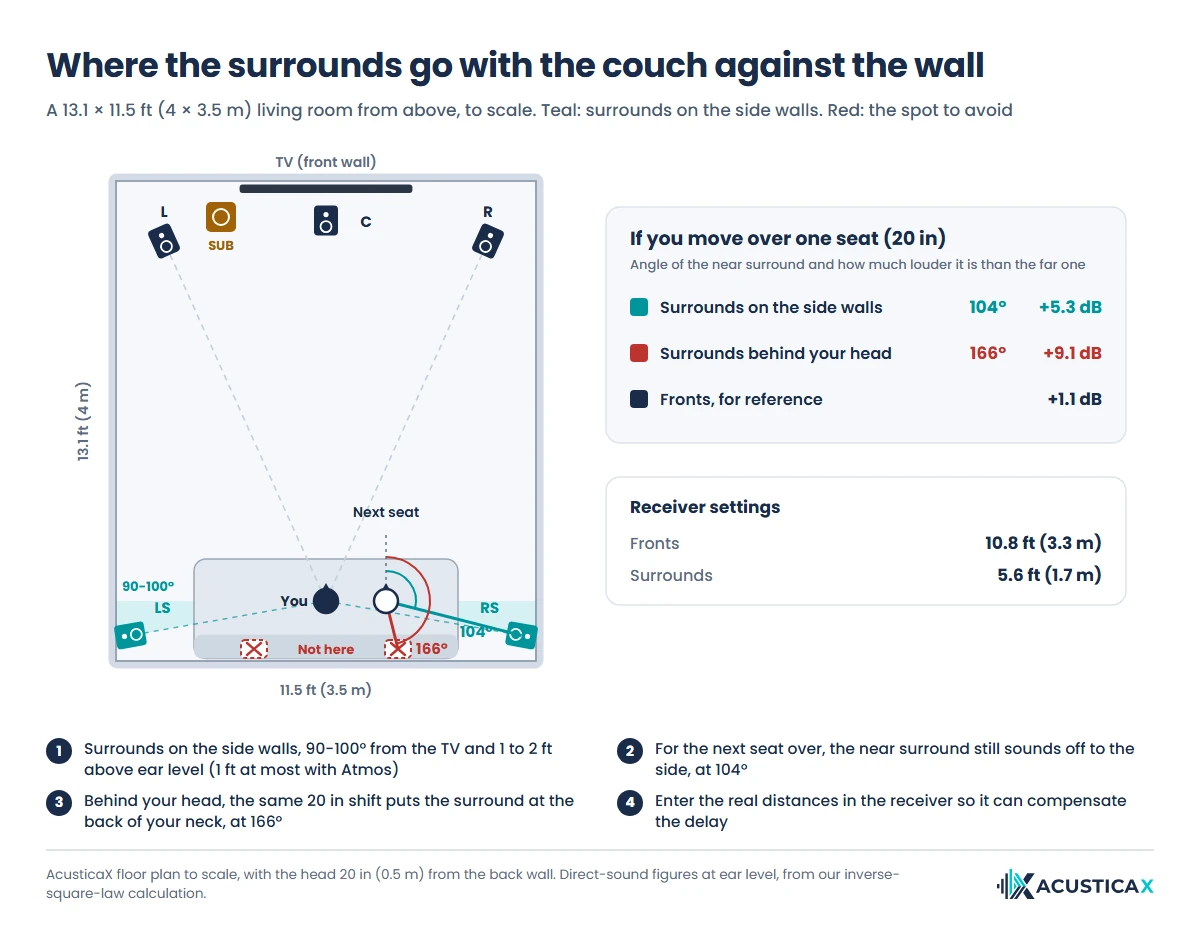
On the side walls, in line with your head or slightly behind it, 90° to 100° from the TV, raised 1 to 2 ft (30 to 60 cm) above ear level and aimed at the middle of the couch. The ITU-R BS.775 recommendation, the one that sets 5.1 angles, puts the surrounds between 100° and 120° and notes that precise location is not necessary. With your head about 20 in (0.5 m) from the back wall, in an 11.5 ft (3.5 m) wide room anything past roughly 102° would land inside the wall, so 90° to 100° is the realistic target, a little ahead of what the recommendation asks for but far better than behind your head. For a 5.1 with the couch pulled away from the wall, the full angles are in our guide to 5.1 speaker placement with distances and angles.
Height has a ceiling if you’re going Dolby Atmos. Dolby’s installation guidelines put the listener-level speakers at 3.9 ft (1.2 m), seated ear height, and ask that the surrounds sit no higher than 1.25 times the height of the fronts. With the fronts at that height, the limit is about 5 ft (1.5 m) off the floor, roughly 1 ft above ear level, and with the fronts on a TV stand at 3.3 ft (1 m), it drops to 4.1 ft (1.25 m). Some guides, and the Google AI Overview that sums them up (checked in October 2026), suggest 2 to 3 ft above ear level without asking whether Atmos is in the plan.
Why behind your head doesn’t work
Because as soon as someone moves over a seat, the surround closest to them ends up right behind their head. We ran the numbers for a 13.1 × 11.5 ft (4 × 3.5 m) room, with the listener’s head 20 in (0.5 m) from the back wall, shifting 20 in (50 cm) and counting direct sound only.
| Where they go | Distance to your head | At ear level | Raised 2 ft (60 cm) | Where the near surround ends up |
|---|---|---|---|---|
| Fronts by the TV | 10.8 ft (3.3 m) | 1.1 dB | – | – |
| Side walls, 11.5 ft (3.5 m) wide room | 5.6 ft (1.7 m) | 5.3 dB | 4.6 dB | Off to the side, at 104° |
| Side walls, 9.8 ft (3 m) wide room | 4.6 ft (1.4 m) | 6.3 dB | 5.2 dB | Off to the side, at 105° |
| On stands by the armrests | 3.3 ft (1 m) | 9.5 dB | 6.3 dB | At your ear, 90° and 20 in (0.5 m) away |
| On the wall behind your head | 2.3 ft (0.7 m) | 9.1 dB | 5.1 dB | Behind your head, at 166° |
At ear level, surrounds hugging the couch or the back wall swing 9 dB when you change seats, against 1.1 dB for the fronts. Raising them 2 ft (60 cm) brings them close to the 5 dB of the side walls, but it doesn’t fix the angle, because the near surround still sits at 166°, practically behind your head. On the side walls it stays off to the side, at 104°, which is where a surround belongs. The 2.2 to 2.9 ms gap between the two surrounds is past the millisecond or so at which the ear locks onto whichever speaker arrives first (the precedence effect), so the person in the next seat mostly hears their own.
The ITU recommendation also asks that surrounds sit no closer to you than the fronts unless the delay is compensated. That’s what the receiver does when you enter the real distances, about 10.8 ft (3.3 m) to the fronts and 5.6 ft (1.7 m) to the surrounds in this room. Those distances set the timing at the center seat, the levels get matched separately, and for the side seats placement is what counts.
Dipole or bipole surrounds?
Either one helps in a classic 5.1, and with Dolby Atmos it’s best to skip both. A dipole or bipole fires forward and backward at once, so the sound arrives more diffuse and the box is harder to pin down, which is exactly what a close-in surround needs. Dolby’s Atmos home theater installation guidelines (the December 2018 edition, in the copy hosted by Display Daily) state that dipole surround speakers are not recommended for Dolby Atmos playback, which makes sense for a format that moves specific sounds from one speaker to the next, and by the same logic we’d leave out bipoles too. If you plan to make the jump, two regular speakers, raised just enough and well aimed, are the better buy.
The subwoofer is the real problem in a small room
In a small room, bass gives you more trouble than the surrounds. There are few modes and they’re spread far apart, so bass level rises and falls depending on where you sit, and with the couch against the back wall your head ends up near the pressure peak of the lowest length modes (43 and 86 Hz in a 13 ft room). A 13.1 × 11.5 ft (4 × 3.5 m) room with an 8.2 ft (2.5 m) ceiling has 13 modes below 120 Hz, and a 21.3 × 14.8 ft (6.5 × 4.5 m) one has twice as many.
| Room | Area | Volume | First axial mode | Modes up to 120 Hz | Modes up to 200 Hz | Schroeder frequency |
|---|---|---|---|---|---|---|
| Bedroom, 11.5 × 9.8 ft (3.5 × 3 m) | 113 sq ft (10.5 m²) | 927 cu ft (26 m³) | 49 Hz | 11 | 37 | 245 Hz |
| Small living room, 13.1 × 11.5 ft (4 × 3.5 m) | 151 sq ft (14 m²) | 1,236 cu ft (35 m³) | 43 Hz | 13 | 47 | 222 Hz |
| Living room, 14.8 × 11.5 ft (4.5 × 3.5 m) | 170 sq ft (15.8 m²) | 1,391 cu ft (39 m³) | 38 Hz | 15 | 52 | 212 Hz |
| Mid-size living room, 16.4 × 13.1 ft (5 × 4 m) | 215 sq ft (20 m²) | 1,836 cu ft (52 m³) | 34 Hz | 18 | 68 | 193 Hz |
| Large living room, 21.3 × 14.8 ft (6.5 × 4.5 m) | 315 sq ft (29.3 m²) | 2,686 cu ft (76 m³) | 26 Hz | 26 | 95 | 167 Hz |
The last column is the key one. Below the Schroeder frequency, bass behaves as individual modes, and in a 151 sq ft room that boundary reaches about 220 Hz, against 167 Hz in a 315 sq ft one. That range swallows the sub crossover (80 to 120 Hz) and the lower end of a male voice, so in a small room the sub and its settings matter more than adding speakers.
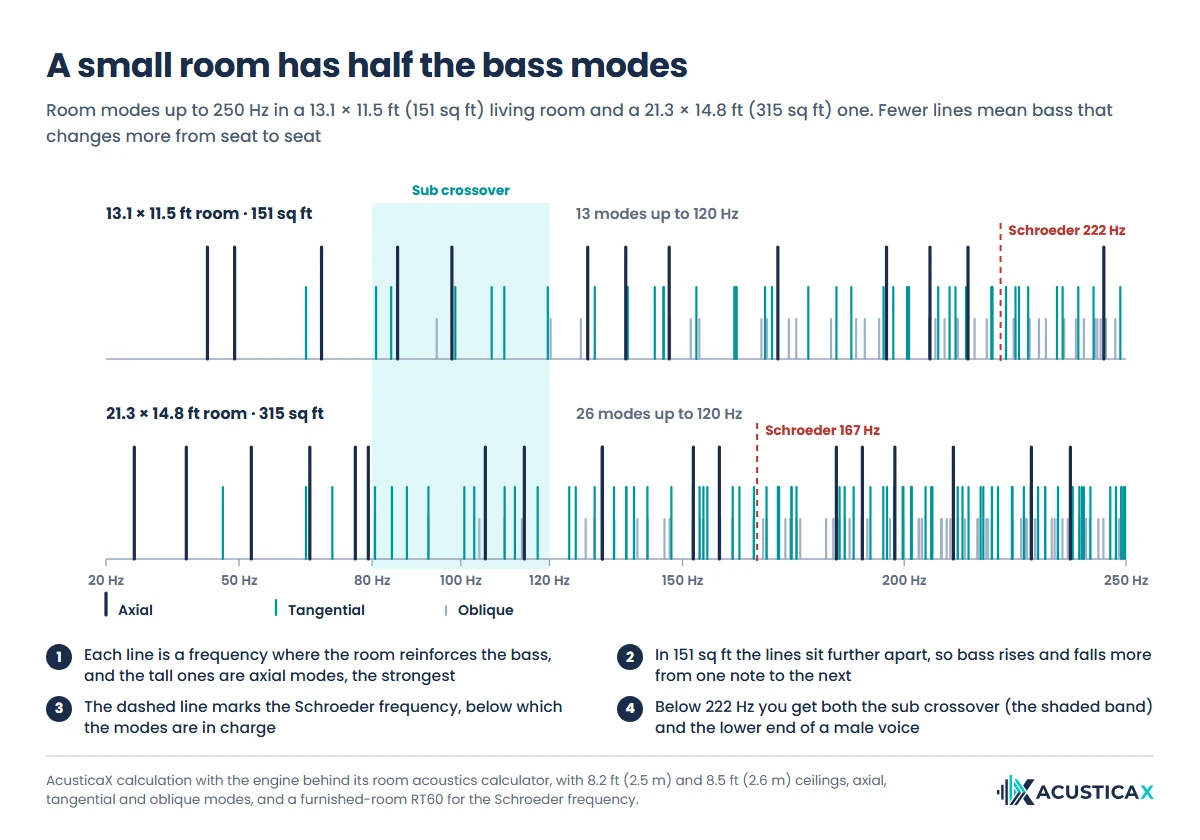
That’s why, with the couch against the wall, those low notes sound louder at your seat than in the middle of the room. If the bass sounds bloated when you sit down, turn the sub down before touching anything else. Our room acoustics calculator gives you the modes for your dimensions, and with its couch-against-the-wall checkbox it lays out the fronts and surrounds, with their distances for the receiver and the notes that pile up at your seat. It works out the balance with the surrounds 18 in (45 cm) above ear level, halfway between the two columns of the table above.
Where to put it, and how many
Start on the front wall, a quarter of the way across, and find the final spot with the subwoofer crawl. Put the sub on your seat, play bass and crawl around the room, because wherever it sounds best is where the sub goes. Our tool to find the best subwoofer spot with your phone does it by measuring, and our guide on where to put a subwoofer explains why a corner gives more output but excites every mode.
If a second sub fits, Todd Welti’s study for Harman found that two subs at the midpoints of opposite walls come close to what four achieve and give much more even bass from seat to seat than one, and the result held in five rooms with different proportions. With the couch against the back wall, the practical spots are the midpoints of the two side walls. Bear in mind that Welti simulated seats in the middle of the room or slightly back, not up against the wall, so measure the result. Dolby’s basic placement guide, by contrast, only brings up a second sub for large spaces.
Reflections and treatment without turning the room into a studio
A rug between the TV and the couch, heavy curtains on any side windows and, if you want to go further, two 2 in (5 cm) panels at the first reflection points on the side walls and one behind your head are all it takes. In an 11.5 ft (3.5 m) wide room, the left front’s bounce off its wall reaches you 1.2 ms after the direct sound and, if the speaker radiated as strongly in that direction, only 1 dB quieter. Some people like to keep that reflection for the width it adds, but if dialogue sounds smeared, a panel at that spot fixes it.
Our calculator puts a furnished 151 sq ft room at an RT60 of about 0.4 s, within the 0.3 to 0.5 s range for a living room that doubles as a home theater. No thin panel tames bass, because a 2 in (5 cm) panel absorbs well from 250 Hz up but never reaches the 43, 86 and 129 Hz modes of a 13 ft (4 m) long room. That takes traps 8 in (20 cm) thick or more, as we explain in our guide to home theater acoustic treatment. Before buying anything, you can measure your room acoustics with a microphone and see whether the problem is reverb or a mode.
Calibrate the receiver with your seat in mind
Enter the real distance from each speaker to your head, match the levels and set the satellites to Small with an 80 Hz crossover, or 100 to 120 Hz if they’re tiny. In a small room it also pays to use a target curve with less treble roll-off than a cinema’s. The 2015 edition of Dolby’s Atmos installation guidelines allows rooms under 4,400 cu ft (125 m³) to ease the slope above 2 kHz to 1.5 dB per octave, instead of the 3 dB of a large room, or to move the knee up to 4 or 8 kHz, and a 151 sq ft room holds about 1,240 cu ft.
The step-by-step process, with or without the brand’s mic, is in our guide on how to calibrate an AV receiver step by step. To check that each channel comes out of the right speaker, run our channel-by-channel surround sound test. If you live in an apartment, the receiver’s night mode or dynamic range compression tames explosions without touching dialogue, which does more for keeping the peace than any panel.
Dolby Atmos in a small room tops out at 5.1.2
In a small room, stop at 5.1.2, with the two height speakers in the ceiling or, if they’re up-firing modules, on top of the fronts. Dolby wants up-firing modules no higher than half the height of the wall, about 4.1 ft (1.25 m) with an 8.2 ft (2.5 m) ceiling, and at least 3 ft (0.9 m) from the seats, ideally 5 ft (1.5 m). On top of raised surrounds they sit above that height, and for whoever is at the end of the couch they end up closer than 5 ft. Dolby also wants a flat, reflective ceiling, ideally 7.5 to 12 ft (2.3 to 3.66 m) high.
More channels don’t fit with the couch against the wall. A 7.1 adds two rear surrounds that go behind you, and a 5.1.4 adds two ceiling speakers behind your head, where there’s only 20 in (0.5 m) left before the wall. With an 8.2 ft (2.5 m) ceiling, even flush against that wall they’d sit at 69° of elevation, almost overhead, and Dolby wants them at 45° (30° to 55°). Getting them down to 55° takes at least 3 ft (0.9 m) between your head and the wall. Even a 5.x.2 is a squeeze, because a What Hi-Fi? writer couldn’t fit a 5.2.2 into a typical British living room of about 184 sq ft (17 m²) without leaving the surrounds less than 4 in (10 cm) from the wall. How many height speakers each room calls for, and which kind, is covered in our guide to how many speakers you need for Dolby Atmos.
Frequently asked questions
What is the best surround system for a small room?
A 5.1 sat/sub system with the surrounds on the side walls and a compact, well-placed sub, as long as the surrounds can sit 4.5 ft (1.4 m) from your head. If they’d end up closer, a 3.1 or a soundbar that virtualizes the sides. If the problem is the wiring, a soundbar with wireless rears, and for one person or late at night, spatial audio headphones.
Is 7.1 worth it in a small room?
No. The two channels a 7.1 adds are rear surrounds that go behind you, and with the couch against the wall there’s no room back there. That money does more as a better center speaker, a second sub or two height speakers for a 5.1.2.
What size subwoofer is best for a small room?
A compact 8 to 10 in sealed sub is usually enough, in our view. A small, closed room boosts the deepest bass on its own (room gain) below the frequency whose half wavelength matches its longest dimension. SVS figures 7 to 9 dB extra one octave down in a room 16 ft (4.9 m) long, although open doorways and thin walls reduce the effect. A bigger sub mainly buys headroom you’ll hardly use in a room of about 150 sq ft (14 m²).
How far should rear ported speakers be from the wall?
At least 16 in (40 cm), and a bit more than front-ported models, because a port close to the wall thickens the bass. If there’s no room, use the foam plug when the maker supplies one. In a small room, pull the fronts away from the wall rather than pushing them into the corners. Wall-mounted side surrounds are fine, since with an 80 Hz crossover they don’t have to make bass.
Are wireless rear speakers worth it?
In a small room, yes, because they solve the hardest part, running audio cable to the sides of the couch. In return they need an outlet or a battery, only pair with a soundbar from the same brand, and still belong in the same place, beside the couch.
How do I keep my subwoofer from bothering the neighbors?
Turn it down, move it away from any shared wall and use the receiver’s night mode. Bass travels through walls and floors far more easily than treble. A platform or rubber feet cut the vibration going into the floor, although the sound traveling through the air gets through just the same. With the couch against the wall you already get extra bass at your seat, so you can turn the sub down without losing punch.
Can a soundbar give real surround in a small room?
It gets closer than in an open-plan room. A bar that bounces sound off the side walls works best in a small, enclosed, symmetrical room, and one with wireless rears gives you true surround. What no bar can fake is a sound coming from right behind you with the precision of a real speaker there.
