
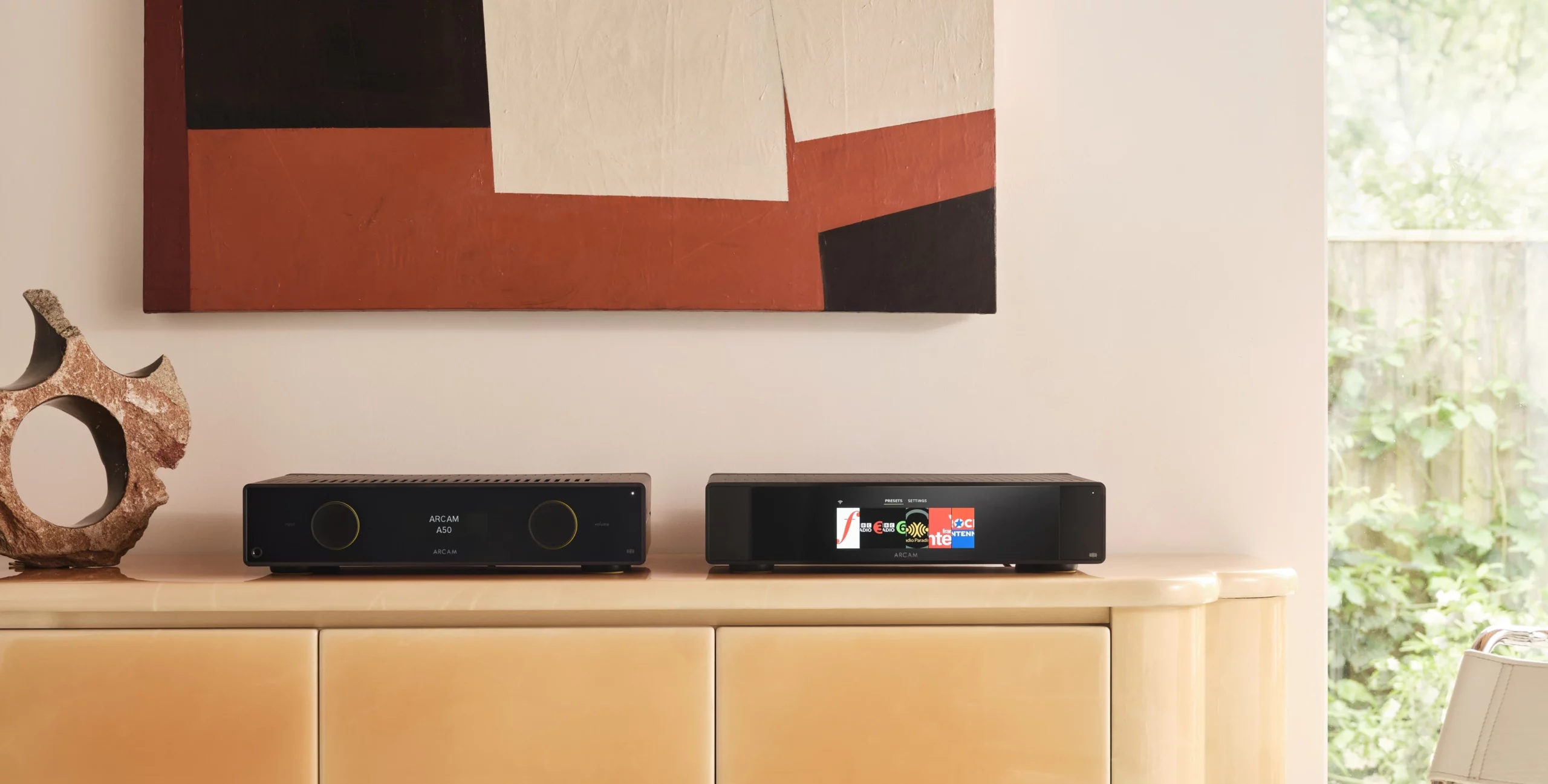
The Arcam A50 Signature is the integrated amplifier Arcam built for its 50th anniversary. It delivers 150 watts per channel into 8 ohms, it’s Arcam’s first dual-mono Class G integrated amp, and it packs an MM and MC phono stage, an ESS DAC, HDMI eARC and two-way Bluetooth. It costs £2,499 in the UK, €2,799 in Europe (MSRP) and $2,999.95 in the US. Arcam unveiled it at HIGH END Vienna in June, and UK dealers such as Richer Sounds and Sevenoaks Sound and Vision list it now.
The launch material tells you what’s inside. Here we look at what each feature means in a living room: how loud those 150 watts really get with your speakers, what you have to change on your TV for HDMI to work, which phones get lossless Bluetooth, and which headphones the headphone output can drive. The figures come from Arcam’s spec sheet and owner’s manual, checked in October 2026, and the math is ours.
Arcam A50 Signature specs at a glance
What sets it apart on paper is the power amp, with each channel built as a separate amplifier, and the range of inputs, from a turntable to a computer and a TV. There’s no Wi-Fi or built-in streaming. For that, Arcam points you to its own ST25 streamer, plugged into one of the inputs.
| Spec | Arcam A50 Signature |
|---|---|
| Continuous power, both channels driven | 150 W per channel into 8 Ω (20 Hz to 20 kHz, 0.5% THD) and 220 W into 4 Ω (at 1 kHz) |
| Distortion | 0.002% at 80% power, 8 Ω, 1 kHz |
| Signal-to-noise ratio | 106 dB on the analog inputs and 109 or 110 dB on the digital ones, depending on the document (A-weighted, referenced to 50 W) |
| Analog inputs | 3 RCA pairs, 1 balanced XLR pair, MM and MC phono |
| Digital inputs | HDMI eARC, USB-C (up to 384 kHz and 32-bit), 1 optical and 2 coaxial (up to 192 kHz) |
| DAC | ESS ES9039Q2M, with five selectable digital filters |
| Wireless | Bluetooth 5.4 in and out (SBC, AAC, aptX, aptX HD, aptX Lossless, LE Audio) and Auracast |
| Outputs | Speakers, full-range pre-amp (for a power amp or a powered subwoofer) and a 6.3 mm headphone jack |
| Power consumption | 700 W maximum, under 0.5 W in standby |
| Size and weight | 431 × 344 × 99 mm (17 × 13.5 × 3.9 in), 12 kg (26.5 lb) |
What is a Class G amplifier, and what does it gain over Class AB?
It’s a Class AB amp with two supply voltages instead of one. While the music plays at modest levels, which is most of the time, the output stage runs on the lower rail. When a peak arrives, a circuit Arcam calls the “lifter” switches to the higher one. The payoff is less heat. In Class AB, every volt the signal doesn’t use drops across the output transistors and turns into heat, and with the supply always at maximum that wasted band is huge in quiet passages. Class G trims it, because most of the time it runs on the lower rail.
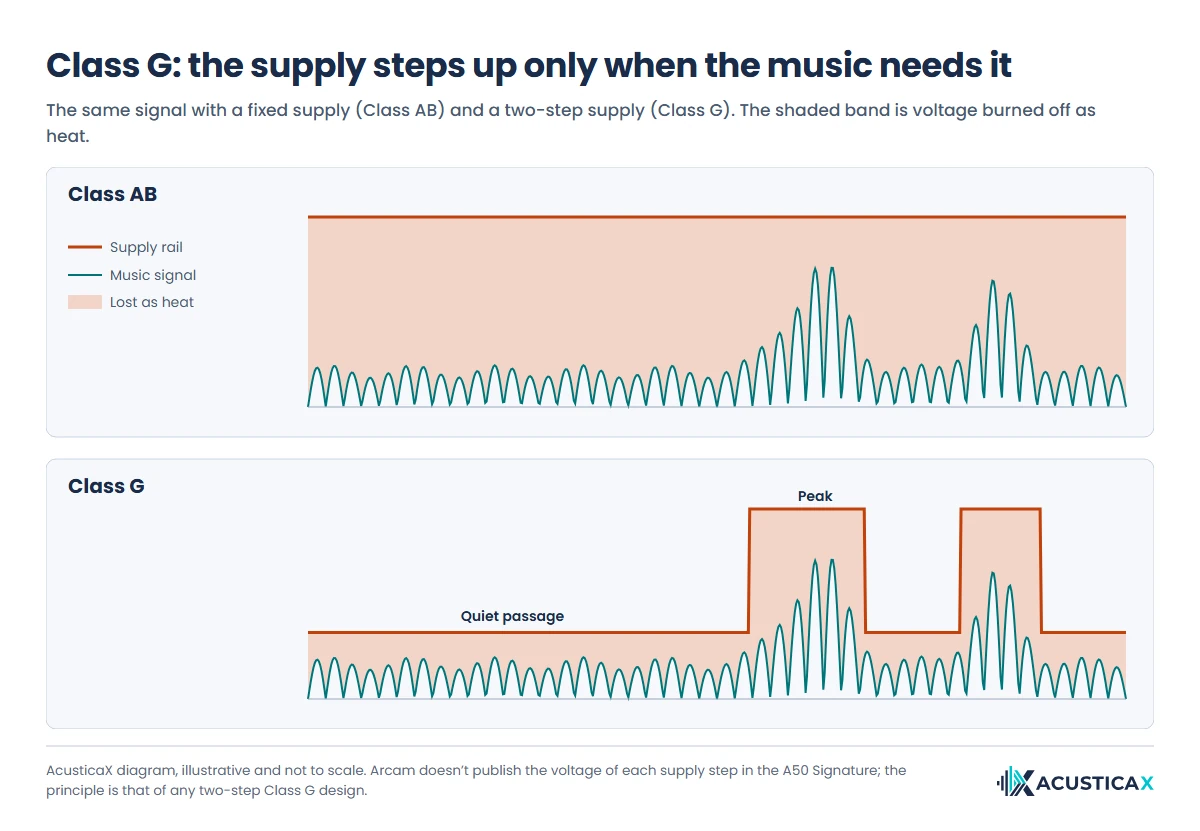
Compared with Class D, which switches at hundreds of kilohertz and wastes far less, Class G keeps the linear output stage of Class AB. Arcam has been building Class G amps for nearly two decades, according to its spec sheet, and the A50 Signature is its most complete take on it. With no rail voltages in the spec sheet, there’s no way to work out how much it saves over an equivalent Class AB amp. In practice it should show up as an amp that runs cooler at normal listening levels, something we’d check if we get one to test.
Dual mono, one amplifier per channel
Each channel has its own circuit board, output stage, voltage regulation, reservoir capacitors and Class G lifter. The power supply sits in the middle of the chassis, with separate transformer windings for each side. That way a big peak on one channel steals far less current from the other, and crosstalk between channels drops. Arcam carries the idea through to the back panel, with each pair of speaker terminals at opposite ends. There’s no channel separation figure in the spec sheet, which is the number that would prove the point.
Is 150 watts per channel enough? What it means with your speakers
For almost any living room, yes. With speakers rated at 87 dB and the couch 10 feet (3 m) away, 150 watts per channel delivers peaks of about 102 dB with both speakers playing, before any help from the room. Listening loud, with 95 dB peaks, takes about 28 watts. Keep in mind that 150 watts against 100 is only 1.8 dB more, a difference you’ll barely hear. Watts matter most with low-sensitivity speakers or a seat far from them.
| Speaker sensitivity | Peaks at 10 ft (3 m) with 150 W | Peaks at 13 ft (4 m) with 150 W | With 100 W, at 10 ft |
|---|---|---|---|
| 84 dB | 99.2 dB | 96.7 dB | 97.5 dB |
| 87 dB | 102.2 dB | 99.7 dB | 100.5 dB |
| 90 dB | 105.2 dB | 102.7 dB | 103.5 dB |
The 220 watts into 4 ohms also tell you the supply holds up when impedance dips, which plenty of floorstanders demand. For the number that fits your speakers, your distance and the music you play, the speaker wattage calculator for your room shows how many watts they need, how much headroom a 150-watt amp leaves and how much the speaker wire costs you.
A phono stage for MM and MC cartridges
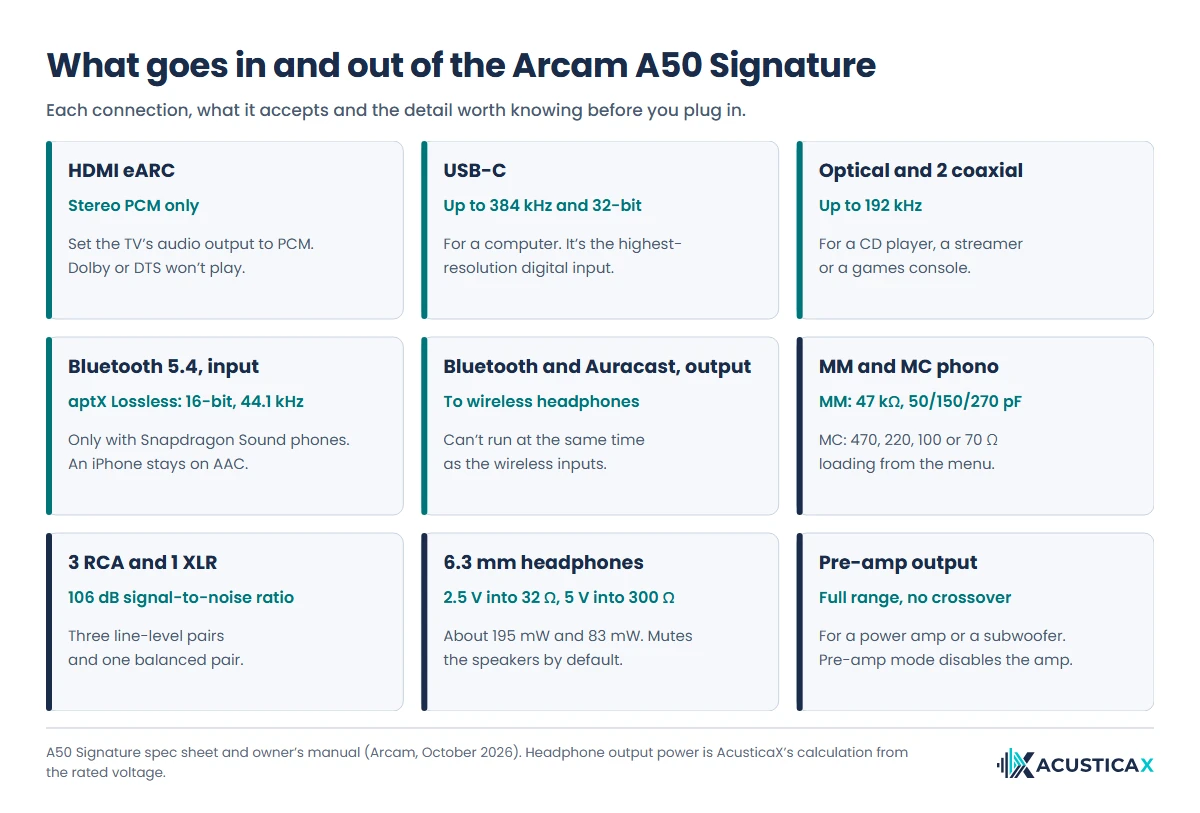
The phono stage runs in Class A and has a separate input for each cartridge type, with loading set from the menu. According to the manual, the MM input is 47 kΩ with a choice of 50, 150 or 270 pF (50 pF by default; the spec sheet lists a fixed 100 pF), and the MC input offers 470, 220, 100 or 70 Ω (470 by default). That covers most MM and low-output MC cartridges; high-output MCs, around 2 mV, go into the MM input. An MM cartridge typically puts out around 5 mV and an MC between 0.2 and 0.5 mV, so the MC input needs 20 to 28 dB more gain. The spec sheet gives no gain or noise figure for the phono stage, only its response, which follows the RIAA curve within ±1 dB.
If you’re buying a cartridge for it, see how to choose between an MM and an MC cartridge. And before spending £2,499 with vinyl in mind, remember what eight lab-measured turntables showed: what to upgrade before the turntable, where the phono stage comes after setup and the stylus.
HDMI eARC for the TV, stereo PCM only
HDMI eARC lets the TV play through your hi-fi speakers, and the amp switches on and changes input on its own when the TV starts playing. But the manual warns that its digital inputs, HDMI and USB-C included, “only support stereo (PCM) audio,” with no multichannel or encoded audio of any kind. It doesn’t decode Dolby Digital, Dolby Atmos or DTS. Over eARC the TV usually reads what the amp accepts and sends PCM on its own, but if it insists on another format, expect silence. The fix is to set the TV’s digital audio output to two-channel PCM.
With that, a 5.1 movie reaches the amp mixed down to two channels by the TV itself, which is what you’d expect from a stereo amp. If an update sets the output to Auto or Bitstream and the sound drops, switch it back to PCM. In our guide on what to check on the TV when eARC goes silent, yours is the TV-to-stereo-amp case, not the AV receiver one. The manual doesn’t list an audio delay setting either, so if voices drift out of sync with lips, fix it from the TV.
Lossless Bluetooth, but not with every phone
The A50 Signature supports aptX Lossless, Qualcomm’s lossless Bluetooth, which Qualcomm says reaches CD quality, 16-bit and 44.1 kHz. It only works with Android phones that support Snapdragon Sound and aptX Lossless. An iPhone connects over AAC, which is compressed. With other Android phones, it comes down to which aptX codecs they carry. Bluetooth works the other way too: the amp can send its sound to wireless headphones, or broadcast it over Auracast so several people can listen at once. The wireless output can’t be used while a Bluetooth or Auracast input is selected, though.
One handy detail from the manual: for the Bluetooth input, the amp caps the volume at level 40 on its scale out of the box, so turning up your phone doesn’t blast the room. You can change it in the Bluetooth settings.
Headphones: 2.5 V into 32 ohms, 5 V into 300 ohms
The 6.3 mm headphone jack delivers up to 2.5 V into 32-ohm headphones and 5 V into 300-ohm ones, about 195 mW and 83 mW, and handles loads from 16 to 2,000 ohms. That’s enough for nearly any dynamic headphone, high-impedance models included. With a 300-ohm pair rated at 97 dB per volt, 5 V gives peaks of about 111 dB. Low-sensitivity planar magnetics are the ones that could run short. Plugging in mutes the speakers, though you can change that in the menu. To check your own pair, the headphone amplifier calculator tells you how much voltage it needs.
The ES9039Q2M DAC and its five filters
The converter is an ESS ES9039Q2M running fully differential, with its own ESS reference voltage regulator. From the menu you choose among five digital filters: apodizing (the default), minimum phase fast and slow, and linear phase fast and slow. Fast filters hold the level up to 20 kHz at the cost of more ringing, and slow ones roll off the very top a little in exchange for less. The differences sit mostly above 20 kHz, where almost nobody hears, so the sensible move is to try them with your usual music and keep the one you like. With 109 to 110 dB of signal-to-noise referenced to 50 W, the noise lands below 0 dB SPL at the couch with typical speakers, far under the background noise of any living room.
What we’d want to check in a review
- How it handles demanding 4-ohm speakers at high volume, by ear and with our sound level meter.
- Case temperature and power draw at the wall with music at normal levels, using a thermometer and a power meter, where Class G should make a difference.
- Phono stage background noise on MM and MC, with the volume up and the stylus raised.
- HDMI and Bluetooth latency, to know whether voices stay in sync with the picture.
- The real headphone output voltage, with a multimeter, and its level with 32-ohm and 300-ohm pairs.
Frequently asked questions
How much is the Arcam A50 Signature, and where can I buy it?
It’s £2,499 in the UK, €2,799 in the eurozone and $2,999.95 in the US, sold through authorized Arcam dealers. In the UK, Richer Sounds and Sevenoaks Sound and Vision both list it.
Does the Arcam A50 Signature have streaming or Wi-Fi?
No. It takes music over Bluetooth, over USB-C from a computer and through its digital and analog inputs. For Wi-Fi streaming you add a streamer, such as Arcam’s own ST25.
Can I connect it to my TV and get Dolby Atmos?
It connects to the TV over HDMI eARC, but it only accepts stereo PCM. It doesn’t decode Dolby or DTS, so the TV has to send PCM. A 5.1 movie plays mixed down to two channels.
Do I need a separate phono preamp for my turntable?
No. It has a Class A phono stage with inputs for both MM and MC cartridges, and the loading for each is set from the menu.
What’s the difference between Class G and Class AB?
Class G is Class AB with two supply voltages. It runs on the lower one most of the time and steps up to the higher one on peaks, so it wastes less energy as heat at normal listening levels.
Does lossless Bluetooth work with an iPhone?
No. aptX Lossless only works with Android phones that support Snapdragon Sound. An iPhone connects over AAC, which compresses the sound.
