Headphone impedance, measured in ohms (Ω), tells you how much current your headphones draw for every volt they get, but it can’t tell you on its own whether you need a separate amp. Every pair of headphones is driven by one, and your phone, laptop, USB-C dongle or DAC already has its own built in: the question is whether that one is enough. Two voltages decide that: the one your headphones need to play loud, set by their sensitivity and impedance, and the one your source can deliver. Apple’s USB-C dongle puts out about 1 V in its US version and 0.5 V in the European one. A recent Mac reaches 3 V into headphones of 150 Ω or more, and a desktop amp like the JDS Labs Atom Amp 2 tops 9 V.
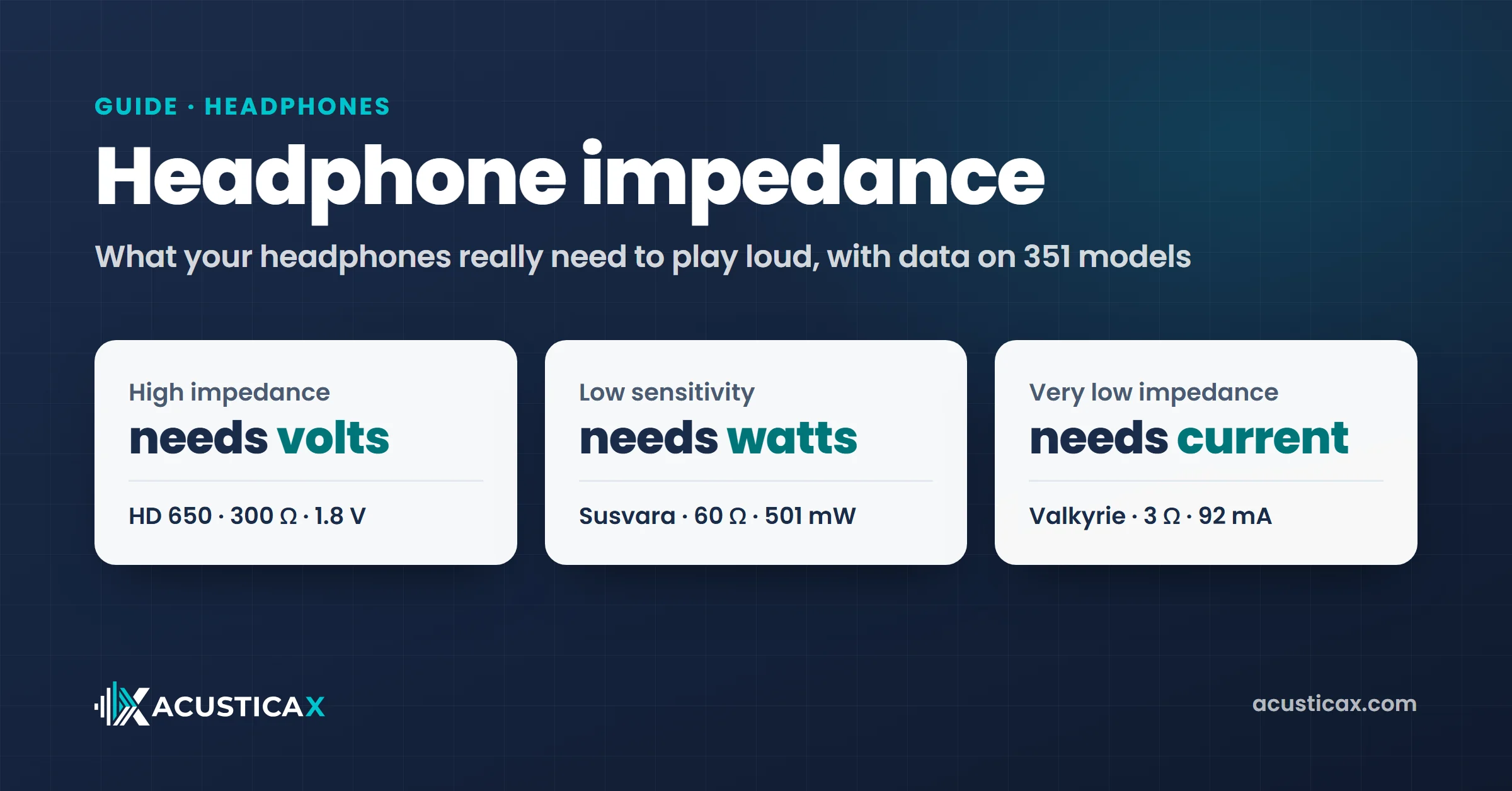
We ran the numbers on the 351 headphones in our calculator’s database, using their spec-sheet figures. For 110 dB peaks, 81% get there on 1 V and 43% on 0.5 V. The data boils down to a short rule: high impedance needs volts, low sensitivity needs watts, and very low impedance needs current.
What does headphone impedance mean?
Voltage, current and impedance always go together, and a garden hose helps picture them. Voltage, in volts (V), is the pressure your source pushes the signal with; current, in milliamps (mA), is the flow that reaches the driver and moves it; and impedance, in ohms (Ω), is how narrow the hose is. At the same pressure, less water gets through a narrower hose. That’s Ohm’s law: more voltage means more current, and more impedance means less. Power, in milliwatts (mW), comes from multiplying voltage by current, and it’s what the driver turns into sound.
That narrowness is the headphones’ impedance: the opposition they present to the audio signal, which is alternating current. At 1 V, a 32 Ω pair draws 31 mA and gets 31 mW, while a 300 Ω pair draws 3.3 mA and gets 3.3 mW, about a tenth; all else being equal, it plays quieter. Giving it the same 31 mW takes about 3 V, three times as much, and the current only reaches 10 mA, a third. So high impedance needs volts, and very low impedance needs current.
The figure on the spec sheet is a nominal value, and the real impedance changes with frequency. For example, Sennheiser rates the HD 650 at 300 Ω, while the HD 650 measurement report from Reference Audio Analyzer shows a 345 Ω average between 40 Hz and 15 kHz and a peak of about 440 Ω. In multi-driver IEMs (in-ear monitors) with crossovers, impedance can swing from under 10 Ω to almost 100 Ω across the band, and that matters more than it seems, as we’ll see further down.
IEMs and headphones meant for phones usually sit between 8 and 32 Ω (112 of the 130 IEMs in our database are 32 Ω or lower). Over-ear studio and hi-fi models span 32 to 600 Ω, and planar magnetics usually stay under 70 Ω even though they’re the most power-hungry of the lot.
Beyerdynamic, which sells the DT 770 PRO in 32, 80 and 250 Ω, argues in its guide to choosing an impedance that a coil wound with thinner wire is lighter and sounds more precise, and that the thinner wire raises the impedance. The other reason 250 Ω and 600 Ω versions exist is the 1996 IEC 61938 standard, which recommended a 120 Ω output impedance for headphone jacks; many headphones were designed to work from that kind of source, as Rod Elliott explains at Elliott Sound Products.
Google’s AI Overview for “high impedance vs low impedance headphones” says high-impedance models “handle higher input without overloading” (checked October 30, 2026). In volts that holds, since the 100 mW the DT 770 PRO is rated for in all three versions works out to 5 V into the 250 Ω and 1.8 V into the 32 Ω, per Beyerdynamic’s spec sheet. In watts, all three take exactly the same.
Is high or low impedance better?
Neither is better in itself; it comes down to what you plug them into. Phones, USB-C dongles and laptops deliver little voltage and work best with low-impedance, high-sensitivity headphones. High impedance headphones belong on amps, audio interfaces and mixers that swing several volts, and they shrug off sources with a high output impedance.
They don’t distort less, either, whatever the AI answers suggest. Beyerdynamic rates all three DT 770 PRO versions at the same distortion, under 0.2%. Driver control, the so-called damping factor, is the headphone impedance divided by the source’s output impedance, so a modern source under 1 Ω damps almost any headphone well, except very low impedance IEMs. Only on sources with a high output impedance do the high-ohm models come out ahead. And the sound itself comes down to each model’s frequency response, not its ohms.
How headphone sensitivity is rated, in dB/mW or dB/V
Headphone sensitivity is how loud a pair plays from a reference signal, and brands quote it either per milliwatt (dB/mW) or per volt (dB/V). To compare two models, or to check whether your source can drive them, convert to dB/V. Sources put out a roughly fixed voltage, unless they have a high output impedance, and it’s the power that changes with impedance.
You need the impedance to convert. The formula is dB/V = dB/mW + 10 × log(1000 / Z), where Z is the impedance in ohms, though in practice you can just add the figure from the table. A 250 Ω DT 770 PRO at 96 dB/mW works out to 102 dB/V; the 32 Ω version, with the same 96 dB/mW, comes to 110.9 dB/V.
| Impedance | Add to dB/mW to get dB/V | Power from 1 V |
|---|---|---|
| 16 Ω | +18.0 dB | 62.5 mW |
| 32 Ω | +14.9 dB | 31.3 mW |
| 50 Ω | +13.0 dB | 20 mW |
| 80 Ω | +11.0 dB | 12.5 mW |
| 150 Ω | +8.2 dB | 6.7 mW |
| 250 Ω | +6.0 dB | 4 mW |
| 300 Ω | +5.2 dB | 3.3 mW |
| 600 Ω | +2.2 dB | 1.7 mW |
The median sensitivity in our database is 122 dB/V for IEMs and 113 dB/V for over-ears. The level a typical IEM reaches with 0.1 V takes a typical over-ear 0.29 V, almost three times as much.
Spec sheets aren’t always comparable
Sennheiser rates the HD 600 at 97 dB at 1 V and the HD 650 at 103 dB at 1 V, yet Reference Audio Analyzer measures both at 105.1 dB/V, averaged from 100 Hz to 10 kHz. Going by the spec sheet, the HD 600 would need 4.47 V for 110 dB peaks; going by the measurement, under 1.8 V. The HD 650’s rating lands 2 dB off the measurement, a small gap, while the HD 600’s is 8 dB off.
Every brand measures under its own conditions. Some use 1 kHz, others average a band, and some don’t state a reference at all, like Beyerdynamic with the DT 770 PRO’s 96 dB or HiFiMan with the Susvara’s 83 dB (our database reads them as per milliwatt). When you compare models, trust measurements from a single lab over two spec sheets from different brands. Our calculator now uses the measured figures for the HD 600 and HD 650, with a note explaining why.
What ohm headphones need an amp? No single number works
There’s no ohm rating above which headphones need a separate amp, because two pairs with the same impedance can need very different voltages. Google’s AI Overview for “what ohm headphones need an amp” puts the line at 100 ohms, while noting that sensitivity “is the more critical specification” (checked October 30, 2026). The Sennheiser HD 560S and the AKG K612 PRO are both 120 Ω. The Sennheiser makes 110 dB from 1 V and the AKG 101 dB, so for 110 dB peaks the first needs 1 V and the second 2.8 V, nearly three times as much.
There is a trend, though, and our database shows it. Nearly all high impedance headphones need more voltage than a phone delivers. Above 150 Ω, 21 of the 22 models need more than 1 V for 110 dB peaks, while at 32 Ω or below only 12 of 200 do, 9 of them planars from HiFiMan, Dan Clark and Audeze.
| Impedance | Models | Median voltage for 110 dB peaks | Need more than 1 V | Most demanding |
|---|---|---|---|---|
| 32 Ω or less | 200 | 0.40 V | 12 (6%) | Dan Clark Audio Stealth, 2.14 V |
| 33 to 80 Ω | 118 | 0.69 V | 29 (25%) | HiFiMan Susvara, 5.48 V |
| 81 to 150 Ω | 11 | 1.12 V | 6 (55%) | AKG K612 PRO, 2.82 V |
| 151 to 300 Ω | 18 | 1.94 V | 17 (94%) | Several at 2.51 V: the 250 Ω Beyerdynamic DT 770 PRO, DT 880 and DT 990 PRO, and the Sennheiser HD 800 S |
| Over 300 Ω | 4 | 3.16 V | 4 (100%) | Beyerdynamic DT 880 and DT 990 600 Ω, 3.88 V |
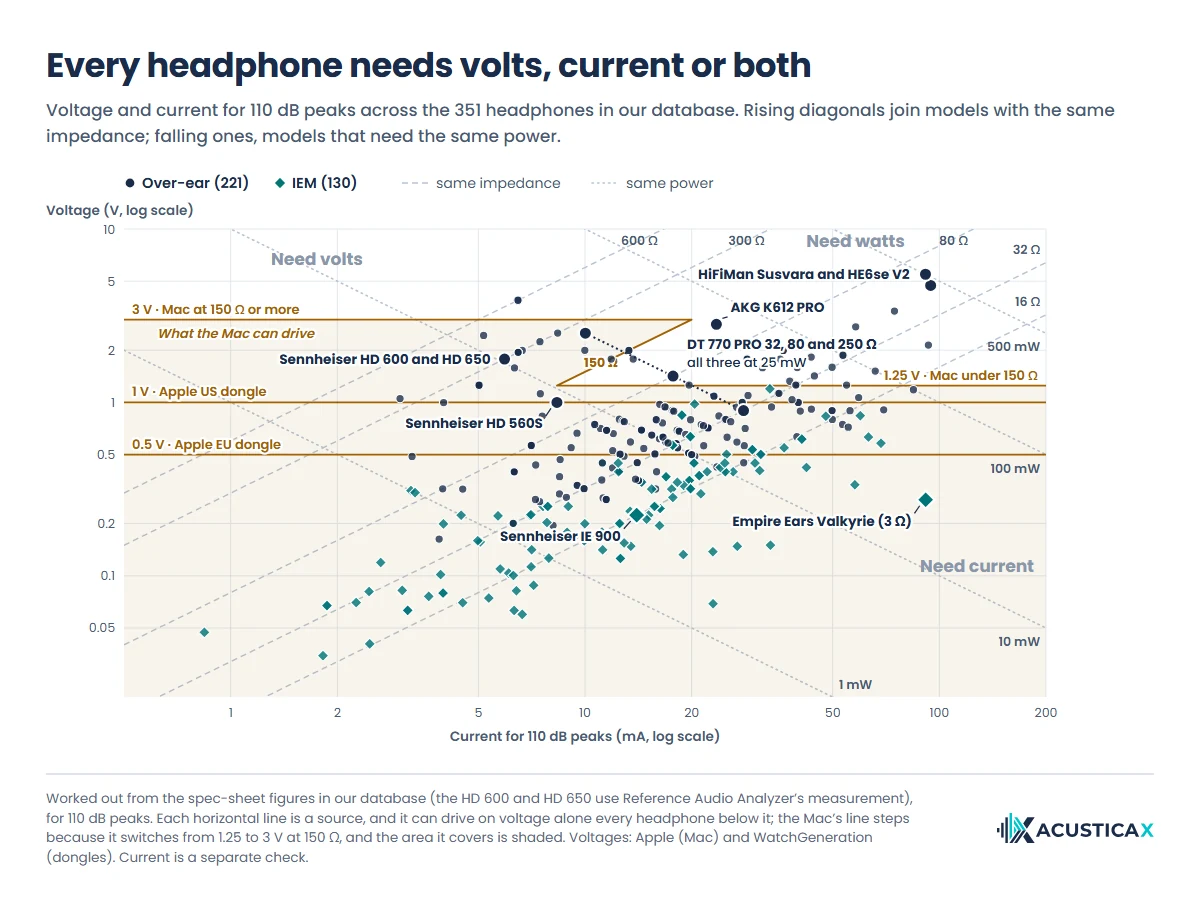
In the chart, each dot is a headphone, and its impedance puts it on one of the rising diagonals. Sensitivity slides it up or down that diagonal, and the further up and to the right it sits, the more watts it takes. Each horizontal line is a source, and it can drive on voltage alone every headphone below it. The Mac’s line steps up because it switches from 1.25 to 3 V at 150 Ω, and the area it covers is shaded. Anything to the right of its slanted segment is under 150 Ω and only gets 1.25 V, which is why the 80 Ω DT 770 PRO falls short even though it sits below the 3 V line.
80 vs 250 ohm on the Beyerdynamic DT 770 PRO
On a phone or a USB-C dongle, get the 80 Ω, or the 32 Ω if it will only ever go on a phone, since it plays louder still. On a Mac with the high-impedance jack, the 250 Ω. On a Scarlett 2i2 4th gen, the 80 Ω by a hair. Its 50 Ω output breaks the 1/8 rule with all three versions (they’d want 4, 10 and 31 Ω at most), but a dynamic headphone’s impedance varies little, so the effect is far smaller than on an IEM, as we cover below.
All three versions share the same 96 dB/mW and need the same 25 mW for 110 dB peaks, but not the same voltage. The 32 Ω gets by on 0.90 V, the 80 Ω needs 1.42 V and the 250 Ω 2.51 V. The open-back DT 990 PRO shares the same 96 dB in its 250 Ω version, so the same math applies.
| Source | DT 770 PRO 32 Ω | DT 770 PRO 80 Ω | DT 770 PRO 250 Ω |
|---|---|---|---|
| Apple USB-C dongle, US version (1 V) | 110.9 dB | 107.0 dB | 102.0 dB |
| Apple USB-C dongle, EU version (0.5 V) | 104.9 dB | 100.9 dB | 96.0 dB |
| Mac with high-impedance headphone jack (1.25 or 3 V) | 112.9 dB | 108.9 dB | 111.6 dB |
| Focusrite Scarlett 2i2 4th gen | 111.0 dB | 111.4 dB | 109.5 dB |
On Apple’s US dongle, the 250 Ω tops out at 102 dB peaks and the 80 Ω at 107 dB; on the European one, the 250 Ω stops at 96 dB, enough for pop at a normal level and short for a symphony. The Scarlett 2i2 4th gen takes the 80 Ω to 110 dB and leaves the 250 Ω just under a decibel short. And because the Mac switches to 3 V from 150 Ω up, the 250 Ω actually plays louder on it than the 80 Ω does.
On sound, Beyerdynamic credits the 250 Ω with a lighter coil and a more precise sound, and forums offer every opinion going. If you can get frequency response curves for both versions, from a measurement site or your own rig, you can overlay them in our headphone frequency response comparator and see where they part ways.
When headphones need more watts (and when they need current)
Headphones need more watts when their sensitivity is low, not when their impedance is high. With the sensitivity Reference Audio Analyzer measures (105 dB/V), the 300 Ω HD 650 needs 1.78 V for 110 dB peaks, but only 10.5 mW and 5.9 mA. The HiFiMan Susvara, a 60 Ω planar rated at 83 dB, needs 5.48 V, 91 mA and 501 mW, which is almost fifty times the power from a fifth of the ohms. Its own owner’s guide says as much, calling it a low sensitivity headphone that “will require more than average amplifier power to drive it properly.” HiFiMan’s HE6se V2, at 50 Ω and 83.5 dB, isn’t far behind at 447 mW.
Very low impedance calls for current even when little voltage is needed. Multi-driver IEMs sometimes dip below 10 Ω, and the original Empire Ears Valkyrie, rated at 3 Ω and 96 dB/mW in the specs Headphone Guru lists, gets by on 0.27 V for 110 dB peaks. It draws 92 mA to get there, more than the HD 650 and as much current as the Susvara.
In our database, 22 models need 50 mA or more at 110 dB, almost all of them planars and very low impedance IEMs. Phones and many dongles can run out of current before they run out of voltage, at which point their output voltage stops being a useful guide. For the amp, our calculator adds 6 dB of headroom over the minimum, because amplifier power is rated right at the limit, and for the Susvara that means 2 W into 60 Ω.
A reasonably priced desktop amp gets close. The $129 JDS Labs Atom Amp 2 is rated at 2.65 W into 32 Ω and 286 mW into 300 Ω, about 9.2 V either way. Into the Susvara that’s roughly 1.4 W, 4.5 dB above the minimum but short of the recommended 2 W.
How much voltage your dongle, Mac or audio interface puts out
Apple’s USB-C dongle puts out about 1 V in the US and 0.5 V in Europe, according to WatchGeneration; a recent Mac 1.25 or 3 V depending on the load; the Scarlett 2i2 4th gen 1 to 2.5 V; and an amp like the Atom Amp 2 over 9 V. Hardly any phone maker publishes its output voltage, so the table sticks to the sources we could verify, with how many of the 351 headphones in our database reach 110 dB peaks on each.
| Source | Maximum voltage | Output impedance | Headphones that reach 110 dB peaks |
|---|---|---|---|
| Apple USB-C to 3.5 mm dongle, US version (A2049) | 1 V | Not published | 283 of 351 (81%) |
| Apple USB-C to 3.5 mm dongle, EU version (A2155) | 0.5 V | Not published | 151 (43%) |
| Mac with high-impedance headphone jack (MacBook Pro 2021+, MacBook Air 2022+, iMac and Mac mini 2023+…) | 1.25 V under 150 Ω; 3 V from 150 Ω to 1 kΩ | Not published | 315 (90%) |
| Focusrite Scarlett 2i2 4th gen | 1.03 V into 33 Ω; 2.45 V into 300 Ω | 50 Ω | 287 (82%) |
| JDS Labs Atom Amp 2 (desktop amp) | 9.22 V into 32 Ω; 9.27 V into 300 Ω | 0.7 Ω | All 351 |
Apple documents how the Mac’s headphone jack behaves. It detects the load and delivers up to 1.25 V into headphones under 150 Ω and 3 V from 150 Ω to 1 kΩ. It’s on the MacBook Pro from 2021, the MacBook Air from 2022, the iMac and Mac mini from 2023, the Mac Studio from 2022 and the 2023 Mac Pro; earlier models such as the M1 MacBook Air aren’t on the list.
The Scarlett 2i2 4th gen spec sheet gives 2.45 V into 300 Ω but 1.03 V into 33 Ω, because its headphone output has a 50 Ω output impedance and loses voltage as the headphone impedance drops. That’s why, across our database, it covers almost the same models as a 1 V dongle.
Why phones sound quieter in Europe
Because personal music players sold in Europe have to limit sound exposure. Commission Decision 2009/490/EC called for standards capping it at 40 hours a week at 80 dB(A) and 5 hours a week at 89 dB(A), and EN 50332, the standard that sets how it’s measured, covers the players’ electrical output.
With Apple’s dongle, the European version (A2155) puts out 0.5 V and the US one (A2049) 1 V, according to WatchGeneration, which bought the US model and recorded both from the same iPhone at full volume. WatchGeneration puts it down to European rules; Apple neither publishes the figure nor explains it. That’s 6 dB, the difference between reaching 110 dB peaks and stopping at 104, and at 0.5 V you need headphones of at least 116 dB/V to hit 110.
Output impedance and the 1/8 rule
Your source’s output impedance should be no more than an eighth of your headphones’ impedance. The engineer known as NwAvGuy proposed that rule in his 2011 write-up on headphone amp impedance. For 32 Ω headphones, the source shouldn’t go above 4 Ω; for a 16 Ω IEM, above 2 Ω.
The output impedance and the headphone impedance split the voltage like a divider, and since the headphones’ impedance shifts with frequency, each frequency gets a different share. With Ultimate Ears SuperFi 5 IEMs, whose impedance runs from 9 to 90 Ω, NwAvGuy shows a 6 dB swing from a 10 Ω source and 12 dB from a 43 Ω one. A high-impedance dynamic headphone barely notices. By our calculation, with the HD 650, at roughly 300 to 440 Ω, a 50 Ω source bends the curve by 0.4 dB and a 120 Ω source by 0.8 dB.
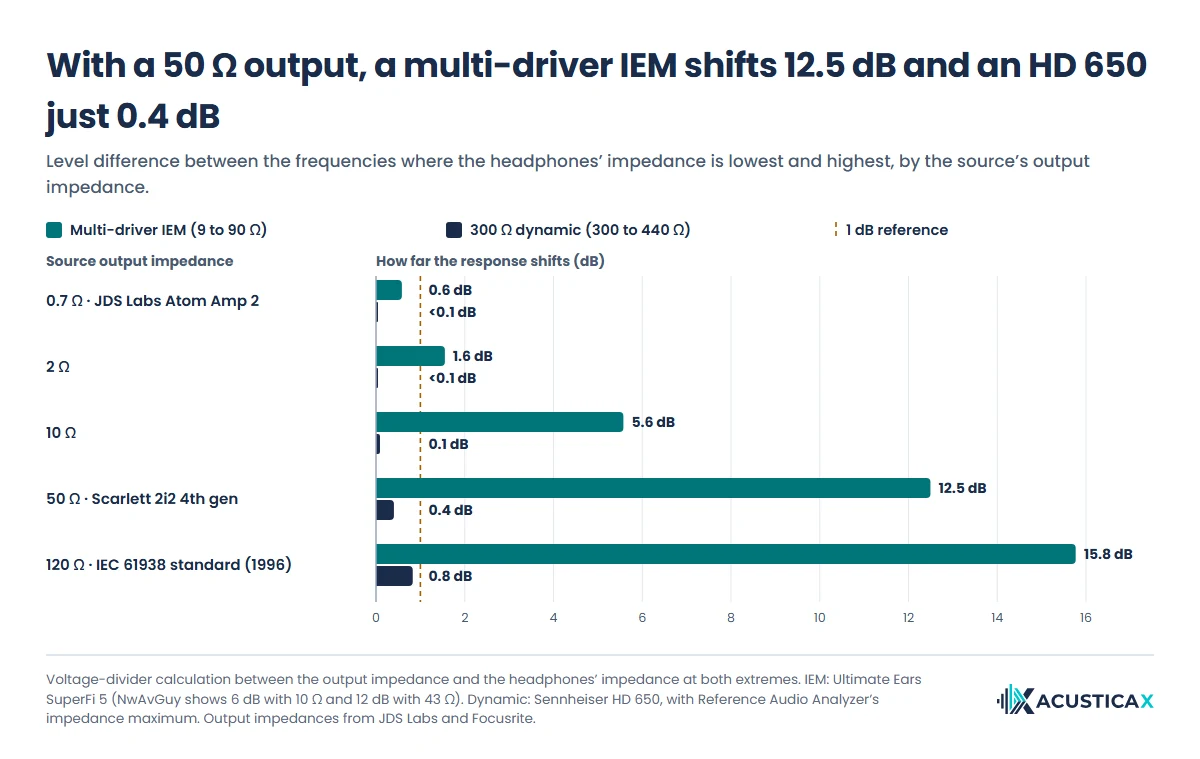
The rule covers the worst case. How far the curve bends depends on how much the headphones’ impedance varies with frequency, which is little in a high-impedance dynamic like the HD 650 and a lot in a multi-driver IEM. That’s why the Scarlett 2i2 4th gen (50 Ω) or outputs built to IEC 61938 (120 Ω) barely change the sound of 250 or 300 Ω headphones yet skew a multi-driver IEM. For those, look for a source at 1 or 2 Ω at most; the Atom Amp 2, for instance, is rated at 0.7 Ω.
When there’s too much amp: hiss with sensitive IEMs
With very sensitive IEMs, the problem stops being power and becomes the source’s noise floor, which you hear as hiss in quiet passages. The Shure SE846, rated at 9 Ω and 114 dB/mW in its user guide (134.5 dB/V), turns the Atom Amp 2’s rated 1.33 µV of noise into 17 dB SPL and a noisy 20 µV output into 40 dB SPL. A typical IEM like the Sennheiser IE 900, at 123 dB from 1 V, lands 11.5 dB lower in both cases.
Because IEMs seal out the room, that hiss can come through in the gaps between songs. With IEMs like these, use the amp’s low gain setting and look for its output noise in microvolts, or a signal-to-noise ratio quoted at a stated voltage. A powerful, high-gain amp adds more noise than benefit here.
How to work out the voltage your headphones need, in three steps
With the spec sheet in hand, it takes a minute to convert the sensitivity to dB/V, work out the voltage your peaks need and compare it with what your source delivers.
- Sensitivity in dB/V. If the spec sheet gives dB/mW, add the figure from the conversion table for its impedance.
- Voltage for your peaks. The voltage is 10 to the power of (peaks − dB/V) / 20. For the peaks, start from your average listening level and add 10 to 20 dB. In the tracks we measured for our watts-per-channel guide, the pop tracks peaked 9 to 12 dB above their average and two recordings of a symphony 16 to 18 dB. At an 80 dB average that’s roughly 89 to 98 dB, and 110 dB leaves headroom for loud listening and very dynamic music.
- Compare with your source. If it delivers more than the voltage you worked out, the amp built into it is enough. If your headphones need 50 mA or more, as planars like the Susvara or HE6se and very low impedance IEMs do, also check the source’s power into a similar load.
Take the 250 Ω DT 770 PRO, rated at 96 dB/mW, which is 102 dB/V. On Apple’s European dongle it reaches 102 + 20 × log(0.5) = 96 dB, and on a Mac at 3 V, 111.6 dB. For 110 dB peaks you’ll want a separate amp with the European dongle; its 96 dB is fine for pop at an 80 dB average and short for a symphony. On the Mac you don’t need one. If you’d rather skip the math, our headphone amplifier calculator has data on 351 headphones and 29 sources, including both versions of Apple’s dongle, the Macs and the Scarlett 2i2, plus an option for 0.5 V European phones and dongles.
Those 110 dB are split-second peaks, not a level to listen at, and they sit next to a front-row concert on our decibel chart of everyday sounds. Your average level is what counts for your ears, and our guide on how loud is safe with headphones explains how to keep it in check.
What about speakers? 4, 6 or 8 ohms
With speakers, what matters is the minimum impedance the amp is rated for, and any speaker at or above that figure is fine. Yamaha’s US and Canadian receivers, like the RX-V4A, have a speaker impedance setting with two positions, “6Ω MIN: For 6-ohm or higher speakers” and “8Ω MIN: For 8-ohm or higher speakers,” according to its online manual. An 8 Ω speaker on an amp rated for 4 Ω works without a problem. The reverse can overheat the amp or trip its protection, because at the same voltage a 4 Ω speaker draws twice the current.
Which plays louder, 4 or 8 ohms? If both spec sheets quote the same sensitivity at 2.83 V, they play equally loud on the same amp. Why that is, and how many watts you need for your room, is in our guide on how many watts per channel your speakers need.
Frequently asked questions
What is a good impedance for headphones?
The one that suits your source. For phones, dongles and laptops, 16 to 32 Ω with good sensitivity (around 110 dB/V or more for a 1 V source). For amps and interfaces that deliver several volts, anything up to 300 Ω works. Check the sensitivity in dB/V along with the ohms.
Which is better, 16 ohm or 32-ohm headphones?
Neither, on impedance alone. A 16 Ω pair needs a little less voltage for the same power but more current, and it’s more sensitive to the source’s output impedance, which should stay under 2 Ω. If both have the same sensitivity in dB/V, they play equally loud from the same source.
What does 250 ohm mean for headphones?
That they draw little current and need more voltage for the same power. A 250 Ω DT 770 PRO needs 2.51 V for 110 dB peaks, more than a phone or a 1 V dongle delivers, so it’s happiest on an amp, an audio interface or a Mac with the high-impedance jack. How much voltage a 250 Ω model needs still depends on its sensitivity.
Can I use 80 ohm headphones without an amp?
Often, yes. An 80 Ω DT 770 PRO needs 1.42 V for 110 dB peaks and reaches 107 dB on a 1 V dongle, plenty for most music at moderate levels. On a European 0.5 V dongle it stops at 101 dB, which still covers pop at a normal level but not loud, dynamic listening; that’s where an amp starts to make sense.
Do headphone amps improve sound quality?
Only if your source falls short. A separate amp helps when the one built into your source can’t deliver the voltage or current your headphones need, when its output impedance is too high for your IEMs, or when it hisses. If none of that applies, a well-designed source already plays your headphones as they are.
Do higher ohm headphones sound better?
Not because of the ohms. Sound comes down to each model’s frequency response. Beyerdynamic says the lighter coil of its high-impedance versions sounds more precise, but it rates all three DT 770 PRO versions at the same distortion, and two headphones with the same impedance can sound completely different.
Are 32 ohm headphones good?
Yes, it’s the most common impedance and the one that gets along best with phones and laptops. The thing to check is sensitivity. A 32 Ω DT 770 PRO at 96 dB/mW reaches almost 111 dB peaks from 1 V, while a 32 Ω planar at 92 dB/mW like the current HiFiMan Sundara lands about 4 dB lower.