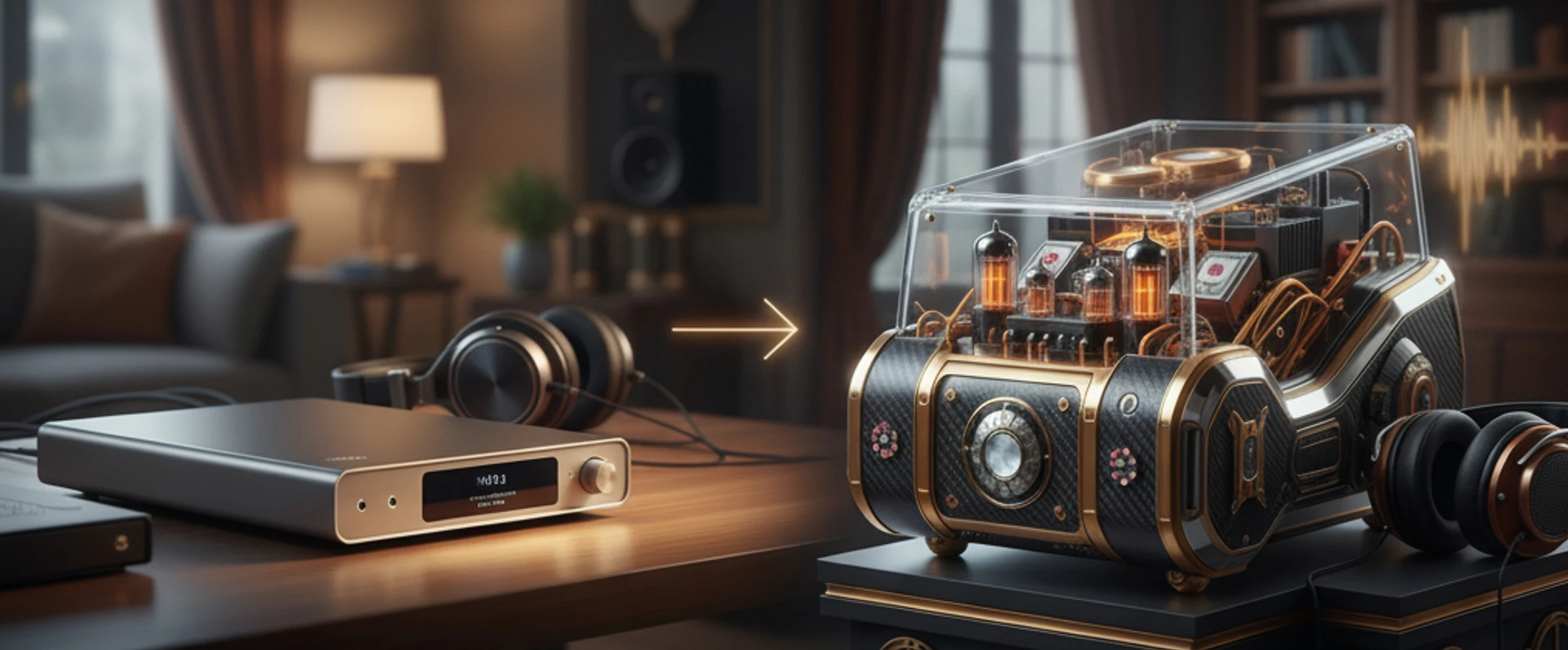
The audible difference between a €1,000 digital-to-analog converter (DAC) and one that costs €20,000 is nowhere near a difference of €19,000. Modern conversion chips—even those found in mid-range equipment—already operate at the theoretical limits of human perception. So where does that astronomical cost come from?
It is a convergence of cutting-edge engineering, luxurious materials, and a clear market positioning. It’s a truism, but it’s worth remembering: in high-end audio, you often pay for much more than just the sound itself.
Let's take a look at the "inner workings" of these devices. An affordably priced DAC will have a functional enclosure. A high-end DAC may feature a chassis machined from a solid 20-kilogram block of aluminum or copper, designed exclusively to dampen any vibration.
Internally, it is not a single circuit board; it is typically divided into separate sections. There are separate compartments for digital processing, the analog stage, and the power supply, all designed to prevent electromagnetic interference (EMI).
The power supply itself is often a feat of over-engineering, featuring multiple giant toroidal transformers—sometimes one for each section of the circuit. Some even use battery banks or supercapacitors to obtain a current of absolute purity, completely isolated from the power grid.
Then there’s the issue of synchronization. Jitter—or temporal inconsistency in the digital signal—is the arch-enemy of digital audio. While good DACs handle it competently, high-end devices are obsessed with it. They use master clocks (Oven-Controlled Crystal Oscillators, or OCXOs, or even GPS-disciplined rubidium units) that can cost thousands of euros on their own. These provide a time reference of incredible stability. Furthermore, instead of using a commercial conversion chip (which, we emphasize, are already excellent), they may choose to manufacture their own. This could be a discrete R-2R resistor ladder, which uses hundreds of tiny resistors hand-matched to an accuracy of 0.01%, or custom processing managed by an FPGA (Field-Programmable Gate Array).
The Analog Heart and the Obsession with Isolation
Once the signal becomes analog, the work isn't done. The audio output stage in these units is often a fully discrete Class A design, which runs hot but is highly regarded for its linearity.
They can use output-coupled transformers with custom-wound cores, or specialized operational amplifier modules instead of standard chips. The signal paths can be routed on solid silver or OCC (Ohno Continuous Cast) copper.
To take isolation to its logical conclusion, many high-end devices are “dual-mono”: they consist of two separate DACs (one for the left channel and one for the right) that share a single, massive chassis. The most extreme examples are divided into one enclosure for digital processing, another for the master clock, and a third for the analog stages.
But wait a minute—don’t modern chips like the Asahi Kasei Microdevices (AKM) AK4191 and AK4499EX already handle resynchronization internally? The answer is yes. The AK4191 (the digital processor) uses an internal Phase-Locked Loop (PLL) and buffers to “clean up” the incoming signal before sending it to the AK4499EX (the analog converter). This reduces jitter. However, the quality of this internal cleaning still depends on the quality of the master clock (MCLK) it receives. The chip’s PLL is good, but it’s not as robust as a dedicated femtosecond-grade external oscillator. It’s competent, but not perfect.
The Value of the Imperceptible and Luxury Positioning
This is why these extremely high-cost designs do not rely solely on the chip's internal solution. They often use an asynchronous FIFO buffer before the signal reaches the AK4191, resynchronizing the entire signal flow with its own high-frequency, stabilized oscillator, located just millimeters from the conversion chip.
Does this make a difference in sound quality as stark as night and day? Honestly, it’s hard to tell. The improvements in noise or distortion reduction are usually well below the threshold of human hearing when compared to a €1,000 DAC that already performs flawlessly.
Therefore, a €20,000 DAC does not offer 20 times better sound quality. That’s simply not possible, physically speaking. What you’re buying is a piece of sophisticated electronic art. You’re paying for limited production runs where each unit is assembled and tested by hand. You’re paying for exotic materials, extreme manufacturing tolerances, and long-term reliability.
The price itself is part of the appeal, securing its place at the top tier of Hi-Fi. It's less about a slight improvement in sound quality and more about the presence of the object itself.