Are Bluetooth turntables worth it? Yes – on one condition that has nothing to do with Bluetooth: a Bluetooth turntable is worth it if the deck underneath would still be a good deck with the radio stripped out. Bluetooth is just another output, like the RCA sockets next to it. What decides whether your records sound right and survive the decade is everything that happens before the signal is digitised: the cartridge, the weight the stylus presses into the groove, and how steadily the platter turns.
There is a shortcut for judging that without listening to anything: check whether the manufacturer publishes numbers at all. Audio-Technica publishes a full spec sheet for the AT-LP70XBT: the cartridge tracks at 2.0 g, channel separation is 18 dB, wow and flutter comes in under 0.25 %, and it transmits SBC, aptX and aptX Adaptive. The “Specifications” tab on the Victrola Re-Spin – Victrola’s own flagship Bluetooth suitcase player – contains four marketing sentences and not a single figure. That asymmetry is the whole answer.
Are Bluetooth turntables worth it? Three questions, answered before you pay
A wireless deck earns its money if it answers yes to all three. Two out of three is a defensible buy. One or none means you are paying for a radio bolted onto a mechanism you would not want sitting on your records.
| The question | Why this is the one that matters | Where to check it |
|---|---|---|
| 1. Is the tracking force published, in grams? | It is the single number that predicts groove wear. When a brand withholds it, the number is not flattering. | Manufacturer spec sheet, cartridge or tonearm section |
| 2. Can the stylus be replaced – and upgraded? | It separates a deck that improves over years from a disposable one. A worn tip cuts the groove wall. | A replacement stylus with its own part number, on sale |
| 3. Is there a wired output as well? | It turns Bluetooth into a choice rather than a sentence. The day you own speakers, you still own a turntable. | RCA sockets on the back (phono or line level) |
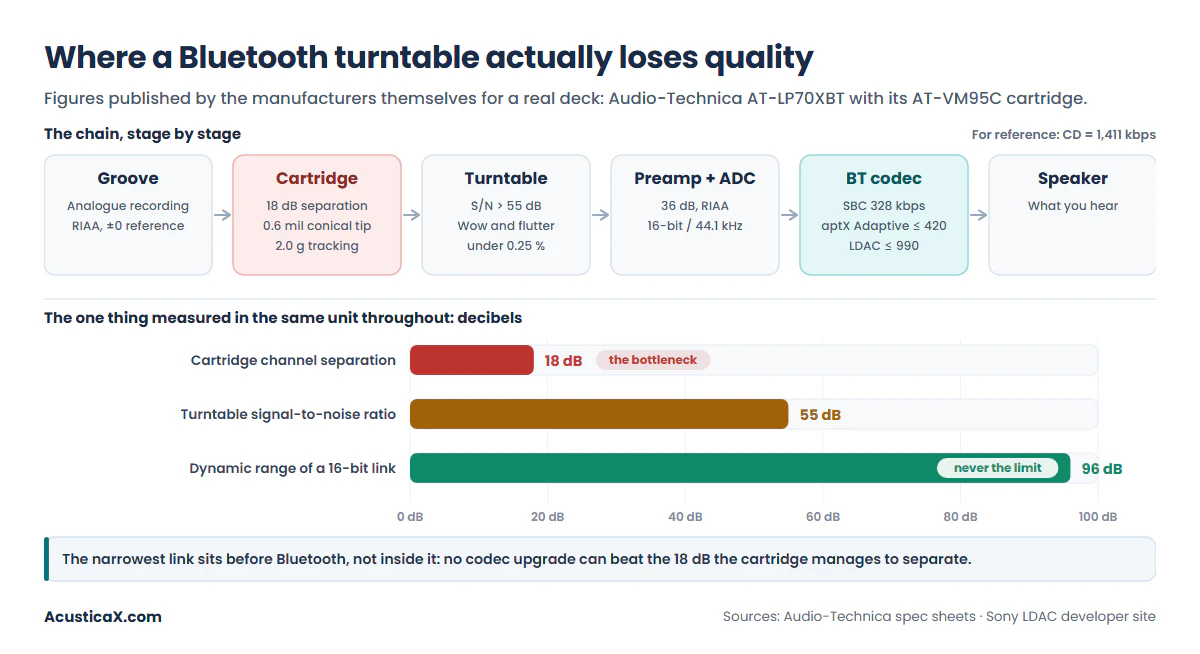
Notice that none of them asks about the codec, the Bluetooth version or the platter material. That is deliberate. The narrowest link in the chain sits well upstream of the radio, and you can see it simply by lining up the published figures side by side.
What actually happens to the music on its way through Bluetooth
Switch Bluetooth on and the deck digitises the analogue signal and compresses it lossily before putting it on the air. That is true and there is no arguing it away. What almost nobody supplies is how much – and the how much changes the entire conversation.
How much compression, in kilobits
A CD carries 1,411 kbps. The Bluetooth codec your gear will almost certainly settle on is SBC, and Sony – a company with every commercial reason to make its own LDAC look better – puts SBC at 328 kbps at 44.1 kHz on its own LDAC developer site. Everything else climbs from there, but only when both ends carry it.
| Codec | Peak bit rate | Who has it | What to know |
|---|---|---|---|
| SBC | 328 kbps | Mandatory on every Bluetooth audio device | The lowest common denominator: if the negotiation falls through, you land here |
| AAC | ~256 kbps | iPhone, iPad, AirPods, Mac | The default across Apple gear; performance on Android is erratic |
| aptX | 352 kbps | Many Android phones and Qualcomm-based gear | Needs a Qualcomm licence at both ends |
| aptX HD | 576 kbps | Upper-mid Android | 24-bit, but still lossy |
| aptX Adaptive | up to 420 kbps | Recent Snapdragon Sound devices | Drops the rate only when the RF environment gets crowded |
| LDAC | up to 990 kbps | Android (it is in the open-source project) and Sony gear | Switches itself between 330, 660 and 990 kbps as the link allows |
| For reference: CD | 1,411 kbps | – | Uncompressed, 16-bit, 44.1 kHz |
If you want the detail behind those kilobits and a way to test what you are actually being served, it is worked through in the guide on how many kilobits per second each format really moves.
The figure that reframes it: your cartridge is the tighter limit
The AT-VM95C cartridge fitted to that deck separates left from right by 18 dB, according to its own spec sheet. Eighteen. A 16-bit digital link carries roughly 96 dB of dynamic range and separates the channels completely, because they are two independent data streams. The deck as a whole is rated at a signal-to-noise ratio of better than 55 dB and wow and flutter under 0.25 % – a pitch modulation that no codec introduces at all.
Put plainly: the analogue front end of an affordable turntable imposes limits three to five times tighter than the digital stage everyone worries about. Bolting LDAC onto a cartridge with 18 dB of separation is racing rubber on a bent chassis. Which is why, if you have $100 to spend on sound, it goes further into the cartridge it comes fitted with than into any codec upgrade.
The Bluetooth codec is negotiated by both ends – the turntable does not pick it
This is the trap that wastes the most money. The codec in use is the best one the transmitter and receiver have in common, and with nothing in common the link falls back to SBC. The AT-LP70XBT makes a clean example because it publishes its list: aptX Adaptive, aptX and SBC. No AAC. So pair that deck with AirPods – which speak AAC and SBC, not aptX – and the connection settles on SBC, the baseline codec, and the 420 kbps you paid for never appear.
Before buying anything sold on “aptX” or “LDAC”, check which codecs the speakers or headphones you already own support. If they do not overlap, that premium does not exist.
Latency: irrelevant for listening, disqualifying with picture
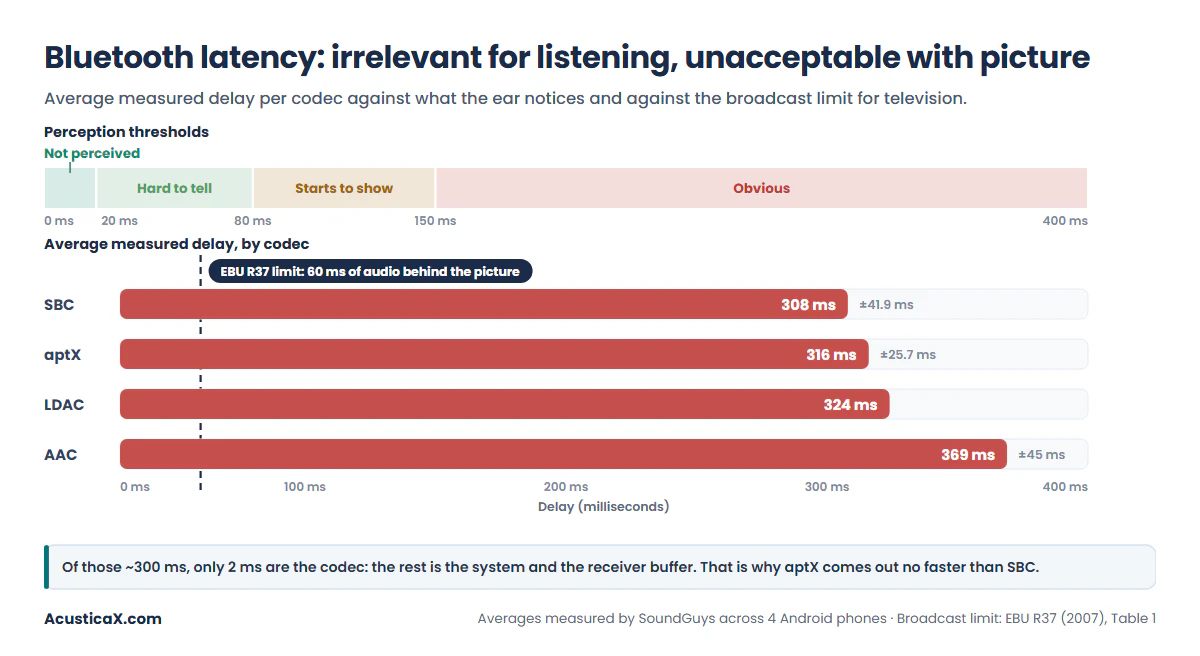
A typical Bluetooth link runs about 300 ms behind, and that one figure settles what wireless vinyl is good for. SoundGuys measured it across four Android phones: SBC 308 ms, aptX 316 ms, LDAC 324 ms and AAC 369 ms. While you are listening to a record it makes no difference whatsoever, because there is nothing to compare it against. The moment a picture enters, it does.
How much delay is noticeable: the broadcast numbers
European television settled this decades ago. EBU Recommendation R37 sets the limits for an outgoing broadcast in its Table 1: sound may run at most 40 ms ahead of the picture or 60 ms behind it. Past that, the mismatch between lips and voice becomes visible to half of viewers.
Now compare: the best measured Bluetooth case, 308 ms, is five times the broadcast limit. Which is why a wireless deck is perfect for putting a record on and a poor idea for playing records while something is on screen, or for beat-matching. With no picture and no reference, a constant delay is invisible.
No, a newer Bluetooth version does not fix latency
Google’s AI Overview for this topic states that “modern standards such as Bluetooth 5.2 and above dramatically reduce this delay”. The measurements say otherwise, and the reason is plumbing: of roughly 300 ms in total, only about 2 ms is encoding and decoding. The rest is the operating system and, above all, the receiver’s buffer, which hoards audio in advance so the stream does not drop out when you walk between the two devices.
The proof sits in the same table: aptX came out 8 ms slower than SBC, not faster. A more efficient codec shaves the 2 ms of arithmetic, not the 300 ms of buffering. The receiver is what governs: headphones with a game mode can dip under 100 ms while any ordinary living-room speaker stays high, both of them running the same Bluetooth 5.4.
How to measure your own gear’s delay
None of this has to be taken on faith – it takes two minutes to measure. Pair the Bluetooth speaker or headphones to a computer, open our surround diagnosis app and use the lip-sync test to read the offset in milliseconds: it fires a flash on screen and a click at the same instant, and you nudge the click until the two feel simultaneous. The nudge you needed is your Bluetooth receiver’s delay.
It is a practical aid, not a lab measurement: it reads the whole chain of your computer plus your receiver, not the turntable’s encoder on its own. But since the receiver contributes most of the delay, the number you get will land close to what the turntable would give you.
Suitcase record players: the problem was never Bluetooth
The suitcase record player – Crosley, Victrola, Auna and the boxes stacked in every high-street electronics shop – is how most people arrive at vinyl. They cost $60 to $120, and they have carried Bluetooth for years. The question everyone asks is whether they wreck records. The honest answer comes in two halves, and both are uncomfortable.
What is measured and what is forum folklore
One play does not ruin a record, and anyone saying otherwise is overstating it. Groove wear is cumulative and depends on tracking force, tip profile and whether the groove is clean. But it is not a myth either: pressing twice as hard on a PVC wall a few microns thick has consequences you can measure over time.
Two widely repeated claims deserve dismantling – both of them appear in the AI Overview Google currently serves for this search:
- “They use soft ruby or sapphire tips instead of hard diamond.” That was true in the 1960s. Today virtually every suitcase deck ships a diamond tip, usually conical. The gemstone is not the problem; the weight pushing it down is, and so is the fact that hardly anyone ever changes it.
- “Damage does not show up until 50 to 100 plays.” That figure traces back to a Facebook group, not to a measurement. Groove wear is not counted in plays, it is counted in grams and microns: the same record played a hundred times at 1.8 g with a healthy elliptical tip is in better shape than one played twenty times at 5 g with a worn one.
The number no suitcase brand publishes
Here is the hard finding. The Victrola Re-Spin page (model VSC-725SB, $99.99 list) carries a tab labelled “Specifications”. Its entire contents are four sentences: three speeds and belt drive, recycled plastic, a bass radiator in the speaker enclosure, and Bluetooth plus a headphone jack. No tracking force, no cartridge model, no wow and flutter, no signal-to-noise ratio, no Bluetooth version, no codec. Not one gram anywhere on the page.
Set that against the Audio-Technica table in the first figure, which declares more than twenty measurable parameters. It is not that the Victrola’s numbers are worse – it is that the brand has chosen not to have numbers. And when a manufacturer will not say how hard its stylus presses into your records, the omission is already an answer.
How to check it yourself for under a tenner
If you already own one, you do not have to take anyone’s word for it. An Ortofon stylus pressure gauge costs $9 and works as a see-saw with two marks, 1.25 g and 4 g. Rest the stylus on the 4 g mark: if the arm tips it, your deck is tracking above four grams – more than double what a normal cartridge asks for.
For reference, here are the figures from the makers who do publish them:
| Deck or cartridge | Tracking force | Stylus tip | Adjustable? |
|---|---|---|---|
| Upper-tier cartridge (elliptical or MicroLine) | 1.5 – 2.0 g | Elliptical, MicroLine or Shibata | Yes, with counterweight and anti-skate |
| Audio-Technica AT-VM95C (fitted to the AT-LP70XBT) | 1.8 – 2.2 g (2.0 g nominal) | 0.6 mil conical | No: the tonearm is factory-balanced |
| Budget moving-magnet cartridge | 3.0 – 4.0 g | Conical | Yes, on decks with a counterweight |
| Suitcase deck with a ceramic cartridge | Not published (4 – 6 g is typical) | Conical diamond | No – no counterweight, no anti-skate |
The other free check is speed. If the platter is not turning at exactly 33⅓, everything plays off-pitch, and on cheap decks the adjustment is literally a screw round the back. Print our strobe disc and you will know in ten seconds whether the platter runs true – it is in the turntable calibration tools, alongside the tracking-force and anti-skate calculator.
50-300 hours against 300-1,000: how long the stylus lasts
There is one number Victrola does publish, in its FAQ: its needles last “up to 50-300 hours” depending on the state of the records. Audio-Technica quotes 300 to 1,000 hours for its moving-magnet cartridges. The bad end of one scale meets the good end of the other, and that gap is the difference between the two categories as stated by the makers themselves.
It matters because a worn stylus does cut the groove irreversibly: the tip loses its shape, stops riding where it should and starts scraping the walls. And on a suitcase deck, few owners realise the stylus is a consumable at all. Whatever you own, it pays to know how many hours a stylus lasts before it starts cutting the groove.
Bluetooth in or Bluetooth out: the confusion that ruins most purchases
A turntable having Bluetooth does not mean it can send your records to a speaker. Two different functions share one logo, and retailers almost never separate them:
- Bluetooth in (receiver). The deck acts as a speaker: you stream Spotify to it from your phone and it plays through its built-in drivers. Nothing to do with vinyl. This is what nearly every budget unit has.
- Bluetooth out (transmitter). The deck picks up the record, digitises it and sends it to your speakers or headphones. This is what people believe they are buying.
Victrola supplies the proof that the distinction is real. Its FAQ states that “every Victrola player has Bluetooth-Input capabilities” – so input is standard across the range – while output is sold as a trademarked feature, Vinyl Stream™, present on selected models only. Nobody trademarks something the whole catalogue already does.
How to tell them apart in thirty seconds: look for the words “Bluetooth out”, “Bluetooth output” or “stream to a speaker”. If the listing only says “Bluetooth” or “Bluetooth connectivity”, assume it means input and ask before paying.
What to look at before buying – and what does not decide anything
Once the numberless decks are out of the running, the rest of the decision is simpler than the buying guides suggest. Three things change the outcome; several others get repeated everywhere and change nothing.
What counts: a replaceable stylus, adjustable tracking force, a wired output
An upgrade path is what separates a purchase from a subscription to landfill. On the AT-LP70XBT the cartridge body is fixed, but the stylus swaps out for any of the VM95 series: the conical replacement is $32, the MicroLine $159 and the Shibata $199. Going from conical to elliptical is the cheapest genuine step up in vinyl, and it shows most in the last few tracks of each side, where the groove gets tightest.
A counterweight and anti-skate arrive one tier higher. The AT-LP120XUSB declares a counterweight, anti-skate from 0 to 4 g and a detachable headshell: at that point you can fit whatever cartridge you like and set tracking force to a tenth of a gram. That is the real border between a player and an instrument you can set up.
And the RCA output is the insurance policy on the whole purchase. With it, the day powered speakers appear in your home, the deck still works. Without it, the day you tire of Bluetooth you have no deck. Which is the same yardstick that decides what separates a decent deck from a bad one, radio or no radio.
What gets repeated and settles nothing
Three received opinions worth deflating, because they turn up in almost every article on the subject:
- “An acrylic or glass platter beats aluminium.” Not as a rule. Both the AT-LP70XBT and the AT-LP120XUSB use die-cast aluminium, and both declare better wow and flutter than any suitcase deck with a plastic platter. What matters is mass, flatness and damping across the whole assembly, not the material the spec sheet boasts about.
- “Belt drive is for home because it is quieter; direct drive is for DJs.” That split is historical, not acoustic. There is excellent domestic direct drive and there are noisy belts. What matters is speed stability, and speed stability is measured – it is called wow and flutter.
- “A built-in phono stage means it is sorted.” Having one is convenient, but a mediocre built-in stage is easy to replace with a $60 external box. A 5 g tracking force cannot be replaced by anything.
One warning that comes with the format itself: a suitcase deck with built-in speakers vibrates its own stylus, because the driver and the tonearm share a box. Turned up, it will skip. If that is what you own, keep it off resonant surfaces and keep the volume down – and while you are at it, look at how to store records upright at the right humidity, which is the other factor that quietly destroys collections.
Three situations, and what I would do in each
You are starting out, you own Bluetooth speakers, you want no cables
Yes, worth it – this is the case where wireless makes the most sense. Look for a $250-$350 deck with a moving-magnet cartridge, a replacement stylus with its own part number, and RCA sockets. Here Bluetooth saves you an amplifier and speakers, which is another $450, and it does not lock you in: the day you want a cable, it is there. If the budget does not stretch, a $180 wired deck plus cheap powered speakers beats a $110 suitcase with Bluetooth.
You already have an amplifier and speakers
Bluetooth adds nothing and should not sway the choice. You are going to connect over RCA because you already have somewhere to plug in. Pick the deck on tonearm, cartridge and platter, and if it happens to include Bluetooth, let it be free. Paying a premium for a radio you will never switch on is money that would have gone much further into the cartridge.
You collect, and some of the records are irreplaceable
Bluetooth stops being the relevant question. You need a counterweight, anti-skate, a swappable cartridge and control of tracking force to a tenth of a gram, and that puts you above $350 regardless. Whether the deck also transmits is neutral for your records; it only changes whether you can hear them in the kitchen. And if there is a suitcase player in the house, keep it for the $3 second-hand bin, not for first pressings.
One closing note, since it always surfaces in this argument: the improvement from SBC to LDAC is real but small – the same order as the gap between a compressed file and a lossless one. If you want to know how much of that is actually audible, it has been tested in the guide on whether one resolution can be told from another at all.
Frequently asked questions
Are turntables with Bluetooth any good?
The good ones are good for reasons unrelated to Bluetooth: a published tracking force, a stylus you can replace and upgrade, and an RCA output. A deck meeting those three is a proper turntable that happens to transmit. One that meets none is a mechanism sold on its wireless feature, and the wireless part is not what will wear your records.
Is Bluetooth or wired better for turntables?
Wired, always, because nothing is compressed. The measurable gap is that a Bluetooth link carries 328 to 990 kbps against a CD’s uncompressed 1,411 kbps. On a turntable, though, that gap is smaller than the one the cartridge already imposes: the AT-VM95C separates channels by 18 dB and the deck is rated above 55 dB signal-to-noise, so the analogue side runs out of headroom first.
Does a Bluetooth turntable defeat the purpose?
Only if the purpose was an unbroken analogue path. If the purpose was records – the ritual, the sleeves, the mastering, the way an album is sequenced – none of that is touched by the transmission. What does defeat the purpose is a deck with an unspecified tracking force, because that damages the records themselves, which is the one part you cannot upgrade later.
Does Bluetooth affect vinyl record quality?
It affects the sound you hear, not the record. Bluetooth is lossy compression applied after the stylus has already done its work; it cannot touch the groove. What affects the record physically is tracking force, the condition of the stylus tip and how clean the groove is – none of which changes when you switch the radio on or off.
Do suitcase record players damage records?
Over time, yes, and the mechanism is tracking force plus a stylus nobody replaces. Typical suitcase decks track somewhere around 4 to 6 g against 1.8 to 2.2 g for a normal moving-magnet cartridge, and none of the big brands publishes the figure. A single play will not ruin anything; hundreds of plays at double the weight, with a tip past its life, will.
Do cheap record players actually damage records?
Cheapness is not the variable – the specification is. A $180 deck that publishes 2.0 g and takes a replacement stylus is safe for your collection. A $110 one that publishes nothing, has no counterweight and no anti-skate is a gamble you cannot audit. Check it with a €7.90 stylus pressure gauge rather than guessing from the price.
Do suitcase record players warp records?
No – warping comes from heat and from storing records flat or leaning, not from playing them. Suitcase decks cause groove wear, which is a different failure: the walls of the groove get worn down, so the sound loses detail and gains sibilance. A warped record is a storage problem; a worn record is a playback problem.
What destroys vinyl records?
Four things, in order of how often they actually happen: heat and humidity in storage, dirt that the stylus grinds into the groove, excessive tracking force, and a worn stylus tip. Bluetooth appears nowhere on that list. Three of the four cost nothing to fix; the fourth costs the price of a replacement stylus.