How to store vinyl records, in one sentence: upright, like books, somewhere stable at around 20 °C (68 °F) and 40-50 % relative humidity, away from sunlight and any heat source, in a polyethylene inner sleeve inside the jacket and a plastic outer sleeve around it, with dividers every 15 cm (6 in) so no record ends up leaning. Stacking records flat is what warps them; heat and damp finish the job.
Those figures don’t come from a forum thread. They are the ones the Library of Congress and the IASA – the international association of sound archives – use to keep discs playable for decades. This guide gives you the exact numbers and, more importantly, the part almost nobody mentions: stability matters more than the number itself. Plus what a collection really weighs (54 kg per metre of shelf, which is why shelves sag) and what to do about a record that is already warped.
How to store vinyl records: the six rules that matter
If you only take one section away from this guide, take this one. The six rules are ordered by how much damage each one prevents:
- Upright, never stacked. A record lying flat carries the weight of everything above it. This is the number one cause of warping.
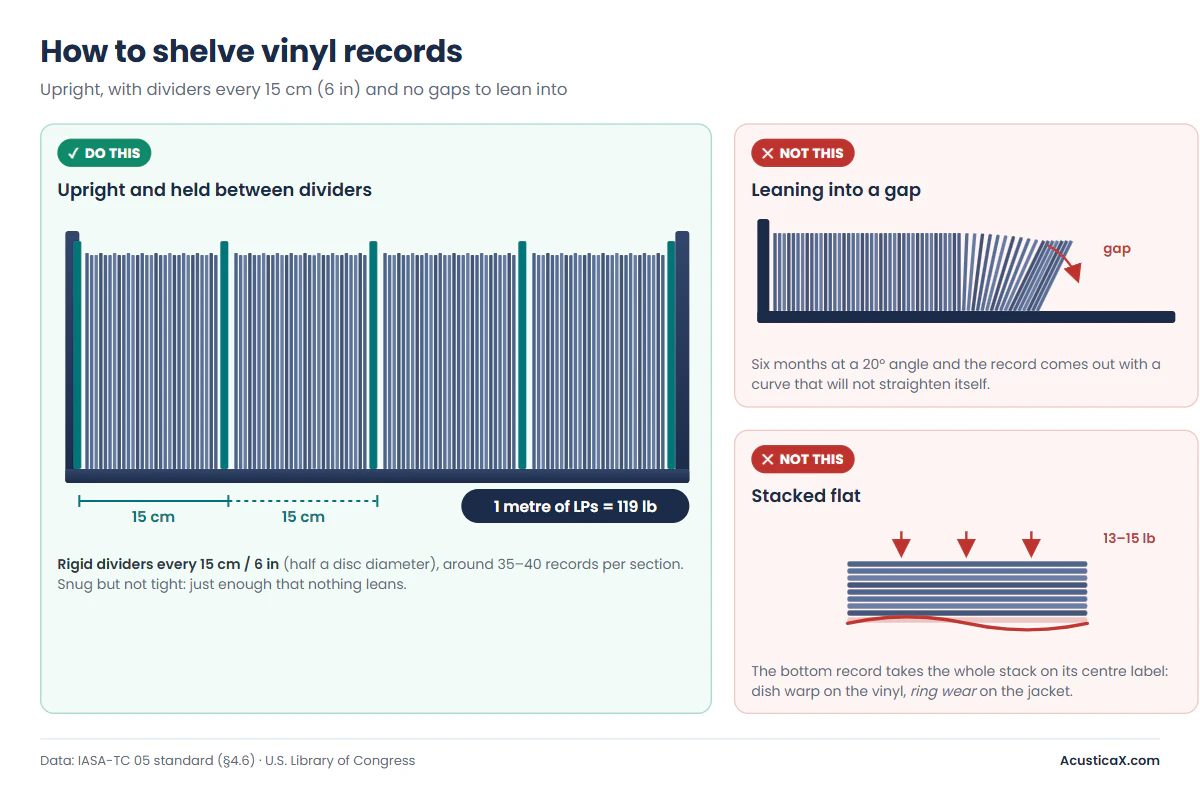
- Snug, but not tight. It isn’t only the weight that deforms a record – it’s sitting at an angle for months. Dividers every 15 cm.
- Below 35 °C (95 °F), always. That is the absolute ceiling sound archives set. A car in the sun or an attic in August blows straight past it.
- Humidity between 40 and 50 %. Below 25 % static takes over; above a sustained 70 % mold appears on cardboard jackets.
- Polyethylene inner sleeves. The original paper sleeve scuffs the record every time it goes in or out. An outer sleeve protects the jacket, which is half the value.
- No direct light, no vibration. Not by the window, not on top of the amplifier, and definitely not on the turntable itself.
The rest of the guide explains where each figure comes from and what exactly goes wrong when you ignore it.
Flat or upright? Upright, always
Upright. There is no technical debate here: the IASA-TC 05 standard states it flatly – all carriers are stored on edge – and the Library of Congress says the same for its own sound collection. The only exception is soft instantaneous discs (gelatin, Decelith), and even those go in stacks of no more than ten.
What actually happens to a stacked record
A 12-inch LP with its jacket weighs roughly 200-230 g (7-8 oz). In a stack of thirty, the bottom record carries six or seven kilos – and carries them unevenly, because the centre label is thicker than the rest of the disc and acts as a fulcrum. Vinyl is a thermoplastic: under sustained pressure it creeps, very slowly, and faster when it’s warm. The result is the classic dish warp that makes the stylus ride up and down and, in bad cases, skip out of the groove.
The record isn’t the only casualty. Stacked jackets develop ring wear, the worn circle you can see when you tilt the sleeve to the light – and the fastest way to lose money on a record you might one day sell.
Not too tight, not leaning: the sweet spot
The IASA wording is precise and counterintuitive: records should not be tightly packed, yet should sit close enough to avoid a permanent inclined position. In other words, there are two opposite mistakes.
- Packed too tight: scuffed jackets every time you pull a record out, and constant lateral pressure on the vinyl.
- Too loose: records gradually lean over like dominoes. An LP that spends six months at a 20-degree angle comes off the shelf with a gentle curve that will not straighten itself out.
The home test: pull a record out of the middle of a row. If its neighbours stay upright, you’re fine. If they collapse into the gap, you need dividers.
Dividers every 15 cm, and the gap you leave behind
The IASA rule is one divider every half disc diameter: for a 12-inch LP, that’s 15 cm (6 in). The Library of Congress is stricter still, asking for rigid dividers every 4-6 inches that support the entire face of the disc in its sleeve, not just the edge. That works out at roughly 35-40 records per section.
And here is a detail you won’t find in any interiors article: IASA requires a dummy record to fill the gap while the original is out. It sounds excessive until you think it through – the record you’re playing spends forty minutes away from the shelf, and its neighbours spend those forty minutes leaning into the space it left. At home the workable version is simpler: put the record back when side B ends, rather than leaving it propped against the furniture for a week.
One last placement rule, this one from the Library of Congress: don’t mix diameters. Seven-inch singles filed among 12-inch LPs support nothing and create exactly the gap that causes leaning.
What a collection weighs: the number that picks your shelving
One metre of LPs weighs about 54 kg (120 lb). That single figure explains why shelves sag and why the furniture matters as much as the sleeves. It comes from the IASA-TC 05 shelf-load table, and the Library of Congress arrives independently at the same place: “grooved discs average 35+ pounds per shelf-foot”, or about 52 kg per metre.
| Format | Weight per metre of shelf | Per 33 cm cube |
|---|---|---|
| 12-inch LP (30 cm) | 54 kg / 119 lb | ≈ 18 kg / 40 lb |
| 10-inch disc (25 cm) | 38 kg / 84 lb | ≈ 13 kg / 28 lb |
| 7-inch single (17 cm) | 21 kg / 46 lb | ≈ 7 kg / 15 lb |
| 12-inch shellac 78s | 92 kg / 203 lb | ≈ 30 kg / 67 lb |
| 10-inch shellac 78s | 72 kg / 159 lb | ≈ 24 kg / 52 lb |
| CDs in jewel cases | 7 kg / 15 lb | ≈ 2 kg / 5 lb |
Look at the shellac row: 92 kg per metre. If you have inherited a run of 78s, don’t put them on just any shelf – and remember they are brittle enough to crack from a single knock.
Why the shelf sags (and it isn’t just the total weight)
The Library of Congress puts it in one line: records concentrate their weight along the centreline of the shelf. A disc standing on edge dumps its entire load into a two- or three-centimetre strip right down the middle, instead of spreading it across the board the way a box would. A shelf that happily holds 50 kg of books can bow under 50 kg of records.
Geometry makes it worse: shelf deflection scales with the fourth power of the span, so doubling the unsupported width multiplies the sag by sixteen at the same load. That is precisely why 33-40 cm cube units work so well for records, and why a 16 mm particleboard shelf spanning 80 cm will bow within a year.
What to check before buying the furniture
- Short spans. Under 45 cm between vertical supports, you have nothing to worry about. Over 70 cm, only with a thick shelf or a central support.
- Enough depth. An LP in an outer sleeve is about 32 cm deep. On a 30 cm shelf the records stick out and get knocked every time you walk past.
- Anchored to the wall. At 18 kg a cube, a filled twelve-cube unit is over 200 kg with a high centre of gravity.
- Let it breathe. IASA advises against airtight storage, so skip sealed display cabinets and lidded plastic tubs.
On materials there is a twist that contradicts the usual advice: archives prefer steel shelving and discourage wood, because components of its chemical treatments can interact with the carriers. At home this is secondary – the real problem is the load – but if the unit is brand-new particleboard, air the room for a few days before you fill it.
Temperature and humidity: the figures sound archives use
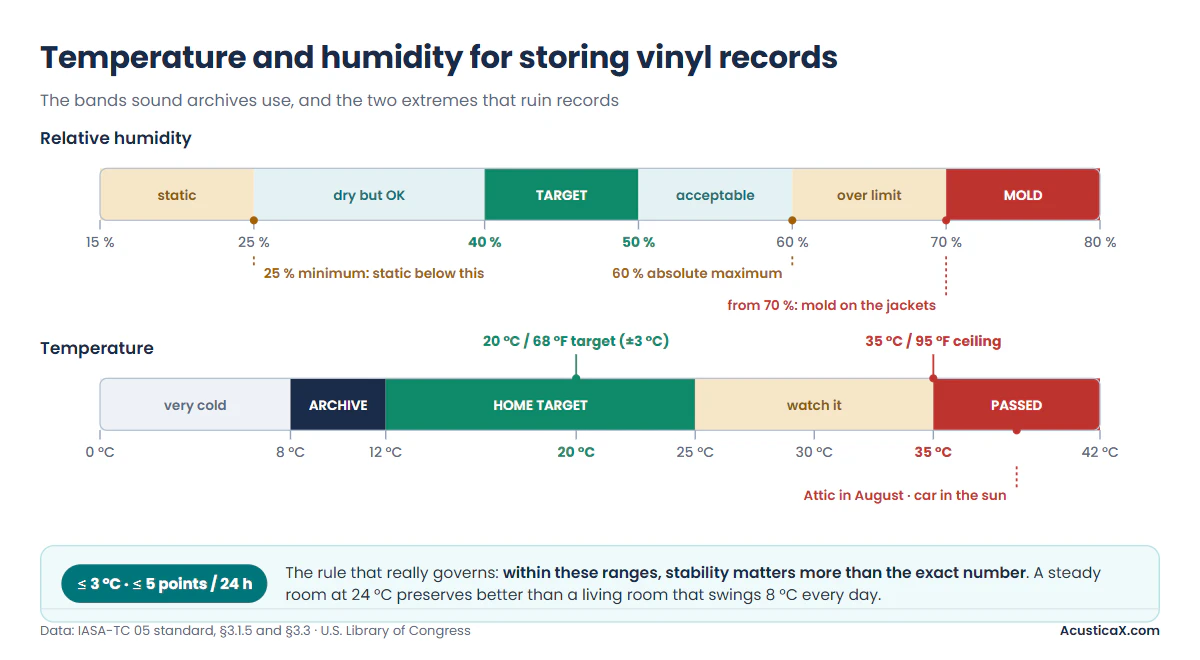
For a home collection in regular use, aim for around 20 °C (68 °F) and 40-50 % relative humidity, with slow changes. That is literally the tier IASA-TC 05 assigns to “mechanical carriers in access storage”, which is exactly what a living room holds: records that get shelved and played.
| Parameter | Absolute limit | Home target | Permanent archive |
|---|---|---|---|
| Temperature | Max. 35 °C / 95 °F | ≈ 20 °C / 68 °F (±3 °C) | 8–12 °C / 46-54 °F |
| Relative humidity | Min. 25 % · max. 60 % | 40–50 % (±5 points) | 25-35 % |
| Maximum change in 24 h | – | 3 °C and 5 points RH | 3 °C and 5 points RH |
| Mold threshold | 70 % RH | 70 % RH | 70 % RH |
The real ceiling is 35 °C, and the car is the trap
IASA sets the absolute maximum at 35 °C (95 °F), and it’s worth reading the full sentence because it gets misquoted constantly. The standard says that “temperatures up to 35 °C do not cause any immediate irreversible effects or lead to any deterioration of any current audiovisual carrier”. It is not that vinyl starts melting at 35 °C – it’s that below that figure you are safe, and above it you are in unmapped territory, especially if there is weight on the record as well.
Where you’ll clear 35 °C without noticing: the inside of a car parked in the sun – where more records die each summer than anywhere else, on the drive home from the shop – an attic in August, the shelf directly above a radiator, and the patch of floor that catches the afternoon sun through a window. In those places the record doesn’t even need to be lying flat; leaning is enough.
Humidity: between static and mold
Humidity has two bad extremes, and they are different problems:
- Below 25 % (a heated house in winter, a dry climate): dry air encourages electrostatic charge. A charged record pulls dust out of the air and holds it in the groove, which is precisely what you were trying to avoid.
- Above a sustained 60 %: that’s the absolute maximum for prolonged exposure. The vinyl itself copes; it’s the cardboard jacket and the paper inserts that suffer.
- From 70 % upward, sustained, you get mold. Fungi literally eat the surface of mechanical carriers, and that shows up as a noise floor no amount of washing will remove.
A ten-euro hygrometer next to the shelf settles the question permanently. In a coastal home the problem will usually be too much humidity; in a heated inland flat, too little.
The rule nobody quotes: 3 °C and 5 points in 24 hours
This is what separates a copied guide from a useful one. IASA spells it out: “within the permissible ranges, stability is more important than the absolute values of temperature and humidity”. And it attaches a number – the change should not exceed 3 °C or 5 percentage points of relative humidity over 24 hours.
In domestic terms: a room that sits steadily at 24 °C is a better home for records than a living room that swings from 17 °C in the morning to 25 °C once the heating comes on, even though the second one has a more “correct” average. The daily expand-and-contract cycle is what fatigues the material, and sharp swings are what condense moisture onto cold surfaces.
The practical consequence: the best spot in the house is usually an internal room – no external wall, no radiator nearby, door normally shut. And rule out the garage and the storage unit even if their annual average looks reasonable. What disqualifies them is the swing, not the mean.
Sleeves: the inner, the outer and the one to throw away
A properly stored record needs two sleeves: an anti-static polyethylene inner sleeve, the one that touches the vinyl, and a polypropylene or polyethylene outer sleeve wrapped around the cardboard jacket. And one you should pull out the moment you spot it: PVC.
Inner sleeves: paper, polyethylene or rice paper
The plain paper inner sleeve most records ship with is abrasive. Every time the record goes in or out, paper fibres drag dust across the groove. The Library of Congress is blunt about it: where possible, replace the original sleeve with high-density polyethylene, and it names three by name – DiscWasher V.R.P., Mobile Fidelity Original Master Sleeve and the Nagaoka No. 102.
| Inner sleeve type | For | Against |
|---|---|---|
| Original unlined kraft paper | Keeps the record exactly as issued | Abrasive; sheds fibres and drags dust into the groove |
| Poly-lined paper | Cheap and fine for everyday use | The paper still sheds along the open edges |
| High-density polyethylene | Anti-static and non-abrasive; the archival recommendation | Slightly bulkier inside the jacket |
| Lined rice paper | Very thin and soft; ideal for a tight jacket | More expensive |
| PVC | Nothing | Plasticiser migration that eventually damages the record surface |
If keeping the original sleeve matters to you – on a first pressing it is worth real money – the Library of Congress offers the way out: Nagaoka sleeves fit inside the original paper sleeve. The record goes in the poly sleeve, and both go back into the jacket.
One free habit borrowed from record shops: when you slide the inner sleeve back into the jacket, rotate it 90 degrees so its opening faces the closed edge of the cardboard. Dust then has no straight path to the record.
Outer sleeves: material and thickness
The outer sleeve protects the jacket, which on a collectable record is half the value. It is a barrier against jacket-to-jacket friction, ring wear and grime. Two criteria:
- Material: polypropylene or polyethylene, never PVC. Soft PVC contains plasticisers that migrate; over the years the sleeve turns tacky and can bond to the artwork or to the vinyl itself. If you own records in rigid, yellowing plastic sleeves from decades ago, replace them.
- Thickness: 2.5-3 mil (60–80 microns). Thinner won’t survive handling; thicker costs more and eats shelf space for no benefit.
Why you should not seal records airtight
This one runs against most people’s instinct: do not store records in airtight boxes or vacuum-sealed bags. IASA advises against it explicitly, and the reason is chemical. Polymers degrade by releasing by-products, and several of those reactions are autocatalytic – the by-product speeds up the very degradation that produced it. An airtight container traps those gases against the record. The standard asks for the opposite: let air move around the carrier, and control dust at the room level rather than by sealing each disc.
The same goes for board: if you are boxing records, use acid- and lignin-free stock. Ordinary cardboard is acidic and will yellow and attack the paper inserts over the years.
Seven places you should never store vinyl records
Nearly every record that dies at home dies in one of these seven places. The first three account for most of them:
- The car. Even just for the drive home from the shop. A closed cabin in the sun goes well past 35 °C, and the record is usually lying flat on a seat.
- The attic. Directly under the roof it is the hottest part of the house in summer and the part that swings most. The Library of Congress rules it out by name.
- The basement or storage unit. Humidity that sits steadily above 70 % means mold on jackets. They are also the spaces most likely to flood.
- The garage. It combines the worst of both: a big daily temperature swing and uncontrolled humidity.
- Against a radiator or over underfloor heating. Direct heat, and more importantly on/off cycles that break the 3 °C-in-24-hours rule every single day.
- Next to a window in direct sun. PVC degrades under prolonged light exposure, and sunlight also drives the local temperature far above the room’s.
- On top of the hi-fi. The amplifier gives off heat and the turntable transmits vibration – archives specifically require distance from vibration sources. It is also the quickest way to scuff a jacket.
Handling: the thirty seconds that decide everything
Hold the record by its edge and the label, with washed and thoroughly dried hands, and put it back in its sleeve when the side ends. It sounds obvious and it is the rule broken most often: finger grease is an adhesive for dust, and dust bonded into the groove is what the stylus turns into surface noise and wear.
How to take one out and put it back
The comfortable grip: rest the edge of the record on the base of your thumb and steady it with your fingertips on the centre label. Sliding it back in, tilt the sleeve and let the record drop in under its own weight rather than pushing it against the paper. Then return it to the shelf when side B finishes – not tomorrow. A record propped against the furniture is a record halfway to a warp.
Let cold records acclimatise before playing
This step only shows up in archival guidance, and it prevents the worst everyday accident with records: if they have come from somewhere cold – a car in winter, a storage unit, a delivery – let them reach room temperature before you take them out of the sleeve. A cold record in a warm room condenses moisture on its surface, and that moisture carries dust straight to the bottom of the groove. The Library of Congress requires acclimatisation for all of its material before playback.
Already warped? What works and what destroys the record
There are two ways to flatten a warped vinyl record, and they are not equally safe. The safe method is steady weight with no heat over several weeks. The fast method uses gentle heat between two panes of glass; it works, but it deliberately exceeds the temperature limit archives set. Before you try anything: a mild warp that just makes the cartridge bob without skipping is often best left alone.
Weight and patience: the no-risk method
Clean record, inside its inner sleeve, laid flat between two rigid flat surfaces – two thick glass panes or two boards – with evenly distributed weight on top. Then wait: two to six weeks, somewhere mild and stable. It won’t fix a severe edge warp, but it does take out gentle dishing, and the risk of ruining the record is essentially zero. It is what a conservator would do.
Controlled heat: why it works and why it’s risky
The method that circulates on forums and video – record between two panes of glass, oven at 120-150 °F (50-65 °C) for five to ten minutes, then cooled under weight – works because at that temperature the vinyl softens just enough to release its internal stress. The part that usually goes unsaid: that range sits far above the 35 °C maximum IASA considers safe, a domestic oven’s real temperature swings by tens of degrees around the dial setting, and if you overshoot, the grooves flatten and the music is gone for good. If you try it, try it on a record you can afford to lose, with an independent oven thermometer.
Flatteners, clamps and ring weights
There are dedicated record flatteners that apply controlled heat and pressure over hours rather than weeks; they are the sensible option if you have a stack of records to rescue, and some larger record shops will run the service for a fee. To live with a mild warp instead of treating it, there are record clamps (which press the centre down onto the platter) and peripheral ring weights (which weight the outer edge). One caveat: both add mass to the platter, so not every turntable – particularly belt drives with small motors or light platters – will take them without a speed change.
Storing them well counts for nothing if playback ruins them
Everything above is about the time a record spends on the shelf, which is 99 % of its life. But the actual wear happens in the other 1 %, and there a worn tip does more damage in an afternoon than a year of slightly-wrong humidity.
The stylus: the other end of the groove
A worn tip stops riding the groove walls where it should and starts ploughing the bottom of the groove – the one area no cleaning will ever recover. So it’s worth knowing how long a stylus lasts and when to replace it, and worth taking a minute to check the stylus alignment and tracking force: a misaligned cartridge loads the groove asymmetrically and wears one wall far faster than the other.
The turntable decides how long your records last
Stylus profile and tonearm mass determine how much pressure lands on each millimetre of groove, so choosing the right cartridge is a preservation decision as much as a sonic one. At the other end of the scale sit the cheaper Bluetooth and all-in-one record players, which usually carry ceramic cartridges tracking at four or five grams: they can undo in a handful of plays what you spent years protecting on the shelf. For the detail on how the deck itself shapes the result, there’s a separate guide on how the turntable shapes vinyl sound quality.
And cleaning, just enough
Storing records properly cuts the need to clean them, because dust that never gets in doesn’t need taking out. Day to day, an anti-static carbon fibre brush before each play is enough, plus a dedicated stylus brush used back-to-front and never sideways. Deep cleaning – manual kits, vacuum machines, ultrasonic baths – is a separate subject and deserves its own guide.
Frequently asked questions
Is it better to store vinyl records flat or upright?
Upright, always. Stored flat, the weight of the stack deforms the records at the bottom and marks the jackets with ring wear. It is the rule in every sound archive and there is no exception for vinyl.
Is storing records at an angle bad?
Yes, and it is the most underrated mistake. A record leaning at an angle for months takes on a gentle curve that does not come out on its own. Records should sit close enough to hold each other upright – dividers every 15 cm – without being packed so tight that the jackets scuff.
What destroys vinyl records?
In order: heat above 35 °C, sustained pressure from stacking or leaning, humidity above 70 % (mold on the jackets), direct sunlight, and a worn or misaligned stylus. Dust is a nuisance rather than a killer – it costs you noise, not the record.
What are the most common record storage mistakes?
Stacking records flat, leaving half-empty shelves so records lean, keeping the original paper inner sleeves, storing them in the attic, basement or garage, and sealing them in airtight boxes. The last one surprises people: archives explicitly advise against airtight storage.
What temperature can a vinyl record withstand?
Up to 35 °C (95 °F) there is no immediate deterioration, according to the IASA-TC 05 standard. Above that the vinyl softens progressively and a little pressure – or its own badly supported weight – is enough to deform it. The inside of a car in the sun clears that figure easily.
What humidity should vinyl records be stored at?
40-50 % relative humidity, with an absolute maximum of 60 % for prolonged exposure and a minimum of 25 %. Above a sustained 70 % mold appears, attacking the cardboard jacket first and then the disc surface itself.
Is it possible to unwarp a vinyl record?
Mild dishing, yes. Leave the record flat between two rigid surfaces under evenly spread weight for two to six weeks, with no heat at all. Severe edge warps rarely come out completely, and any method involving heat carries a real risk of flattening the grooves.
How much does it cost to have a record flattened?
Larger record shops and specialists that own a flattening press typically charge a per-record fee, so it only makes sense for records that are valuable or irreplaceable. A dedicated flattener is worth buying only if you have a whole stack to rescue; for one or two discs, weight and patience cost nothing.
The temperature, humidity, shelf-load and sleeve-material figures in this guide come from the IASA-TC 05 standard published by the International Association of Sound and Audiovisual Archives and from the Library of Congress collections-care recommendations, both linked above. These are archival criteria: at home, getting most of them right already multiplies the life of a collection.