
The short answer: replace a turntable stylus every 500 to 1,000 playing hours – not after a set number of years. Put in usable terms: if you play a record a day, that is roughly every two years; if you play one a week, five years or more is fine. And if you own a suitcase player with a sapphire tip, the figure collapses to 40-60 hours, which is a matter of months.
The catch is that waiting until you can hear the wear means waiting too long. By the time a stylus sounds bad it has already been cutting into your vinyl, and that damage cannot be undone – grooves do not grow back. Below you will find the real hours by tip profile, how to turn listening habits into hours, the seven signs of a worn stylus, a test you can run today without a microscope, how to work out which stylus your deck takes even if it is decades old, and the five faults that sound exactly the same and get blamed on the stylus every day.
How long a turntable stylus lasts: the real hours
Stylus life is measured in playing hours, and it depends mostly on the tip profile. The reason is geometric: the closer a tip’s shape is to the cutting stylus that carved the groove, the more contact area it has, the lower the pressure on each micron of vinyl, and the longer it takes to wear down. A conical tip rides on two tiny points; a Shibata or MicroLine rides on two vertical strips. That is the whole story.
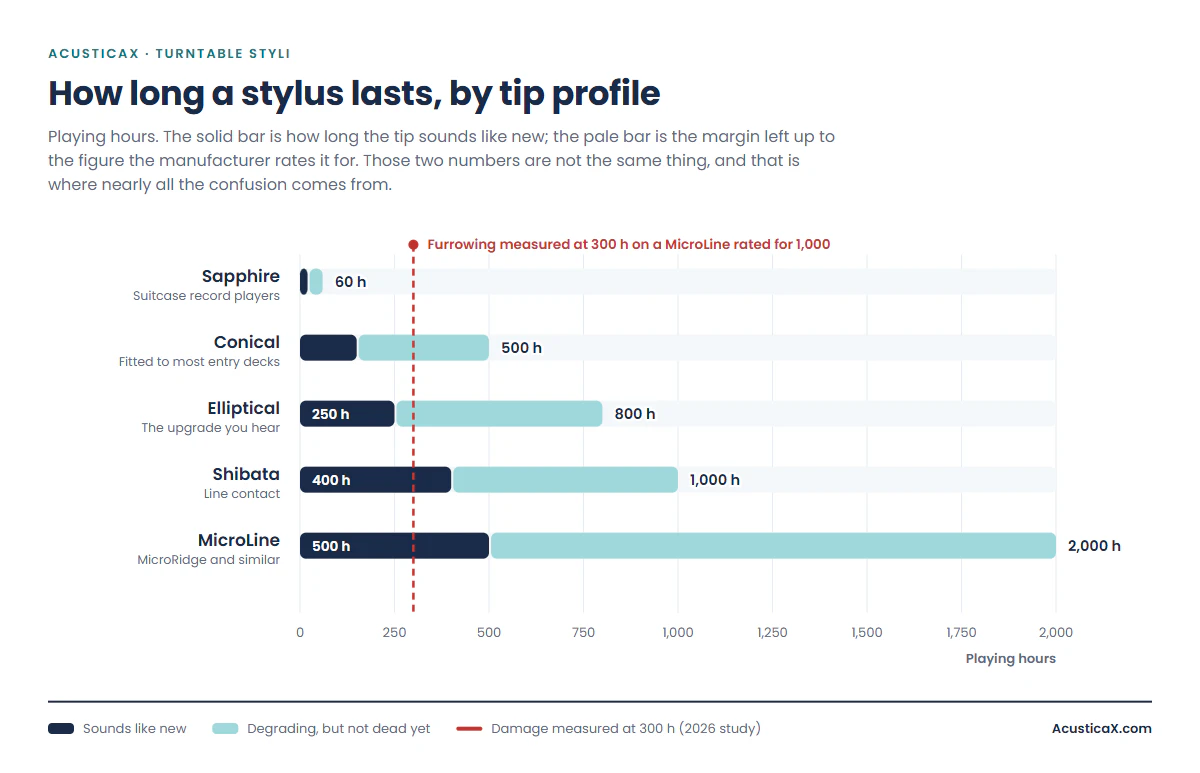
Rated hours and real hours, side by side
Almost everything written on this subject quotes a single number. There are really two, and they are very different: how long the tip survives, and how long it keeps sounding like new. The second one is what matters, because that is the point where it starts mistreating your records.
| Tip profile | Rated | Degradation starts | At one record a day | Replacement |
|---|---|---|---|---|
| Sapphire Suitcase players and vintage gear | 40-60 h | Almost from new | 2 to 3 months | $8-25 |
| Conical / spherical Standard on most entry-level decks | 300-500 h | From ~150 h | Just over a year | $20-45 |
| Elliptical The upgrade you actually hear | 300-800 h | From ~250 h | One to three years | $35-100 |
| Shibata / line contact | 500-1,000 h | From ~400 h | Two to four years | $100-280 |
| MicroLine / MicroRidge | 1,000-2,000 h | From ~500 h | Four to seven years | $170-450 |
Look at that first row, because it affects more people than any other. The sapphire tips fitted to suitcase players last ten to twenty times less than a diamond, and those machines typically track at 4 or 5 grams instead of 2. The combination – soft tip, heavy tracking, nobody counting hours – is the most common reason records get worn out without their owner ever knowing why.
How many hours do you actually play?
Nobody listens in units of “1,000 hours” – people listen in records per week. The conversion is simple, and it is what turns the figures above into something you can act on. An LP side runs 18 to 22 minutes, so a full record is about 45 minutes.
| Your habit | Hours per year | Conical (500 h) | Elliptical (800 h) | MicroLine (1,500 h) |
|---|---|---|---|---|
| One record a week | ~39 h | Every 12 years | Every 20 years | Effectively never |
| Three records a week | ~117 h | Every 4 years | Every 6–7 years | Every 12 years |
| One record a day | ~274 h | Every 20 months | Every 3 years | Every 5 years |
| Two hours a day | ~730 h | Every 8 months | Every 13 months | Every 2 years |
| DJ or party use | Highly variable | Max. 500 h | Max. 500 h | Max. 500 h |
The conclusion surprises people: the casual listener almost never wears a stylus out by hours. They lose it earlier to dirt, to a knock, or to the rubber suspension hardening with age. The opposite is just as true – someone playing two hours a day on a conical tip is due a new stylus every eight months, however recently it feels like they fitted one.
Why the numbers you find online contradict each other
If you have looked this up before, you will have seen figures that flatly disagree, and it is worth knowing why rather than trusting whichever one appeared first. Manufacturers are not all publishing the same metric. Audio-Technica, in its own educational material, gives no per-profile figure at all: it quotes a single band for any diamond stylus, “300 – 1,000-hour playback lifespan”. Ortofon says a stylus can reach 1,000 hours “with proper care” – clean records, a brushed tip, correct tracking force – and cuts the ceiling to around 500 hours for DJ use. Nagaoka accepts that in home use, sound quality starts to fall off between 150 and 200 hours. None of them is lying: some are quoting mechanical life and others sonic life.
There is also a recent warning worth knowing. In 2026 a year-long study followed an Audio-Technica AT-VM95ML – a MicroLine tip from the top of the rated range – combining microscope photography with harmonic distortion measurements. By 300 hours the tip was already bottoming out in the groove on some records, and the images showed furrowing: the stylus cutting its own channel rather than following the existing one. The study stopped there because the test records were too damaged to measure reliably. It is one tip, in one system, with one set of habits, so it is not a universal rule – but it is a clear signal that the catalogue figure describes the best possible case, not necessarily yours.
The sensible way to use all of this: treat the low figure for your profile as the point to start watching, and the high one as a limit you should not push past. Between the two, the decision belongs to your ears and to the test further down this page.
Seven signs of a worn stylus
Wear does not arrive suddenly – it creeps in as a slow decline your ears quietly adapt to. That is why these are ordered by reliability: the first ones appear earliest and mislead you least.
The five you can hear
- Sibilance – spitty S sounds on vocals. The first symptom and the most reliable one. Sibilants are the most demanding signal cut into a record, so a tip with a flat facet fails there before it fails anywhere else. If every singer suddenly sounds like they are hissing at you, check the stylus.
- Distortion at the end of a side but not at the start. This is inner-groove distortion: closer to the label, the same music is packed into a shorter path with tighter curves. A worn tip copes on the outer tracks and gives up on the inner ones. If the last track of every side sounds rough and the first one is clean, the stylus is suspect number one.
- Loss of treble and detail compared with how that same record sounded a few months ago. Cymbals lose their shimmer, the room behind the recording disappears, and everything flattens out slightly.
- Mistracking on loud passages even with tracking force set correctly. A deformed tip cannot stay in the groove once modulation gets wide.
- New surface noise on records that used to play clean. Watch this one carefully: if the noise is on specific records, it is the records; if it appears across the whole collection at once, it is the stylus.
One honest caveat about sign number three: the treble you lost may not be in your system. From your forties onwards, human hearing naturally gives up the region above 14 kHz – exactly the range you miss when a stylus wears. Before spending money, take two minutes to check how high your own hearing still reaches: if your ceiling sits at 13 kHz, the sparkle you think the record lost may have been lost by you.
The two you can see
A 10× jeweller’s loupe – under $15 – and a strong side light will show you enough. A phone works too, with the loupe held in front of the lens. You are looking for two specific things:
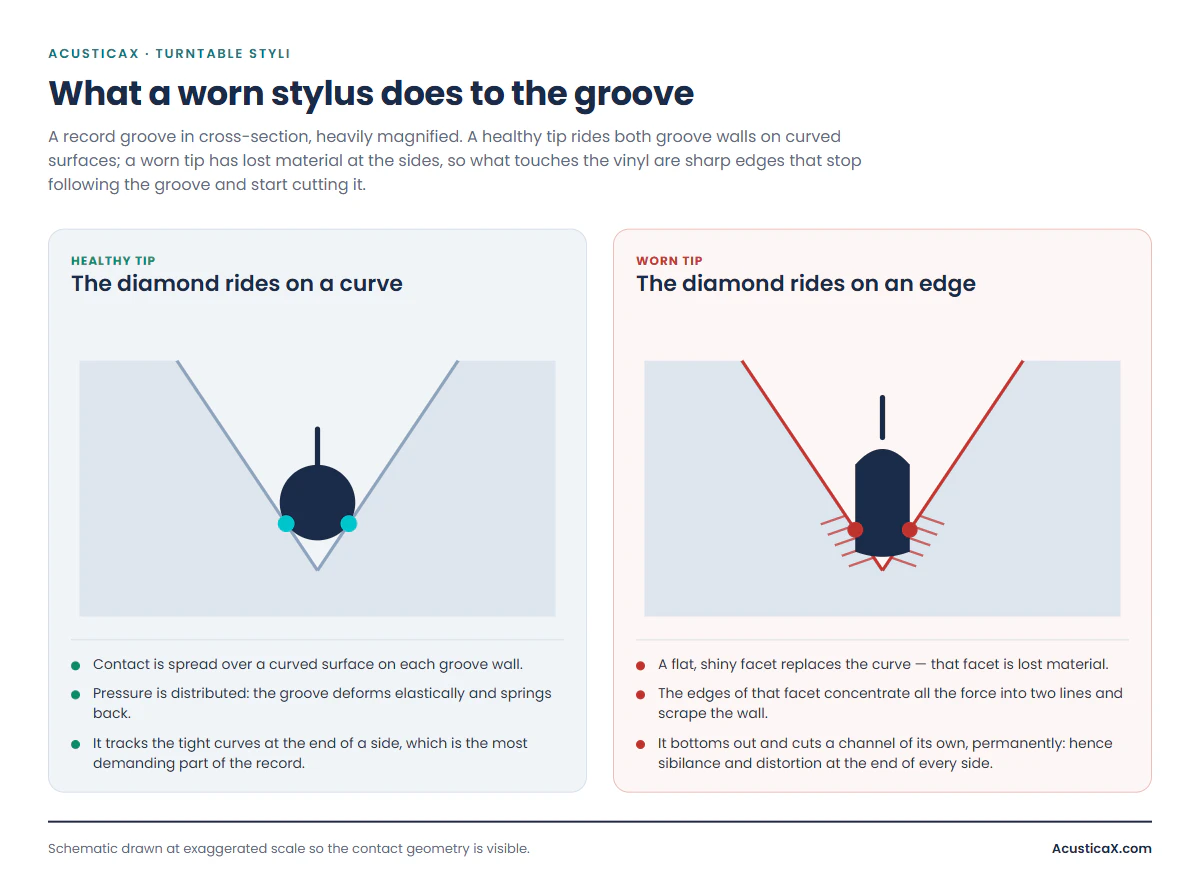
- A flat, shiny facet on one side of the tip. A new diamond does not reflect light in a plane, it reflects it in a curve. When a flat flash appears as you rotate the loupe, that plane is lost material – and its edges are the sharp corners that no longer fit the groove wall.
- A bent or sagging cantilever. The little tube holding the diamond should come out straight and centred. If it leans to one side or has pulled up towards the cartridge body, what has failed is the rubber suspension – a new stylus will not fix that, and it usually means a new cartridge.
How to check stylus wear without a microscope: the inner-groove test
This test settles the question in ten minutes, and hardly anyone explains it even though it is essentially what the serious studies do: instead of judging whether it “sounds worse”, measure how much distortion appears in the part of the record where a worn tip fails first. No lab gear needed – a microphone in front of a speaker will do.
- Pick a record you know well and that is properly clean. A vocal with plenty of sibilance is ideal.
- Play the first track of the side and watch the spectrum on the real-time spectrum analyzer, microphone pointed at one speaker at a moderate level. Watch the 5-12 kHz region during the sung passages.
- Skip to the last track of the same side and repeat at exactly the same volume.
- Compare. With a healthy tip, treble energy looks broadly similar in both. With a worn one, the inner track grows a ragged ridge of energy between 5 and 10 kHz that is not there on the outer track – inner-groove distortion, made visible.
To close the loop, do the version of the check that almost nobody bothers with: record thirty seconds of that inner track today, save the file, and record it again once the new stylus is fitted. With those two clips you can run a blind A/B/X listening test that tells you, with a p-value, whether the improvement you think you hear is real or is the sound of the money you just spent. It is the only way to know whether the change did anything – and it works just as well for deciding whether a costlier tip is worth it.
Before you blame the stylus: five faults that sound identical
A large share of replacement styli were never needed. These five problems produce the same symptoms – distortion, skipping, harsh treble – and none of them is fixed by a new tip. Rule them out before you pay.
| What you hear | If also… | It’s this, not the stylus | Fix |
|---|---|---|---|
| Constant distortion and hiss | Grey fluff visible on the tip | Dirty stylus | Carbon-fibre brush, back to front. This is cause number one |
| Skipping and breakup on loud passages | Started after moving the deck | Tracking force too light | Rebalance the counterweight to the maker’s figure |
| Right channel dirtier than the left | Always the same channel | Anti-skate misadjusted | Start by matching it to the tracking force |
| Crackle and background hum | Changes when you touch the cables | Contacts or grounding | Clean the four headshell pins and tighten the ground wire |
| Everything sounds off-pitch or wobbly | Happens on every record | Platter speed | Stretched belt or tired motor – measure it before touching anything else |
The last one deserves an objective check, because it is the easiest to confirm and the one fewest people think of: a stretched belt or a tired motor makes everything sound slightly off-key, with audible wobble on sustained notes – piano gives it away instantly. You can measure your actual platter speed with a phone microphone in a minute and read the deviation as a percentage; anything past 0.5 % is audible. And if the check points at something further back in the chain, here is which parts of a turntable genuinely affect the sound.
How to find out which stylus your turntable takes
Once you have confirmed it needs replacing, the question that stalls most people is which replacement to buy. The answer is not the make of your turntable but the cartridge fitted to it, which is often not the one it left the factory with. Here are the four routes, fastest first.
The code printed on the cartridge itself
Nearly every cartridge carries its part number on the side or the top face. Look at it under raking light, with the loupe if necessary, and you will find something like AT3600L, ATN95E, OM5E, NP6 or DN166. That reference is all you need to search for a replacement, and the naming logic helps: with most brands, the cartridge and its stylus share a number with one letter changed. An Audio-Technica AT-VM95E cartridge takes an AT-VMN95E stylus; Ortofon’s OM series takes OM styli. Find the cartridge number and you have the stylus number.
If nothing is printed, or the deck is decades old
On older machines – the Technics, Dual, Garrard, Pioneer and BSR decks that keep turning up in lofts and thrift shops – the reference is usually worn away or hidden. Then you work by elimination:
- Make and model of the turntable, printed on the front, the back or under the platter. With the exact model, the cross-reference tables specialist dealers publish will tell you which cartridge it shipped with.
- A good photograph of the assembly: headshell, cartridge and stylus, from the front and from the side, well lit. It is the first thing any hi-fi dealer will ask for, and it identifies the mounting format even when there are no numbers left.
- The manual or the box, if either survived. Manuals for almost every classic model have been scanned and posted online, and they usually list the replacement part.
- The mounting type. Half-inch with two screws is the standard and accepts almost any modern cartridge; P-mount plugs straight into the arm; and on suitcase players the stylus clips into a ceramic cartridge that rarely carries any branding at all.
A word about “universal” styli
There is no such thing as a universal stylus in the strict sense. What gets sold under that name are sapphire tips with a body that fits the ceramic cartridges used in almost every suitcase and briefcase-style player – Crosley, Victrola, ION and their many relatives. Within that world they work, and they are the only realistic option. Outside it they are useless: forcing a “universal” stylus into a moving magnet cartridge will not produce sound, because the mechanism is entirely different.
If that is your situation, keep the whole machine in view: on suitcase decks and cheap Bluetooth record players the replacement costs little and needs doing often, but the player as a whole tracks far heavier than it should. If the records you are playing have any value – sentimental or otherwise – that is the moment to consider a better deck rather than yet another $10 stylus.
New stylus, new cartridge, or a retip?
There are three routes, and which one applies depends on the type of cartridge rather than on your budget. The rule that covers most of it: on a moving magnet (MM) cartridge the stylus pulls off and replaces in ten seconds; on a moving coil (MC) the stylus is not removable, so the only options are sending it back to the maker or buying another.
| Situation | What to do | Ballpark cost |
|---|---|---|
| MM cartridge, worn tip, straight cantilever | Genuine replacement stylus. It pulls forward and slightly down | $20-170 |
| MM cartridge, bent or sagging cantilever | New cartridge: the suspension is worn too | From $60 |
| Budget MM cartridge over 15 years old | New cartridge. A new stylus on hardened rubber is money thrown away | From $60 |
| Mid-range MC cartridge | Replace it, or use the maker’s trade-in programme | From $220 |
| Expensive MC with an intact cantilever | Retip: a specialist workshop replaces the diamond only | $200-400 |
| Suitcase player with a ceramic cartridge | Compatible sapphire stylus – and consider a better deck | $8-25 |
Is an aftermarket stylus worth it instead of the genuine part?
Aftermarket styli cost a third to a half of the genuine part, and the difference is rarely the diamond: it is the rubber suspension and the cantilever, which decide how the tip tracks the groove and how the assembly behaves in your tonearm. A cheap aftermarket unit usually fits a conical tip where the original had an elliptical, so you end up with something that lasts less, retrieves less detail, and can shift the resonance of the arm-and-cartridge pair.
A sensible line to draw: on a cartridge under about $70 the aftermarket stylus is defensible, because the genuine part costs nearly as much as the whole cartridge. Above that, and wherever the maker still sells an official replacement, buy genuine or step up to a better cartridge instead. If you are weighing up the second option, the guide on picking a moving magnet cartridge for your deck covers the pairings that make sense for your tonearm and phono stage.
How to replace a turntable stylus, step by step
On an MM cartridge this is a thirty-second job that needs no tools at all. The only delicate parts are never touching the diamond with your fingers and never leaving the tonearm loose.
- Switch off, take the record off, and clamp the tonearm in its rest. A loose arm falling onto the platter takes out both the new stylus and whatever record was sitting there.
- Fit the plastic guard to the old stylus before handling it. You will work with far more margin for error.
- Pull the old stylus off by holding the cartridge body in one hand and drawing the assembly forward and slightly downward with a small rocking motion. Do not pull straight down and do not force it: if it will not come, that model detaches differently and it is time to check the manual.
- Click the new one in with its guard still fitted. Check that it sits parallel to the body with no side play.
- Reset the tracking force. This step gets skipped almost every time and it is what kills new styli: every tip has its own recommended range, and an elliptical does not want the same weight as the conical you just took off. Zero the counterweight with the arm floating, then dial in the maker’s figure.
- Remove the guard and allow a few hours of run-in. A new suspension is stiff, and the sound settles over the first few plays.
If you replaced the whole cartridge rather than just the stylus, there is one more step and it is not optional: realigning. Geometry changes with every cartridge body, and a well-chosen cartridge mounted crooked sounds worse than a cheap one mounted straight. The same tool you used to measure platter speed also has the alignment protractor, printable at full size and set to your tonearm’s geometry.
How to keep track of the hours without obsessing
If stylus life is measured in hours, the hours have to be counted. The good news is that you do not need a stopwatch: counting sides is enough, because a side is roughly twenty minutes and the accumulated error is trivial against a 500-hour threshold.
- A pencil mark on the sleeve. The old method: one tick on the inner sleeve each time you play a side, and a monthly total on a sheet of paper. Three sides make an hour.
- A pinned note on your phone. Two numbers – the date you fitted the stylus and the running count of sides. It is the minimum that works.
- An hour meter. Dedicated chronographs you start as you drop the arm, and logging apps, both exist and cost little. They only help if you have the discipline to use them every time.
- Estimating from habit. If you would rather count nothing, use the hours-per-year table above, write the fitting date on a slip of paper inside the deck’s box and set a calendar reminder. It is rough, but infinitely better than having no idea at all.
Whichever you choose, write the fitting date down somewhere it will not get lost. The most repeated question on any vinyl forum is “how many hours do you reckon this stylus has?”, and it has no answer: a tip with 200 hours and one with 900 look much the same without a decent microscope.
How to clean a stylus and make it last
The thing that shortens stylus life most is not playing time, it is dirt. Every dust particle trapped in a groove is an abrasive the tip drags across under pressure, and at the contact patch – a few microns across – that pressure is enormous. A stylus working on dirty records can last half as long, and that dirt gets pressed into the vinyl on the way past.
- Brush the tip before every side with a carbon-fibre brush, always back to front, never side to side: the cantilever is not built to take lateral force.
- No liquid poured onto the cantilever. If you use a dedicated cleaner, apply it to the brush and never straight onto the stylus – solvent wicking up the tube attacks the adhesive holding the diamond and the rubber in the suspension.
- Melamine blocks do work – the magic-eraser trick – but only the plain white part, used dry, lowering the arm gently two or three times. Wet them and the mesh collapses and stops cleaning.
- Clean the record, not just the stylus. An antistatic brush before each side removes what would otherwise end up under the diamond.
- Correct tracking force, always. Tracking too light wears things faster than tracking slightly heavy: the tip bounces inside the groove and hammers the walls instead of gliding along them.
- Dust cover down, guard on whenever you are not listening. The dust that settles between sessions is the dust that ends up in the groove.
The first three cost under $35 between them and make the difference between 400 and 800 hours of useful life. The rest of the job is on the record side – how to clean vinyl records without damaging them has its own guide, and which sleeves to use and how to store them is covered in the guide to storing your vinyl collection properly, which is the other half of the same problem.
Frequently asked questions
How do you know when a turntable stylus needs replacing?
Compare the first track of a side with the last one. If the inner track distorts and hisses on sibilants while the outer track stays clean, the tip is worn – that is inner-groove distortion, the most specific symptom there is. A 10× loupe confirms it if you can see a flat, shiny facet on the diamond. And before buying anything, rule out a dirty tip or misset tracking force, which are the two most common causes.
What is the lifespan of a turntable stylus?
500 to 1,000 playing hours in most cases, which at one record a day is roughly two years. A conical tip brings that down to 300-500 hours; a MicroLine pushes it up to 1,000–2,000. Sapphire tips on suitcase players last only 40–60 hours. Catalogue figures describe the best case: on dirty records they halve.
What does a worn stylus sound like?
Spitty, exaggerated S sounds on vocals is the giveaway, along with distortion that appears on the last track of a side but not the first. Beyond that: dulled treble, less detail than the same record had a few months ago, mistracking on loud passages, and new surface noise across your whole collection at once rather than on particular records.
Can a worn stylus damage your records?
Yes, and permanently. A worn tip has sharp edges where it should have curves, so it stops riding the groove wall and starts scraping it – eventually cutting a channel of its own. Vinyl does not heal: damage from a single play with a ruined stylus stays there for good. A stylus costs far less than the records it is chewing through.
How do I know which stylus my turntable needs?
Look for the part number printed on the side or top of the cartridge: codes like AT3600L, ATN95E, OM5E or NP6, which is all you need to search for a replacement. With most brands the stylus carries the cartridge’s number with one letter changed. If nothing is printed, identify the make and model of the deck, or take a well-lit photo of the headshell from the front and the side to a specialist dealer.
How much does it cost to replace a stylus on a record player?
A sapphire tip for a suitcase player runs $8-25; a genuine replacement for a common domestic cartridge, $35-100; and an advanced profile, $170-450. A professional retip on a moving coil cartridge sits between $200 and $400, so it only pays on expensive cartridges with an intact cantilever. There is no labour cost: the swap takes thirty seconds at home.
How do you clean a turntable stylus?
With a carbon-fibre brush, dry, always moving back to front and with the lightest possible pressure. Never side to side, because the cantilever cannot take lateral force. If you use a cleaning fluid, wet the brush rather than the stylus, so nothing wicks up to the diamond’s adhesive or the rubber suspension.
In short: write down the date you fitted the stylus, count sides rather than years, brush the tip before every listen, and when in doubt compare the first track of a side against the last. Replacing it on time costs a few tens of dollars; leaving it too late costs you the collection.