
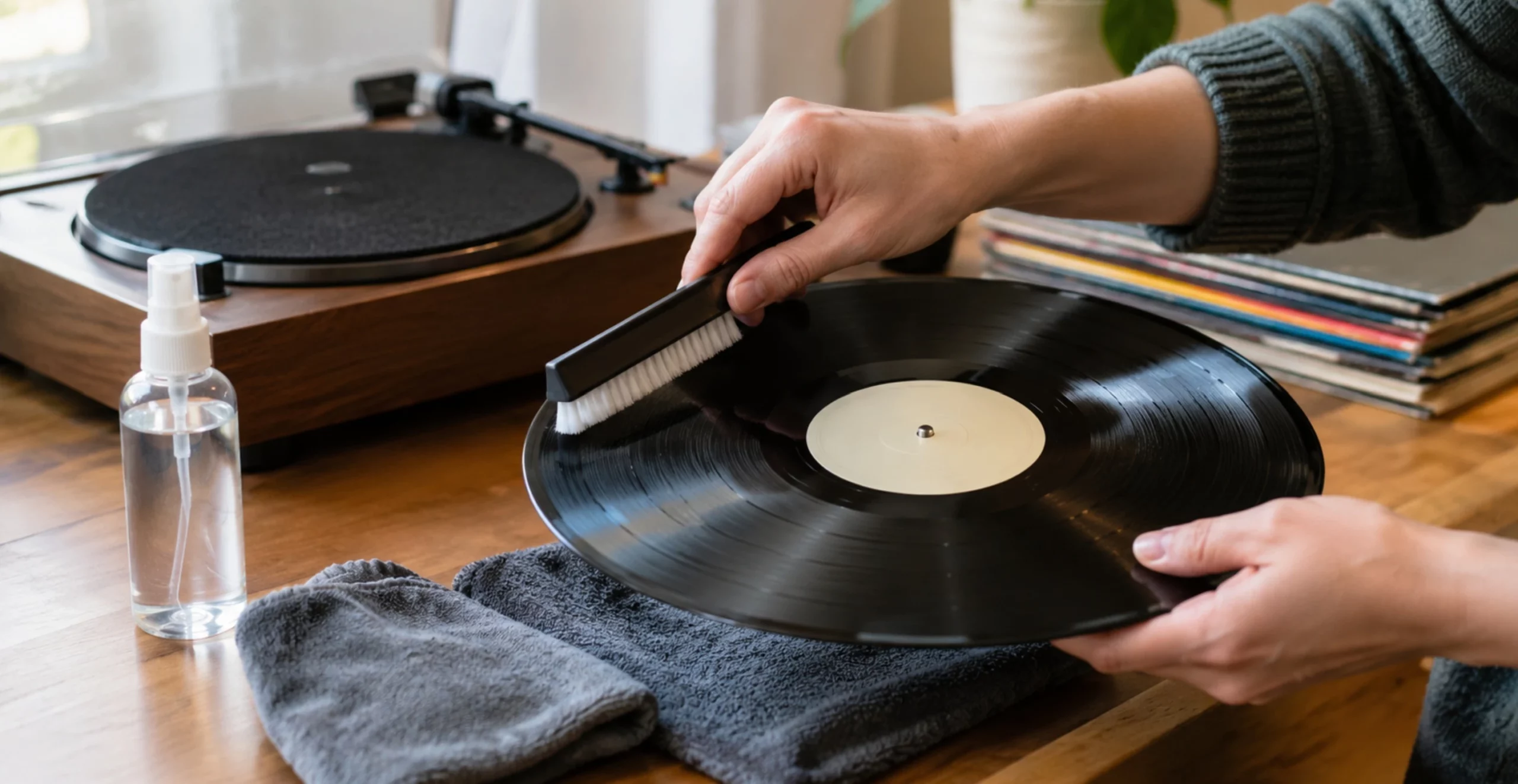
To clean vinyl records without damaging them, you need two habits. Before every side, a dry carbon fiber brush with the platter spinning and no pressure. And when a record is secondhand, covered in fingerprints or crackling like frying bacon, a wash with distilled water and a few drops of surfactant (the ingredient that lets water wet the surface and lift grease), worked in with a soft brush along the groove, rinsed with plain distilled water and left to dry completely before it goes into a fresh sleeve. Alcohol is unnecessary, and on a shellac 78 it is off limits, because alcohol dissolves shellac. Heat is out too, and so are household products that leave a film in the groove.
This is how sound archives do it, scaled down for home. The Library of Congress, the NEDCC conservation lab, the guidelines of IASA (the International Association of Sound and Audiovisual Archives) and the SonoLAB at Complutense University of Madrid agree on the essentials, and where they disagree, we say so. Doing it right pays off. The Library of Congress preservation bibliography summarizes wear tests that Hans Fantel published in The New York Times in 1976: an LP cleaned before every play was almost as good as new after 200 plays, while a dirty, neglected one could be badly damaged in fewer than twenty.
How to clean vinyl records in five steps
The protocol labs use to wash records fits into five steps. At home we reckon on about ten minutes per record, plus drying time. It comes from the NEDCC procedure for lacquer discs, the most fragile records there are, and from the IASA guidelines, so for vinyl, which is far tougher, it is more than enough.
If you want to know afterwards whether it worked, count the record’s clicks first. The click counter in our turntable calibration tool listens through your microphone to a stretch with no music (the run-out groove at the end of the side, or the lead-in) and gives you clicks per minute before and after cleaning. It is a rough measure, but good enough to compare the same record.
- Remove loose dust dry. With the record spinning on the platter, rest the carbon fiber brush on it without pressing, let it ride for two or three revolutions, then slide it off toward the edge, slowly. Lift it straight up and the dust drops back onto the record.
- Wet the playing surface, not the label. Use distilled water with a surfactant. NEDCC uses 0.5% Tergitol 15-S-7, a lab-grade surfactant, and at home a few drops of fragrance-free dish soap in about two cups (500 mL) of water do the same job. Cover the label with a label protector or keep the center dry.
- Let it sit for 2 to 5 minutes, then work it in with a soft brush or a microfiber cloth in circles, following the groove and without pressing. Never wipe from the center out or in a straight line.
- Rinse with distilled or deionized water. This is the step almost everyone skips, and the one that stops the dissolved grime from drying back into the groove.
- Blot dry with microfiber and stand the record upright in a rack until it is completely dry, about 30 minutes. Then into a clean inner sleeve. Never sleeve a damp record.
If you only do one thing, make it the first step. A carbon fiber brush costs $15 to $35, and using it before every side keeps dust from bonding to the groove, so you need to wash far less often.
Is it vinyl, shellac or lacquer? Check before you wet it
Check what the record is made of before anything touches it, because what is harmless to one ruins another. Vinyl (LPs and singles at 33 and 45 rpm) is light and slightly flexible. A 78 from before the 1950s is usually made of mineral fillers bound with shellac, and it is heavy, rigid and brittle. A lacquer disc, often called an acetate, is a one-off direct recording, a nitrocellulose coating on an aluminum or glass base (nothing to do with shellac), and the most fragile of the three. IASA adds a fourth case, laminated discs with a paper or cardboard layer under the surface, which it does not consider suitable for wet cleaning.
| Method | Vinyl | Shellac (78 rpm) | Lacquer or acetate |
|---|---|---|---|
| Dry brush | Yes, before every side | Yes, gently | Yes, very gently and along the groove |
| Water with surfactant | Yes | Yes, and dry it right away | Only if there is no cracking or flaking, ideally by a pro |
| Alcohol | Optional, isopropyl, one part to three of water at most | Never | Never |
| Ultrasonic bath | Yes, with the water below 35 °C (95 °F) | With care, no heat and no alcohol | No |
| Vacuum machine | Yes | Yes, with an alcohol-free fluid | Professionals only |
| Wood glue or peel-off film | Only on records you are willing to risk | No | No |
Why the rinse matters
Rinsing matters more than the recipe, because whatever dries in the groove stays there, cleaner and minerals alike. We ran the numbers. The groove on a 20-minute side is about 430 meters (1,400 ft) long and, at a typical width of 56 µm, holds just 0.34 mL, roughly seven drops. One milliliter of a 0.5% surfactant solution like NEDCC’s leaves 5 mg behind as it dries, enough to fill about 1.5% of that groove. One milliliter of tap water with 500 mg of dissolved minerals per liter leaves ten times less (0.5 mg), and soft water less still. A few drops of dish soap in two cups of water leave less than that tap water, by our estimate, but they stay too if you skip the rinse.
This matches the IASA-TC 04 guidelines, which accept washing by hand with tap water as long as you finish with a thorough rinse in demineralized water. Some sources are stricter, among them the Complutense lab and machine makers such as Degritter, which want distilled water throughout. What nobody disputes is the final rinse.
Drying and resleeving without undoing the work
Blot the record with a clean microfiber cloth, which does not shed lint, then stand it in a dish rack or a record rack until there is no moisture left anywhere. NEDCC allows about 30 minutes and never resleeves a wet disc, because moisture lets the sleeve grow mold. Spin-Clean’s instructions say its drying cloths leave the record ready to play. The What Hi-Fi? tester still racked his records to air-dry for a few hours, in case the cloth had not reached the bottom of the groove, and we would do the same.
Don’t put it back in the paper sleeve it came out of. Paper sheds fibers and drags dust across the groove every time the record goes in or out, and the Library of Congress recommends replacing it with a high-density polyethylene sleeve. Which sleeves to buy and how to shelve the record afterwards is covered in our guide on how to store vinyl records.
A carbon fiber brush before every side
The cleaning that protects a record most is also the simplest, a carbon fiber brush before every side with the platter turning. The fibers conduct electricity, so they drain static through your hand, and they are fine enough to reach into the groove. That is why brushes such as Audio-Technica’s AT6013a pair rows of carbon fiber with a velvet strip, which picks up the dust while the carbon bleeds off the charge.
Hold it at an angle with no pressure, let the record turn two or three times, then slide it off toward the edge, slowly, as the SonoLAB at Complutense University (in Spanish) describes it, so the dust stays in the bristles instead of landing back on the record. If dust reappears right after brushing, or the record crackles as it leaves the sleeve, static is the culprit, and according to IASA it takes off in dry air, below 25% relative humidity.
What you should not do is dry-wipe with a rag, a tissue or a paper towel. You drag dust along the groove like sandpaper, charge the record with static and, with paper, leave fibers behind. The IASA-TC 05 guidelines boil it down to two rules, bristles softer than the material and a motion that follows the groove. Carbon fiber is stiff as a material, but each filament is so thin that it bends at a touch. If you want to follow the rule to the letter, velvet and goat hair are softer still.
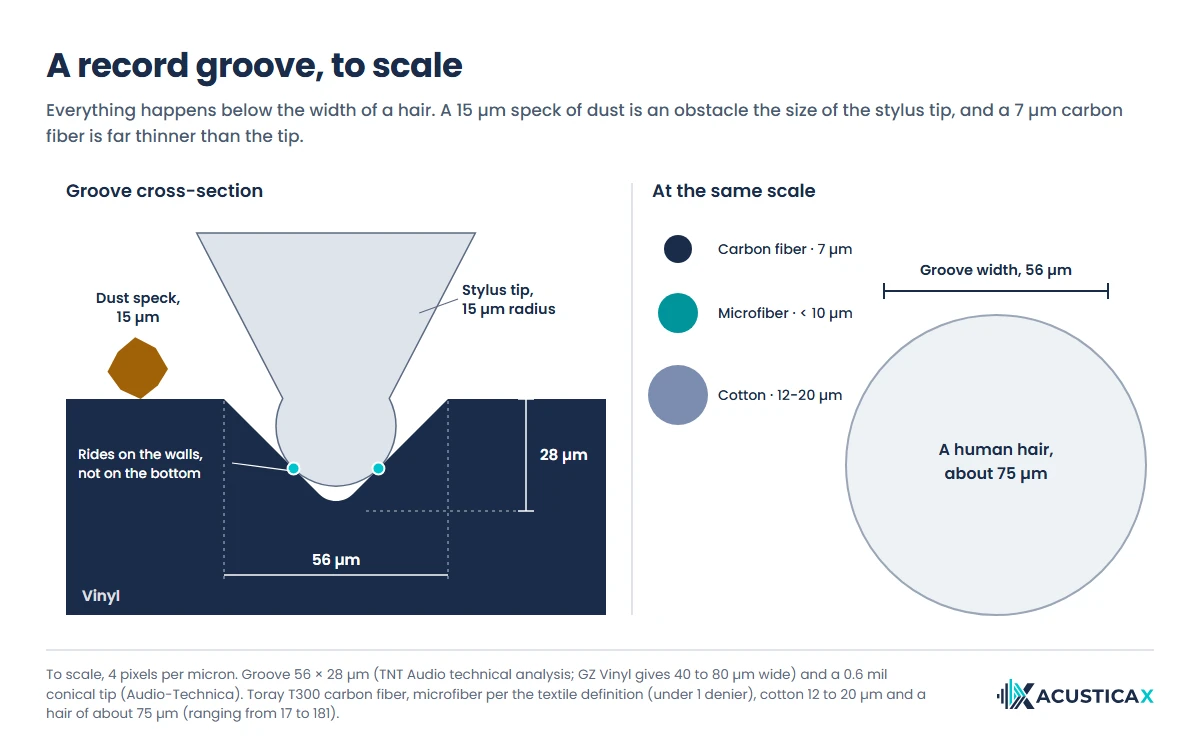
Scale explains why dust matters so much. The groove is about 56 µm wide, narrower than a human hair, and a conical stylus tip has a 15 µm radius. A 15 µm speck of dust is an obstacle the size of the tip itself, and the stylus crushes it into the groove walls with the whole tracking force concentrated on a few microns.
Which record cleaning solution should you use?
Distilled or deionized water with a little surfactant, which is what conservation labs use. The surfactant lets water wet the vinyl, get into the groove and lift fingerprint grease, while plain water just beads up and runs off. NEDCC, whose protocol is based on research by the Library of Congress, uses 0.5% Tergitol 15-S-7 in deionized water, and the Complutense lab uses three parts distilled water to one part alcohol. At home, a few drops of fragrance-free dish soap do the same job, provided you rinse afterwards.
A commercial record cleaning solution works too, although few publish their formula, and IASA keeps products that don’t disclose theirs out of archives. With distilled water and a surfactant, you know exactly what goes on the record. Many DIY recipes call for Triton X-100, which you don’t need, and which in the European Union has required an authorization since January 4, 2021 under Regulation (EU) 2017/999. Tergitol or a drop of dish soap does the same job.
| Product | Use it? | Why |
|---|---|---|
| Distilled or deionized water | Yes | To wash and, above all, to rinse. Avoid scented ironing water |
| Tap water | For washing, yes | If you rinse with distilled water afterwards (IASA). Left to dry, its minerals stay in the groove |
| Dish soap | A few drops | Fragrance-free, without lotions, and always rinsed off. Hand soap leaves residue (Complutense SonoLAB) |
| Plain isopropyl alcohol | Optional, vinyl only | One part to three of water at most. Never on shellac or lacquer, or in an ultrasonic bath |
| Scented rubbing alcohol | No | Wintergreen, aloe and other additives don’t evaporate with the alcohol |
| Glass cleaner | No | Typically contains ammonia, solvents and fragrance, and leaves a film |
| WD-40 | No | A solvent carrying a petroleum-based oil that stays in the groove and ends up on the stylus |
| Vinegar | No | Adds nothing a surfactant doesn’t, and leaves a smell |
| Toothpaste | No | It is abrasive, so it polishes, which means it scratches |
| Baby wipes | No | Usually contain lotions that stay in the groove |
| Paper towels | No | They shed fibers and scratch when dry |
| Wood glue | With reservations | It can work, but it has risks (more below) |
Can you clean vinyl records with isopropyl alcohol?
Yes, on vinyl and diluted, but you don’t need to. The recipe repeated across the web, and in Google’s AI Overview in October 2026, is one part 99% isopropyl alcohol to three or four parts distilled water, a 20 to 25% alcohol mix. With 70% isopropyl, one part to three of water comes to 17.5%, and the Complutense lab’s mix, made with 96% ethanol, to 24%. For comparison, the Kirmuss ultrasonic machine that What Hi-Fi? tested takes 40 mL of 70% isopropyl in six or seven liters of water, about 0.4%, or 40 to 60 times less. NEDCC uses none at all.
On whether you should, the sources disagree. The Complutense lab uses alcohol because it evaporates without residue, Kirmuss uses it to help the water get into the groove, and the Degritter manual suggests a cloth dampened with isopropyl to take the worst off a very dirty record. IASA rules it out for shellac, lacquer discs and cylinders, and Pro-Ject, which sells cleaning machines, claims without offering evidence that alcohol-based fluids can destroy musical information in the groove. The idea that alcohol “leaches the plasticizers” out of vinyl has not been shown either way. A record is mostly PVC (over 80% of the compound, according to pressing patents), and some formulations include a plasticizer while others do not. In our view, a surfactant and a good rinse get the same result without the argument.
If you do use it, make it plain isopropyl, on vinyl only and one part to three of water at most. Skip rubbing alcohol with wintergreen, aloe or anything else added, since those additives stay in the groove. And never put alcohol in an ultrasonic bath. Branson, one of the big makers of ultrasonic baths, forbids alcohol and any flammable liquid in the tank in the manual for its 3800 bath, citing fire risk, and asks for water-based solutions only. The Kirmuss adds no more than a trace.
Tap, distilled or deionized water
Rinse with distilled or deionized water; for the wash itself, IASA accepts tap water too. Distilled, deionized and demineralized water are the same thing for this job, water without the dissolved minerals that leave spots when it dries. NEDCC rinses with distilled or deionized water “to prevent minerals from depositing,” and Degritter asks for distilled, reverse-osmosis or deionized water because tap-water scale hurts the cleaning. In the US, distilled water is sold by the gallon in most grocery stores, which is plenty for dozens of records.
What actually damages a record when you clean it
These seven mistakes can do more damage than the dirt they are meant to remove. We rank them, in our view, from most to least harmful.
- Alcohol on a shellac or lacquer disc. IASA warns it can have an immediate corrosive effect. With shellac it is easy to see why, since shellac varnish is made precisely by dissolving shellac in alcohol.
- Heat. Pro-Ject flattens warped records in its Flatten it at 58 °C (136 °F) for two hours, according to its user guide, so vinyl will already reshape at that temperature. The heater in a budget ultrasonic tank like VEVOR’s 6-liter record cleaner goes up to 80 °C (176 °F), even though its listing advises staying below 45 °C (113 °F), and the Degritter starts cooling its water as soon as it passes 35 °C (95 °F). IASA wants the fluid and the record at room temperature. No hot water, no hair dryer.
- Letting dirty fluid dry on the record. Whatever you dissolved settles back into the bottom of the groove, out of reach of the brush.
- Getting the label wet. It is paper, so it stains or peels. On lacquer discs it is also stuck on with an adhesive that water dissolves, according to NEDCC.
- Sleeving a damp record. The sleeve grows mold, and mold attacks the playing surface.
- Dry wiping, or wiping across the groove. Dust acts like sandpaper, and the fine scratches it leaves never come out.
- Pressing hard or using stiff bristles. A toothbrush or a clothes brush scratches, and pressure does not clean better, it only pushes grime deeper.
Outside of cleaning, playing a record dirty, with a worn stylus or with too much tracking force also wears the groove. A turntable that tracks at 5 g, like some suitcase players, punishes it far more than any brush, which we cover in our guide on whether Bluetooth turntables are worth it.
Which record cleaning machine pays off for your collection
With a few dozen records, washing by hand makes the most sense. The $80 Spin-Clean gets to $1 a record or less from 80 records, a vacuum machine ($350 to $800) from 350 to 800 records, the Kirmuss from 1,150 and a $3,600 Degritter from 3,600. That rule of thumb is ours, taken from the chart below, and it leaves out your time, which is where automatic machines win.
The three systems What Hi-Fi? tested in November 2024 (a Spin-Clean manual washer, a Record Restore peel-off film and a Kirmuss ultrasonic machine) all cleaned dirty records well, and none won every time. In its test, the tester recorded the records before and after. All three removed clicks, running a record through a second system added little or nothing, and well-kept records showed no change. Vacuum machines were not part of that test, and IASA says vacuum is usually the most effective wet method.
| Method | Examples and price | Time per record | Strengths | Watch out for |
|---|---|---|---|---|
| By hand | Carbon fiber brush ($15-35) and an alcohol-free record cleaning solution | About 10 min, plus drying (our estimate) | Full control, almost free | Tedious for a big collection |
| Manual washer with pads | Spin-Clean MkII ($80 in What Hi-Fi?’s test) | 3 to 5 min | 20 to 50 records per bath, no power needed | The bath gets dirty, so change it and rinse |
| Vacuum RCM | Record Doctor VI ($349.95), Pro-Ject VC-E2 ($549) or VC-S3 ($799) | One or two turns of vacuum, plus the wash | Dries instantly. IASA says vacuum is usually the most effective wet method | Noise, and the brush touches the record |
| Ultrasonic, dedicated | Kirmuss KA-RC-1 ($1,150 in What Hi-Fi?’s test) or Degritter Mark II ($3,600) | 2 to 8 min plus drying (Degritter) | For the most stubborn grime, according to IASA. The Degritter also filters its water and controls the temperature | The price |
| Ultrasonic, converted tank | VEVOR’s 6-liter 40 kHz tank with a rack for 4 records | Cycles of up to 30 min | Cheap and touchless | Its heater reaches 80 °C (176 °F), and drying is separate |
| Peel-off film | Record Restore (about £1.60 per record, per What Hi-Fi?) | 24 h to dry | No water, no machine | If the film tears, it leaves strands in the groove |
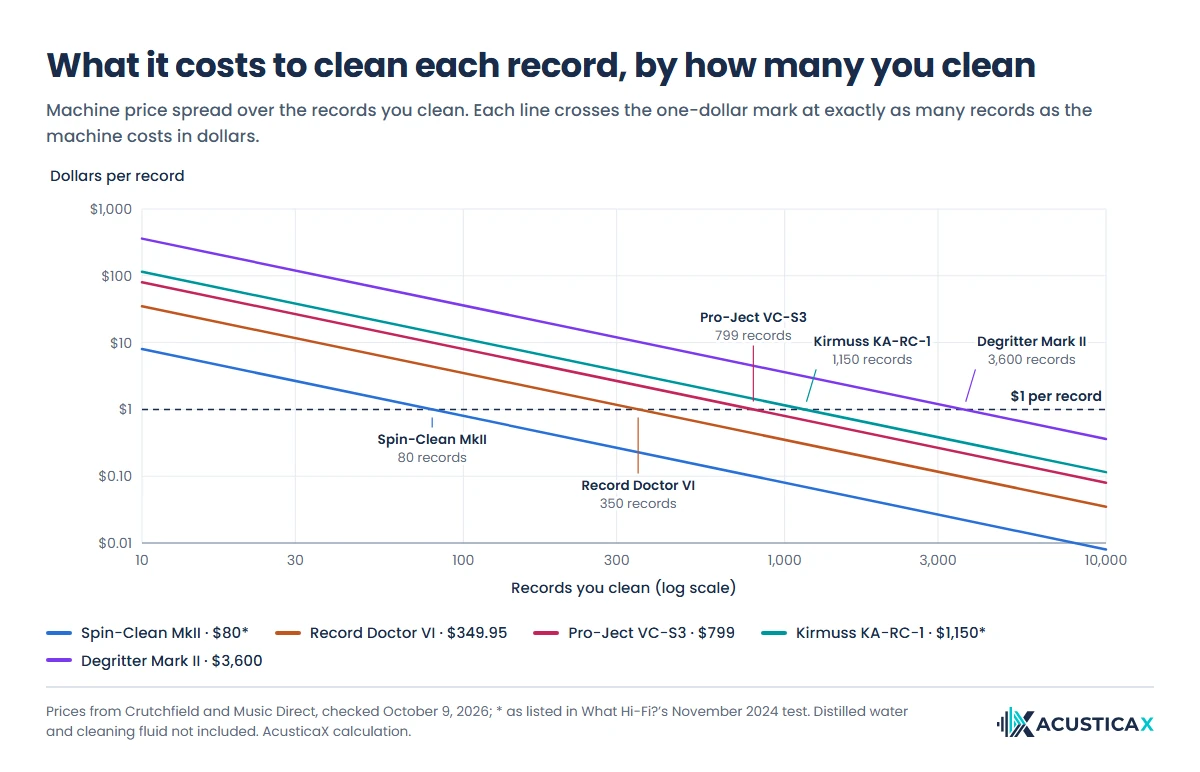
The chart spreads each machine’s price over the records you clean. At 100 records, the Spin-Clean works out to $0.80 a record and the Degritter to $36. The Spin-Clean gets to $1 a record or less from 80 records, the Record Doctor from 350, the VC-S3 from 799, the Kirmuss from 1,150 and the Degritter from 3,600. Water and fluid come on top of that.
Is an ultrasonic record cleaner worth it?
It is if you clean hundreds of secondhand records and value your time; for a handful a year, it is not. Ultrasound makes the water vibrate tens of thousands of times a second, forming tiny bubbles that implode and knock grime loose. In a plain bath nothing touches the record, though some machines add brushes. The higher the frequency, the smaller the bubbles and the gentler the cleaning, according to industrial maker Crest Ultrasonics. VEVOR’s tank runs at 40 kHz, the Kirmuss at 35 and the Degritter at 120.
Three precautions apply. First, keep the water under 35 °C (95 °F), as the Degritter does, because the ultrasound itself warms the bath on every cycle. Second, the fluid, which should be distilled water with a few drops of a low-foaming surfactant and never alcohol. Third, keep the water level below the label. The Degritter Mark II manual also recommends changing the water every one to two weeks, or after 30 records, so nothing grows in it.
Wood glue and peel-off films
They sometimes work, but we would not use them on a record we cared about. The idea is to spread a layer that dries, traps the grime and peels off in one piece. In What Hi-Fi?’s test, Record Restore, a fluid made for the job, removed a skip and several clicks from a brand-new Dire Straits pressing with a first application, and the rest with a second. The tester recommends 4 mL per side and 24 hours of drying, because at 3.5 mL the film tended to tear and left strands in the groove that had to be picked out with sticky tape. Carpenter’s wood glue, the trick that keeps circulating on TikTok, was never meant for this, takes a day per side and is not used by any archive. Never on shellac or lacquer.
Used, moldy, brand-new and shellac records
Used and inherited records
Wash them once before the first play, even if they look clean. You don’t know how the previous owner treated them, and decades of embedded dust are exactly what a stylus turns into wear. Look at them under a strong light first, because deep scratches will not wash out. And if there are 78s among the records you inherit, treat them as shellac until you are sure they are vinyl.
Moldy records
Keep them away from the rest, wear a mask and throw out their sleeves. IASA treats mold as a health hazard, advises getting professional advice and says to clean it outdoors or under extraction. If you do it at home, NEDCC washes moldy discs with the same surfactant-and-rinse method. Don’t dry-brush them first, because you will spread the spores. Then fix the cause: according to IASA, mold sets in when humidity stays above 70%, and how to keep it down is in the storage guide linked above.
Should you clean new vinyl records?
Brush them, yes; wash them only if they click. A new record leaves the plant with dust from its paper sleeve, and sometimes more. The What Hi-Fi? tester found four globs of glue at the start of all four sides of a sealed record, and his new Dire Straits pressing skipped until he cleaned it. What we could not find measured anywhere is the “oily mold-release film” that many sites say every new record carries. Record compounds do contain lubricants that help the disc release from the stamper, and pressing patents only mention oily spots when the formula carries too much plasticizer.
Shellac records and other 78s
No alcohol, little water and immediate drying. IASA rules out alcohol on shellac and asks for these records to be dried at once after any wet cleaning, because their mineral fillers swell with moisture. Wash them with distilled water and a few drops of dish soap, as the Complutense lab does (it uses lukewarm water, while IASA wants fluid and disc at room temperature), or with a fluid that explicitly says it is safe for shellac, such as Pro-Ject’s Wash It 2. The Spin-Clean has a roller position for 10-inch records, and its UK distributor says its fluid contains no alcohol. And no heat. IASA flattens 78s only in the lab, at around 42 °C (108 °F) and with as little heat as possible, and Pro-Ject forbids putting them in its flattener.
Not every 78 is shellac. There are lacquer instantaneous discs, which need even more care, and from the mid-1940s some 78s were pressed in vinyl-type plastics, such as part of the US Army’s V-Disc series. If in doubt, treat it as shellac. And if you can see a paper or cardboard layer under the surface, keep it dry.
How often should you clean vinyl records?
Brush before every side, and wash when you bring home a used record or when it starts clicking where it never did. There is no magic number of plays. The “every 10 to 20 plays” figure that Google’s AI Overview gave in October 2026 traces back to a TikTok video. Where serious sources do differ is on brushing. Audio-Technica notes that some people clean before and after every play, while the Complutense lab considers every five or six plays enough, on the grounds that each pass wears the groove a little. We side with a light brush before every side, because dust that never reaches the stylus never becomes wear.
If it still sounds bad after cleaning
Then the problem lies somewhere else. Either the groove is worn or scratched, the stylus is dirty or worn, or the arm is out of adjustment. If you counted the clicks before washing, count them again at the same spot and the same volume, and the counter will tell you whether the cleaning worked.
How do you clean a scratched record?
The same way as any other, with water, surfactant and a rinse, knowing the scratch itself will stay. What does come out is the grime packed into the scratch, which is why some clicks disappear after a wash. What Hi-Fi? puts it bluntly: no cleaning removes the noise of wear or physical damage. Be wary of tricks that promise to “erase” scratches with toothpaste or polish, because polishing means removing vinyl.
The stylus, dirty or worn
A dirty stylus sounds like a dirty record, and after a cleaning session it tends to pick up whatever was left loose. Brush it from back to front, never side to side. How to clean a turntable stylus without bending the cantilever, and how many hours it lasts before you replace it, is in its own guide. If the noise is the same across your whole collection, suspect a worn tip, and if it is time for a new one, take the chance to choose a turntable cartridge with a better tip profile.
If it skips, check tracking force, anti-skate and level
A clean record that skips almost always has a setup problem, not a dirt problem. Set the tracking force with a stylus gauge to the middle of your cartridge’s range, which the Force tab of our turntable calibration tool gives you, and set anti-skate to the same number. The Level tab checks that the platter is level. If it always skips at the same spot, look at the record under a light, because it may be a scratch or a pressing defect.
Frequently asked questions
Can you use WD-40 to clean vinyl records?
No. WD-40 is mostly a hydrocarbon solvent carrying a petroleum-based oil, and the oil stays in the groove after the solvent evaporates. It traps dust, ends up on the stylus and has to be washed off again with a surfactant.
Can you wash a vinyl record with soap and water?
Yes, with a few drops of fragrance-free dish soap in distilled water, keeping the label dry and wiping along the groove. The key is the final rinse with plain distilled water, because soap left to dry stays in the groove. Hand soap is a worse choice, since it leaves residue.
What should you not clean vinyl records with?
Glass cleaner, WD-40, vinegar, toothpaste, baby wipes, paper towels and scented rubbing alcohol, plus anything hot. On shellac and lacquer discs, no alcohol of any kind. And avoid dry rags, which drag dust along the groove like sandpaper.
Do vinyl records need to be cleaned?
Yes. Dust in the groove is what the stylus turns into noise and wear. In the 1976 tests summarized by the Library of Congress, a record cleaned before every play was almost as good as new after 200 plays, while a neglected one could be badly damaged in fewer than twenty.
What is a good DIY solution for cleaning vinyl records?
About two cups (500 mL) of distilled water with a few drops of fragrance-free dish soap in a spray bottle. If you want alcohol, one part plain isopropyl to three parts water at most, on vinyl only. Spray it without wetting the label, work it along the groove and rinse with plain distilled water.
Are all 78 rpm records shellac?
No. Most commercial 78s from before the 1950s are shellac, but there are lacquer instantaneous discs and some 78s pressed in vinyl-type plastics from the mid-1940s on. Shellac is heavy, rigid and brittle, while vinyl flexes slightly. If you are not sure, clean it as if it were shellac, with no alcohol.
What destroys vinyl records?
Heat, dirt and a heavy or worn stylus. Vinyl reshapes at around 58 °C (136 °F), the temperature record flatteners use, dust in the groove is ground in by every play, and a worn or badly set-up stylus carves the groove walls. Bad storage adds warping and mold.
