
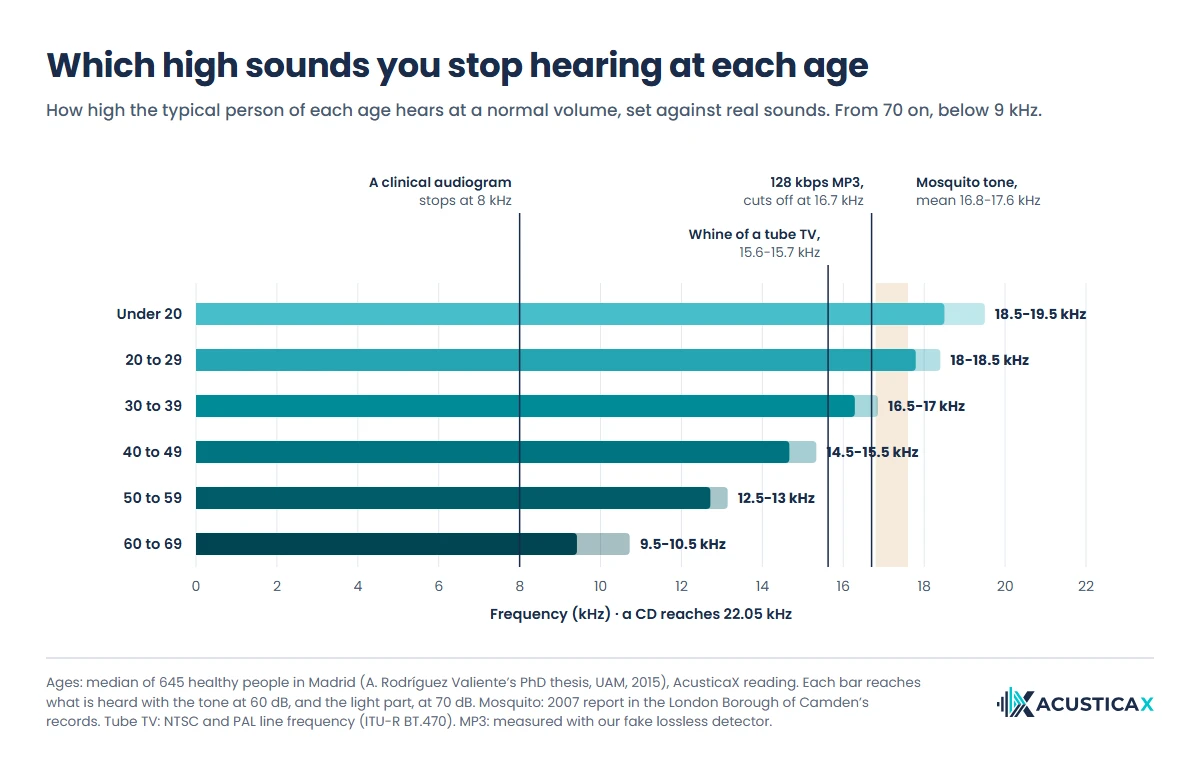
Hearing frequency by age drops by about 2 kHz per decade after 30. In a study that tested 645 people in Madrid up to 20 kHz, the typical person at a normal listening level hears up to about 19 kHz before 20 and 18 kHz in their 20s, then reaches 16.5 kHz in their 30s, 15 kHz in their 40s, 13 kHz in their 50s and 10 kHz in their 60s. Studies from China and the Czech Republic put the start of the decline at the same point, between 30 and 35.
What almost no chart online tells you is that your highest audible frequency depends on volume. Above 12 kHz, your ear needs a lot more level for every extra kilohertz, so the same hearing test gives a different age depending on how loud it plays. And losing the very top end barely touches speech, which is why a clinical hearing test doesn’t even measure above 8 kHz.
Hearing frequency by age, measured in 645 people
With the tone at 60 dB, the typical person hears up to 18.5 kHz before 20 and up to 9.5 kHz between 60 and 69, and raising it to 70 dB adds half a kilohertz to a kilohertz. This is the full hearing range by age, measured in a sound booth with a clinical audiometer.
| Age | Highest frequency with the tone at 60 dB | With the tone at 70 dB | Level needed at 16 kHz | At 18 kHz |
|---|---|---|---|---|
| Under 20 | 18.5 kHz | 19.5 kHz | 40 dB | 55 dB |
| 20 to 29 | 18 kHz | 18.5 kHz | 17 dB | 65 dB |
| 30 to 39 | 16.5 kHz | 17 kHz | 55 dB | 90 dB |
| 40 to 49 | 14.5 kHz | 15.5 kHz | 80 dB | 95 dB |
| 50 to 59 | 12.5 kHz | 13 kHz | 95 dB | 110 dB |
| 60 to 69 | 9.5 kHz | 10.5 kHz | 120 dB or more | 120 dB or more |
| 70 to 79 | Below 9 kHz | Below 9 kHz | 120 dB or more | 120 dB or more |
The numbers come from Antonio Rodríguez Valiente’s PhD thesis, defended at the Autonomous University of Madrid in 2015. He tested otologically normal people from the northwestern Madrid region at Puerta de Hierro University Hospital, in a sound booth, with a clinical audiometer and Sennheiser HDA 200 audiometric headphones, and he reported the high-frequency thresholds in dB SPL, the actual sound pressure level of the tone. The study covered 645 people aged 5 to 90 and was published in the International Journal of Audiology in 2014.
Here’s how to read it. The typical person aged 30 to 39 hears a 16 kHz tone at 55 dB, while the typical person aged 40 to 49 needs 80 dB, so at a normal volume they no longer hear it. The same thing happens at 18 kHz a decade earlier, since the typical person aged 20 to 29 hears it at 65 dB and the typical person aged 30 to 39 needs 90.
Hearing starts to fall at the same age in other countries, though with worse high-frequency results. In China, Wang and colleagues tested 162 healthy adults in 2021 with the same headphone model, counting a response at any level the audiometer could produce (the study doesn’t report its maximum output). At 16 kHz, a response came from 100% of the ears in the 21 to 30 group, 64% in the 31 to 40 group, 38.6% in the 41 to 50 group and 16.1% in the 61 to 70 group. In the Czech Republic, Škerková and colleagues tested 316 people aged 18 to 64 and concluded that high-frequency thresholds begin to deteriorate from age 35.
That makes the Madrid table a fairly optimistic benchmark. The thesis itself concludes that its high-frequency thresholds are better than other researchers’, with an otologically normal sample (no history of heavy noise exposure, no ear-damaging medications and no family history of hearing loss). If you come out a little lower, that’s well within normal.
Why don’t the hearing charts online agree?
Because hardly any of them cite a study, and none of them say how loud the tone was. AI summaries in search results repeat different charts for the same age. One puts people in their 40s at 12,000 to 14,000 Hz, another gives 14,000 to 15,000 Hz for ages 30 to 40, and a widely shared mosquito-tone chart says 14 kHz is heard up to 45 and 16 kHz up to 30. Our own hearing test used a more generous chart, which gave 16 kHz to people in their 40s and 14 kHz to people over 60, and we have corrected it with this data.
The shape of the curve is the root cause. Between 12 and 18 kHz, the level your ear needs climbs by tens of decibels within a few kilohertz (for people aged 30 to 39, from 25 dB to 90 dB). Any difference in volume between two tests shifts the result by one or two kilohertz, and in that region that’s a whole decade of “hearing age”.
What is the highest frequency humans can hear?
About 20 kHz in everyday conditions, though in the lab a few ears have picked up 28 kHz at around 110 dB SPL. Only a young ear listening to a fairly loud tone covers the whole textbook range of 20 Hz to 20 kHz. The top limit is the one that moves with age, and the bottom one barely does. In the Madrid thesis, the median threshold at 125 Hz goes from 15 dB HL in people in their 20s to 25 dB HL in people aged 80 to 90.
Above 20 kHz, people hear very little and only at extreme levels. Japanese researcher Kaoru Ashihara tested tones from 16 to 30 kHz in 2007 at up to about 110 dB SPL at the ear canal entrance, with pink noise in the background so that nobody could respond to distortion at lower frequencies. Only 3 of 32 ears detected 28 kHz, and none detected 30 kHz. Ashihara found that the threshold rises abruptly between 16 and 20 kHz, and that jump explains most of what this article is about.
Below 20 Hz, something else happens. In their review of hearing at low and infrasonic frequencies (2004), Møller and Pedersen explain that the sense of pitch fades out around 20 Hz, below 10 Hz you start perceiving individual cycles, and a feeling of pressure on the eardrums appears. That’s infrasound, which doesn’t sound like a note but can still be perceived when it’s loud enough.
Why your highest audible frequency depends on volume
Because it’s the point where your threshold curve crosses the level of the tone. Up to about 12 kHz, the curve of a healthy adult under 50 is almost flat. Beyond that it climbs by tens of decibels within a few kilohertz, and wherever the test volume cuts across it, that’s your ceiling.
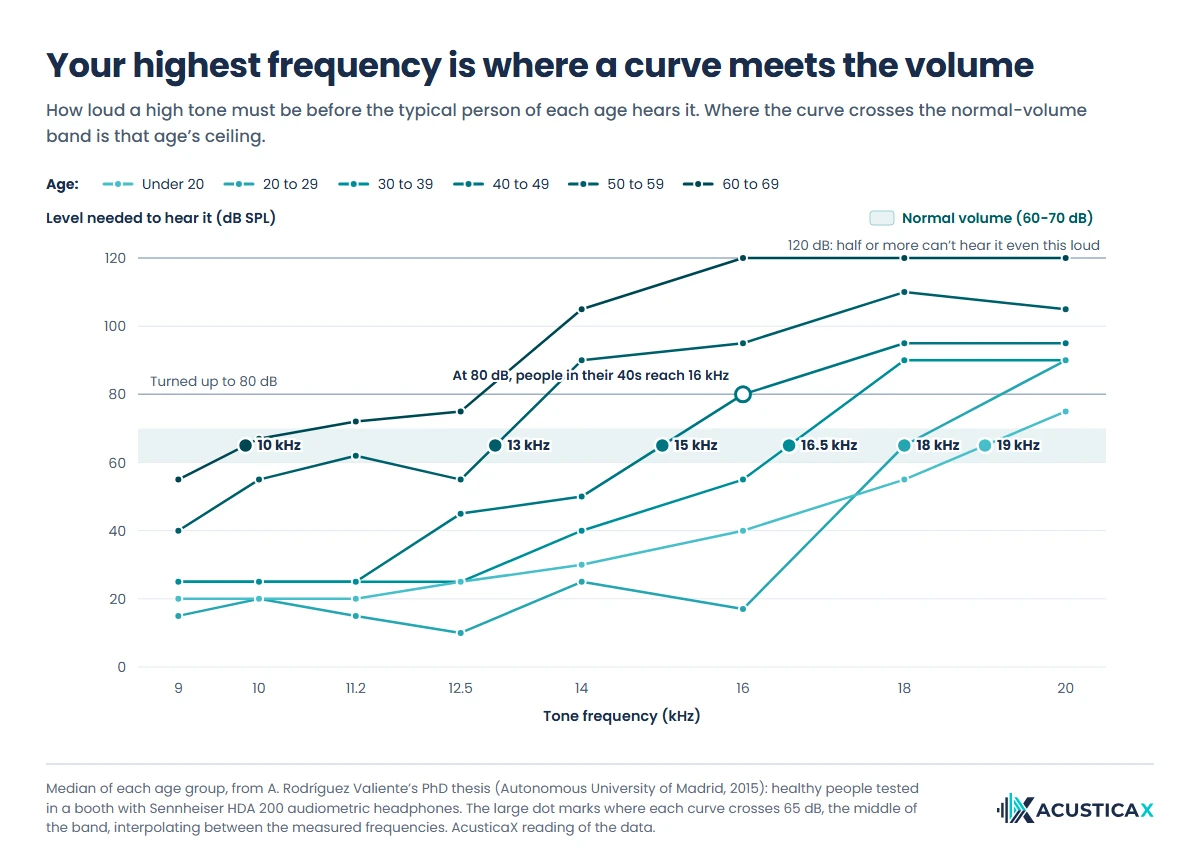
The table shows the effect. Going from 60 to 70 dB adds half a kilohertz to a kilohertz at almost every age. With the tone turned up to 80 dB, the typical person aged 40 to 49 reaches 16 kHz, like someone in their 30s at a normal volume, and the typical person aged 60 to 69 goes from 9.5 kHz to almost 13. In those groups, twenty extra decibels take about ten years off the result.
Turning it up makes you younger on the test, and it isn’t worth it
A hearing age test played loud makes you sound younger than you are, and one played quietly adds a decade. For the result to mean anything, the volume has to be comfortable, around the level of a conversation, and stay put for the whole test.
Cranking it up to catch a tone you can’t hear isn’t a good idea either. Loud, very high pure tones are unpleasant and can leave a temporary ringing. A 2007 report on the Mosquito deterrent, kept in the London Borough of Camden’s records, cites a UK Health and Safety Executive (HSE) report that sets a maximum of 75 to 85 dB for these frequencies, chosen to avoid nausea and tinnitus.
At what age does hearing start to decline?
The very top end, above 9 kHz, starts to go between 30 and 35. The range a standard audiogram covers, up to 8 kHz, holds up far longer, and the median barely moves until the 50s or 60s. Here’s the same Madrid thesis again, this time with conventional audiometric headphones.
| Age | Threshold at 1 kHz | At 4 kHz | At 8 kHz | Average of 0.5, 1, 2 and 4 kHz |
|---|---|---|---|---|
| 20 to 29 | 5 dB HL | 5 dB HL | 5 dB HL | 6 dB HL |
| 30 to 39 | 10 dB HL | 10 dB HL | 10 dB HL | 9 dB HL |
| 40 to 49 | 10 dB HL | 10 dB HL | 15 dB HL | 9 dB HL |
| 50 to 59 | 15 dB HL | 15 dB HL | 20 dB HL | 14 dB HL |
| 60 to 69 | 15 dB HL | 25 dB HL | 35 dB HL | 17.5 dB HL |
| 70 to 79 | 20 dB HL | 35 dB HL | 50 dB HL | 23 dB HL |
| 80 to 90 | 25 dB HL | 55 dB HL | 70 dB HL | 35 dB HL |
In its World Report on Hearing (2021), the World Health Organization grades hearing loss by the average of 0.5, 1, 2 and 4 kHz in the better ear. Under 20 dB is normal hearing, 20 to 35 dB is mild hearing loss and 35 to 50 is moderate. On the medians in the table, the typical person is still in the normal range at 60 to 69 (17.5 dB), moves into mild hearing loss in their 70s (23 dB) and reaches the edge of moderate between 80 and 90 (35 dB).
The WHO estimates that over 25% of people older than 60 have disabling hearing loss, meaning greater than 35 dB in the better ear. And the US National Institute on Deafness and Other Communication Disorders (NIDCD) says about one in three people aged 65 to 74 has hearing loss and nearly half of those older than 75 have difficulty hearing.
The official benchmark for comparing thresholds is ISO 7029, which gives their distribution by age and sex from 18 to 80, from 125 Hz to 8 kHz (it lists 9 to 12.5 kHz for information only). A 2024 paper compared the standard with recent national data from the US, the Czech Republic, Germany and Korea and found the same overall trend, with bigger differences for men and at the higher frequencies.
Presbycusis, the loss that starts at the top
Presbycusis is the hearing loss that comes with age, and it usually starts with the highest frequencies. As the NIDCD explains in how we hear, hair cells near the wide end of the snail-shaped cochlea pick up higher-pitched sounds, and those closer to the center pick up lower ones. Its page on noise-induced hearing loss adds that, unlike bird and amphibian hair cells, human hair cells don’t grow back.
Age isn’t the whole story. The NIDCD also points to long-term noise exposure, high blood pressure, diabetes, some medications and genes, which is why the spread between people of the same age is so wide. In the Madrid group aged 40 to 49, the best-hearing 5% caught 16 kHz at 15 dB, while the worst-hearing 5% needed 120 dB or didn’t hear it at all.
Men lose high frequencies sooner than women
In the Madrid study, women aged 20 to 69 had lower, meaning better, thresholds than men, especially at 12.5 and 16 kHz. The Czech study found the same and adds that men’s thresholds rose significantly faster. In its 45 to 54 group, the median at 12.5 kHz was 45 dB HL for men and 30 for women.
When it isn’t just age
Age explains a slow loss that’s similar in both ears and starts at the top. If one ear hears noticeably worse than the other, if the loss appears overnight or if it comes with ringing that won’t go away, book an appointment rather than waiting for your next checkup. The NIDCD says sudden deafness should be treated as a medical emergency, because the chances of recovering hearing drop when treatment is delayed by more than two to four weeks.
The mosquito tone and other sounds you stop hearing
The mosquito tone is a whine of about 17 kHz, and who hears it depends mostly on how loud it is. At a normal volume of 60 to 70 dB, almost everyone under 30 and some people in their 30s hear it. At the level of the device it’s named after, the Mosquito made by the British company Compound Security to keep teenagers from hanging around on street corners and outside stores, most people in their 30s and some in their 40s hear it too.
The 2007 report in Camden’s records gives its numbers. The manufacturer quoted a mean frequency of 17.6 kHz, modulated at 4 Hz, while an independent review by AERC gives a mean of 16.8 kHz and a maximum of 18.6 kHz. The same review, quoting the UK’s National Physical Laboratory, puts its level at 76 dBA at 3 meters, about 83 dB unweighted. It switches itself off after 20 minutes and is effective out to about 15 meters.
Interpolating the Madrid data at 17 kHz, the typical person aged 20 to 29 starts hearing it at about 41 dB, the typical person aged 30 to 39 at about 72 and the typical person aged 40 to 49 at about 87. So at a normal volume it stays with the under-30s and part of the 30s, while at the device’s 83 dB it reaches most people in their 30s and a little under half of those in their 40s. These are rough figures, because the thesis tested with headphones and the device plays outdoors, at varying distances.
There’s another high whine many people remember from childhood. Tube TVs whined at their line frequency, which ITU-R Recommendation BT.470 puts at about 15,734 Hz for the NTSC sets used in North America and 15,625 Hz for the PAL sets used in most of Europe. The sound came from the flyback transformer and other parts of the deflection circuit. Sam Goldwasser’s long-running TV repair FAQ calls that frequency borderline audible for adults and warns that if you’re over 40, men more than women, you may not hear it at all. That matches the table, which puts the typical person aged 40 to 49 at 14.5 to 15.5 kHz at a normal volume.
How to find out how high you can hear
Use a test that plays pure tones one ear at a time, getting higher and higher, at a fixed volume. Our online hearing test does this from 8 to 20 kHz right in your browser and gives you the highest frequency each ear hears, plus one hearing age based on your better ear. For a result you can trust:
- Use wired headphones, ideally over-ear ones.
- Find a quiet room, with no TV or washing machine running.
- Set the volume with a mid-frequency tone to a comfortable level, about that of a conversation, and leave it alone during the test.
- Test each ear separately, because a gap between them matters too.
- Repeat it on another day with the same headphones and volume before drawing conclusions.
The age it gives you comes from the Madrid data read at a normal volume. The test plays 8, 9, 10, 12, 14, 15, 16, 17, 18, 19 and 20 kHz, and each top frequency maps to an age.
| Highest tone you hear in the test | Age it gives you |
|---|---|
| 19 or 20 kHz | Under 20 |
| 17 or 18 kHz | 20 to 29 |
| 16 kHz | 30 to 39 |
| 14 or 15 kHz | 40 to 49 |
| 12 kHz | 50 to 59 |
| 9 or 10 kHz | 60 to 69 |
| 8 kHz | 70 or older |
When one of these tests comes out worse than expected, your ears often aren’t to blame. This table rounds up what can cut the high frequencies before they reach you.
| What cuts the highs | What happens | How to avoid it |
|---|---|---|
| A phone or laptop speaker | It’s tiny and not designed to play 16 to 20 kHz pure tones at any real level | Take the test on headphones |
| The headphones | Many models lose output at the very top, and each one rolls off at a different point | Try another pair, and if the cutoff moves by 2 kHz or more, it was the gear |
| Bluetooth | The audio travels through a lossy codec, which can cut the extreme highs | Use a cable for this test |
| A compressed video or song | A 128 kbps MP3 encoded with LAME cuts off at 16.7 kHz, and a “hearing age” video depends on how it was compressed | Use tones generated in the browser, like the ones in our test |
| The volume | Too loud takes years off, too quiet adds them | Comfortable, and fixed for the whole test |
| Background noise | It masks the quietest tones | A quiet room |
To check one specific frequency, such as a tube TV whine, you can play it with an online tone generator, at a low volume and for a few seconds.
No browser test replaces an audiogram. The one you get at a hearing clinic goes up to 8 kHz in a sound booth, with a calibrated audiometer and results in dB HL. Extended high-frequency audiometry, the kind that goes up to 20 kHz, is mostly used in research.
Does losing the highest frequencies matter?
For understanding people, not much, as long as the loss stays above 8 kHz, where a clinical audiogram ends. In the Madrid data, the average across 0.5 to 4 kHz stays under 20 dB through the 60s, and according to the NIDCD it’s from 65 on that hearing loss becomes common. Because it comes on gradually, the institute adds, you may not even notice it.
Where it does change things is in what’s worth paying for in your audio gear. If you reach about 15 kHz at 45, whatever a high-resolution file adds above 20 kHz never gets to you, as we explain in our guide on whether high-resolution audio is worth it. And the cutoff of a 128 kbps MP3, which our fake lossless detector measures at 16.7 kHz, already sits above your ceiling.
That doesn’t make every MP3 transparent, because compression leaves other traces besides the cutoff, but it does take the weight off that one number. Our guide on what bitrate you need for music explains where the real limit lies.
How to protect the high frequencies you have left
What’s gone doesn’t come back, so the job is not to speed up the decline. Noise is the part you control, and the safe times for each level, along with the 60/60 headphone rule (no more than 60% of maximum volume, and a break every 60 minutes), are in our guide on how many decibels are dangerous.
And if you struggle to hear the TV or radio, or to follow a conversation at a party or in a group, book an audiogram. It’s the test that measures what actually matters for hearing well, and the one that tells you whether a hearing aid would help.
Frequently asked questions
What frequency should I hear at my age?
At a normal volume of 60 to 70 dB, the typical person hears up to about 19 kHz before 20, 18 kHz in their 20s, 16.5 kHz in their 30s, 15 kHz in their 40s, 13 kHz in their 50s and 10 kHz in their 60s. These are medians from 645 healthy people tested in Madrid, a fairly optimistic benchmark, so half of each age group hears higher and half lower.
How many Hz can a 60 year old hear?
At a normal volume, the typical person aged 60 to 69 hears up to about 9.5 to 10.5 kHz, and with the tone turned up to 80 dB, up to almost 13 kHz. The low end hardly changes with age, so their range still starts at around 20 Hz.
What is the normal hearing range of a 70 year old?
In the Madrid data, the typical person aged 70 to 79 needs 80 dB SPL to hear 9 kHz, so at a normal volume their range ends below 9 kHz. On a standard audiogram, their median average across 0.5 to 4 kHz is about 23 dB HL, which the WHO grades as mild hearing loss.
What age can hear 14000 Hz?
At a normal volume of 60 to 70 dB SPL, the typical person still hears 14 kHz through their 40s. The median person aged 40 to 49 needs 50 dB, while for ages 50 to 59 it takes 90 dB, so past 50 it usually takes a much louder tone.
Can anyone hear above 20,000 Hz?
A few people can, but only at very high levels. In Kaoru Ashihara’s 2007 study, with tones up to about 110 dB SPL, 3 of 32 ears detected 28 kHz and none detected 30 kHz. At a normal volume, even the typical person under 20 stops short of 20 kHz.
Can adults hear mosquito sound?
Yes, many adults under 40 can, especially close to the device. At a normal volume, the typical person aged 20 to 29 starts hearing a 17 kHz tone at about 41 dB and the typical person aged 30 to 39 at about 72, so it’s mostly the under-30s. The Mosquito deterrent is louder, around 76 dBA at 3 meters, which brings in most people in their 30s.
Is hearing 8000 Hz good?
It’s normal at almost any age. In the Madrid data, the typical person still hears 9 kHz at a normal volume up to their 60s, and on a standard audiogram the median threshold at 8 kHz stays at 20 dB HL or better up to age 59. If you can’t hear 8 kHz at a comfortable volume and you’re under 75, it’s worth getting an audiogram.
Can hearing loss be reversed?
Age-related and noise-induced hearing loss can’t, because human hair cells don’t grow back. The NIDCD notes two exceptions. A temporary loss after loud noise usually goes away within 16 to 48 hours, and with sudden deafness about half of people recover some or all of their hearing on their own, usually within one to two weeks. For permanent loss, hearing aids make sounds louder.
