
By 2026, almost every major music streaming service delivers lossless audio, so the raw quality gap between Spotify, Apple Music, Amazon Music, Tidal, Qobuz and Deezer is small, and over Bluetooth it is practically nil. This music streaming quality comparison lays out what each one gives with real figures. Four of them reach hi-res 24-bit/192 kHz (Apple Music, Amazon Music, Tidal and Qobuz), and of those four only Qobuz lacks spatial audio. Spotify has offered CD-quality FLAC since September 2025, and the only major platform still without a lossless tier is YouTube Music, capped at 256 kbps lossy.
The figures for every platform are checked against their own documentation in September 2026, so you can see at a glance what quality each one gives and which fits your gear. Because what actually separates one service from another today is no longer the bit count, but the price, the catalog, spatial audio and whether it leaves each recording at its original volume.
Music streaming quality comparison, tier and price of each service in 2026
Six of the seven services already deliver lossless audio, which is why lossless streaming is now the norm. Here are the figures that matter when comparing the sound quality of the seven most popular services in the US and Europe. Six offer FLAC or ALAC at CD quality or better and four reach hi-res 24-bit/192 kHz. Individual-plan prices sit between roughly $11 and $13 a month, a little lower on annual billing.
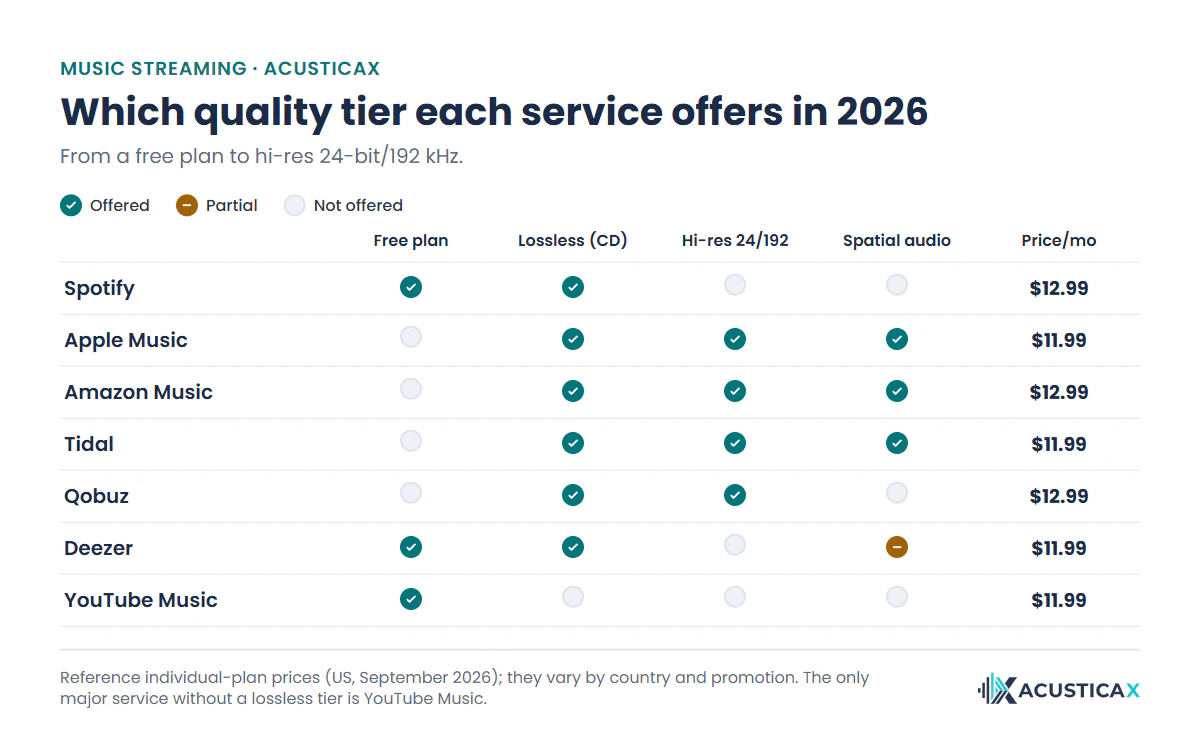
| Service | Lossless (CD 16/44.1) | Hi-res (up to 24/192) | Spatial audio (Atmos) | Free tier | Individual price/mo (US) |
|---|---|---|---|---|---|
| Spotify | Yes (FLAC 24/44.1) | No | No | Yes (up to ~160 kbps) | $12.99 |
| Apple Music | Yes (ALAC) | Yes (ALAC 24/192) | Yes | No | $11.99 |
| Amazon Music Unlimited | Yes (FLAC) | Yes (Ultra HD 24/192) | Yes | No | $12.99 ($11.99 with Prime) |
| Tidal | Yes (FLAC) | Yes (FLAC 24/192) | Yes | No | $11.99 |
| Qobuz | Yes (FLAC) | Yes (FLAC 24/192) | No | No | $12.99 ($10.83 annual) |
| Deezer | Yes (FLAC) | No | Partial (360RA) | Yes (with ads) | $11.99 |
| YouTube Music | No | No | No | Yes (with ads) | $11.99 |
The quick takeaway is that none of them falls behind on quality except YouTube Music. If you want hi-res out of the box, Apple Music, Amazon, Tidal and Qobuz deliver it; if you want Dolby Atmos, rule out Qobuz; and if you want to try before you pay, only Spotify, Deezer and YouTube Music have a genuine free plan, while the rest offer just a temporary trial.
Lossy, lossless and hi-res, what the numbers really mean
The three tiers the platforms advertise map to three very different qualities. Lossy audio (MP3, AAC, Ogg Vorbis) throws away the data your ears barely register in order to weigh less; its practical ceiling is around 320 kbps, which already sounds transparent to almost everyone. Lossless (FLAC, ALAC) keeps the music bit-for-bit identical to a CD, at 16-bit and 44.1 kHz, cutting nothing, and runs at roughly 1,000 kbps. Hi-res raises the bit depth to 24 bits and the sample rate to 96 or 192 kHz, and there the technical debate is whether the human ear can actually make use of it.
For this comparison, one idea is enough. From 320 kbps lossy to lossless FLAC there is a real but very small improvement, and from CD-quality FLAC to 24/192 the audible gain is arguable and depends entirely on your gear. If you want the detail of how many kbps each format needs and when the difference actually shows, we cover it in the guide on what bitrate you really need for music, and if you are unsure whether hi-res is worth the price, in the one on whether high-resolution audio is worth it.
Service by service, what quality each one gives
Each platform has its own quality ladder and details that never make it into a table, such as volume normalization or the gap between the app and the web player. Here is what each one gives, with its codec and maximum resolution, according to each service’s documentation.
Spotify, now lossless too
Spotify stopped being lossy-only in September 2025, when it added its Lossless tier in FLAC up to 24-bit/44.1 kHz, included in Premium at no extra cost. That FLAC keeps a CD’s 44.1 kHz sample rate, so it is lossless but not hi-res, because the treble ceiling is set by the sample rate rather than the 24 bits. Below that, the app uses Ogg Vorbis at roughly 24, 96, 160 and 320 kbps (“Very high”), while the web player runs AAC at 128 kbps on free and 256 on Premium. The free account tops out at “High”, around 160 kbps. It offers no spatial audio, and its strengths remain the catalog, the playlists and sheer ease of use. Any AI Overview or comparison still claiming Spotify caps at 320 kbps lossy is out of date.
Apple Music includes lossless and Dolby Atmos
Apple Music delivers lossless audio in ALAC up to 24-bit/192 kHz and spatial audio with Dolby Atmos, both included in the standard $11.99 plan at no surcharge. The Lossless tier reaches 24/48 and Hi-Res Lossless goes to 24/192, though the latter needs an external DAC, because Apple devices do not output above 48 kHz through their own hardware. Below that it uses AAC at 256 kbps. It is the most complete option for anyone living inside the Apple ecosystem who wants Atmos without paying extra.
Amazon Music Unlimited, hi-res and a Prime discount
Amazon Music Unlimited offers FLAC in HD quality (16-bit/44.1 kHz) and Ultra HD (up to 24-bit/192 kHz), plus spatial audio in Dolby Atmos and 360 Reality Audio, all within the same plan. It costs $12.99 a month, dropping to $11.99 for Amazon Prime members, which brings it in line with the cheapest lossless plans if you already pay for Prime. In our experience its catalog and search sit a step behind Spotify or Apple, and its app is more basic than either.
Tidal, hi-res without MQA and with volume normalization
Tidal delivers FLAC up to 24-bit/192 kHz and Dolby Atmos in a single $11.99 plan, after merging its old HiFi and HiFi Plus tiers in April 2024. In that change it dropped the MQA format, which was proprietary and contentious among audiophiles, and moved to standard hi-res FLAC. It applies ReplayGain volume normalization so every track plays at a similar level, handy for mixed playlists but something that costs a little punch for some listeners. Its catalog and artist-facing features lean toward modern music and hip-hop.
Qobuz, the audiophile favorite (no Atmos)
Qobuz streams entirely in CD quality (16-bit/44.1 kHz) or hi-res up to 24-bit/192 kHz, and by default it does not normalize volume, so it preserves the exact dynamic range of the master. At $12.99 a month it sits at the top of the price range, dropping to about $10.83 a month paid annually. It has no Dolby Atmos, but it stands out for a carefully curated catalog in classical and jazz, its editorial write-ups on each album and its hi-res download store. It is the pick for the listener who values fidelity and liner notes over spatial audio.
Deezer, CD quality on its Premium plan
Deezer includes HiFi sound in CD-quality FLAC (16-bit/44.1 kHz) within its $11.99 Premium plan, after folding the old HiFi tier into the standard price. It does not reach 24/192 hi-res, though it does offer spatial audio in 360 Reality Audio across part of its catalog. It keeps a free ad-supported plan. As a quality service it holds up, but it does not match the two giants on catalog.
YouTube Music, the only major service without lossless
YouTube Music is, as of 2026, the only major platform that offers neither lossless nor hi-res audio. Its ceiling is 256 kbps lossy (AAC or Opus) on the “High” tier of Premium, which costs $11.99 a month on its own or comes bundled inside YouTube Premium. It has a free ad-supported plan and an enormous catalog that adds live versions, remixes and user-uploaded rarities you will not find anywhere else. For pure sound quality it is the weakest on this list; for variety and for watching the videos, the most complete.
Can you actually hear the difference between them?
Rarely, and even less over Bluetooth. The top figure each platform advertises is only a starting point, because the signal loses quality at every step on its way to your ears and the weakest link wins. The most common bottleneck is the wireless link, since any Bluetooth headphone or speaker re-encodes the audio before it reaches you. A 24/192 FLAC listened to over SBC ends up at about 328 kbps, so Qobuz or Tidal at their top quality sound the same as Spotify at 320 through those headphones.
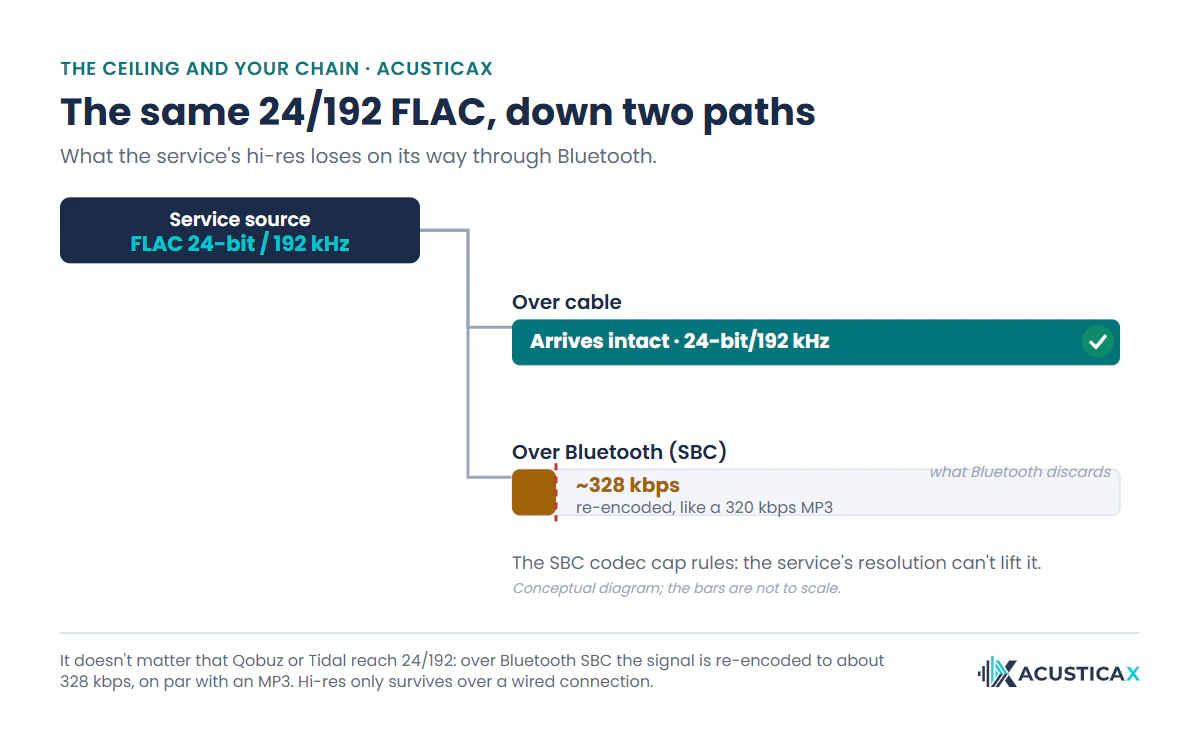
Over a wired connection, with a DAC that supports it and demanding recordings, the lossless advantage does show, though it is subtle, and hi-res beyond CD quality is arguable even for trained ears. It is worth looking at your headphones and your connection before the plan tier you sign up for. If you want to dig into when the file matters and when it does not, we cover it in the guide on whether you really need lossless audio, with the Bluetooth bottleneck codec by codec.
Which music service has the best quality for you
There is no single winner, because the best one depends on your gear, your ecosystem and what you already pay for. The head-to-heads people search most, like Tidal vs Qobuz or Apple Music vs Spotify, come down more to catalog and price than to sound, since on quality they nearly tie. This table sums up which service suits each situation, with the reason behind it so you can adapt it to your own case.
| Your case | Recommended service | Why |
|---|---|---|
| Casual listener, I want easy | Spotify | Best catalog, playlists and compatibility; lossless now included in Premium |
| Audiophile, classical and jazz | Qobuz | Hi-res without normalization, curated catalog and per-album write-ups |
| Apple ecosystem, I want Atmos | Apple Music | ALAC 24/192 and Dolby Atmos included, tight iPhone and Mac integration |
| I already pay for Amazon Prime | Amazon Music Unlimited | Hi-res and Atmos for $11.99 with Prime, among the cheapest lossless plans |
| I want to try without paying | Spotify, Deezer or YouTube Music | All three have a genuine ad-supported free plan; the rest offer only a temporary trial |
| I watch videos and rare live sets | YouTube Music | Unique catalog of live versions and remixes, though no lossless |
How to check the quality that actually reaches you
The honest way to settle it is to measure and test on your own gear, not to trust the plan’s label. Three quick checks tell you whether the quality you pay for is really reaching you. The first is a blind test, to find out if your ears can tell lossless from 320 on your chain. The second is verifying that a file you download is what it claims to be. The third is looking up which format and edition a release actually came in.
For the first, set up a blind ABX test with your two versions and the tool will level-match the volume before challenging you to tell them apart; only if you get it right enough times in a row is the difference real. For the second, run the file through the fake lossless detector, which reads its spectrum and exposes an MP3 repackaged as FLAC by the treble cut-off. And for the third, you can look up a release’s format and edition with its first-release year and track list, handy when the same album has remasters of different quality.
Frequently asked questions
Which music streaming service has the best audio quality?
On raw technical quality, Qobuz and Tidal, because they stream hi-res FLAC up to 24-bit/192 kHz, and Qobuz on top of that does not normalize volume. Apple Music and Amazon Music match that resolution and, like Tidal, add Dolby Atmos. In practice, the gap between the six services with lossless is very small and, over Bluetooth, practically nil, so the real tie-breaker is the price, the catalog and your gear.
Does Qobuz have better sound quality than Apple Music?
Both stream up to 24-bit/192 kHz, so on maximum quality they tie. Qobuz does not normalize volume by default, preserving the master’s dynamic range, and leans toward classical and jazz. Apple Music adds Dolby Atmos and tight integration with iPhone and Mac. For pure fidelity and dynamic range, Qobuz has a slight edge; for spatial audio and the Apple ecosystem, Apple Music.
Is Apple Music’s streaming quality better than Tidal’s?
They are on par. Both deliver lossless up to 24-bit/192 kHz and both include Dolby Atmos. Apple Music integrates better with Apple devices and includes a large Atmos catalog; Tidal skews toward modern music and artist features and applies ReplayGain volume normalization. At a similar price, the choice comes down to your ecosystem rather than the sound.
Does Qobuz or Tidal have better music quality?
Both offer FLAC up to 24-bit/192 kHz, so on top quality they tie. Qobuz preserves the master’s dynamic range by not normalizing volume and has a stronger classical and jazz catalog. Tidal normalizes with ReplayGain, includes Dolby Atmos and focuses on modern music. For pure fidelity and classical, Qobuz; for Atmos and current pop, Tidal.
Does Spotify have lossless audio?
Yes, since September 2025. Spotify’s Lossless tier delivers FLAC up to 24-bit/44.1 kHz (CD quality) and is included in Premium at no extra cost. It does not reach hi-res above 44.1 kHz and offers no spatial audio, but it finally puts Spotify on a level with the rest of the platforms on the lossless tier. Its free account is still limited to about 160 kbps lossy.
Is it worth paying for hi-res 24/192?
Only if you listen over a wired connection, with a good DAC and demanding recordings, and even then the improvement over CD quality is subtle and heavily debated. Blind studies rarely find that the human ear reliably tells 24/192 from a well-made 16/44.1. If you listen over Bluetooth or through a phone speaker, hi-res adds nothing, because the bottleneck sits far earlier in the chain.
Which service has the best free tier?
Among free plans, Spotify Free reaches about 160 kbps and Deezer and YouTube Music offer lossy quality with ads. None gives lossless for free, which is always reserved for paid plans. If the goal is to try high quality without spending, almost every service offers a one-to-three-month free trial of the full plan before it charges.
Does YouTube Music have lossless audio?
No. As of 2026, YouTube Music is the only major platform that offers neither lossless nor hi-res audio. Its top quality is 256 kbps lossy (AAC or Opus) on the “High” tier of Premium. That is good quality for most listening, but below what Spotify, Apple Music, Amazon, Tidal, Qobuz and Deezer give, all of which do include a lossless tier.
