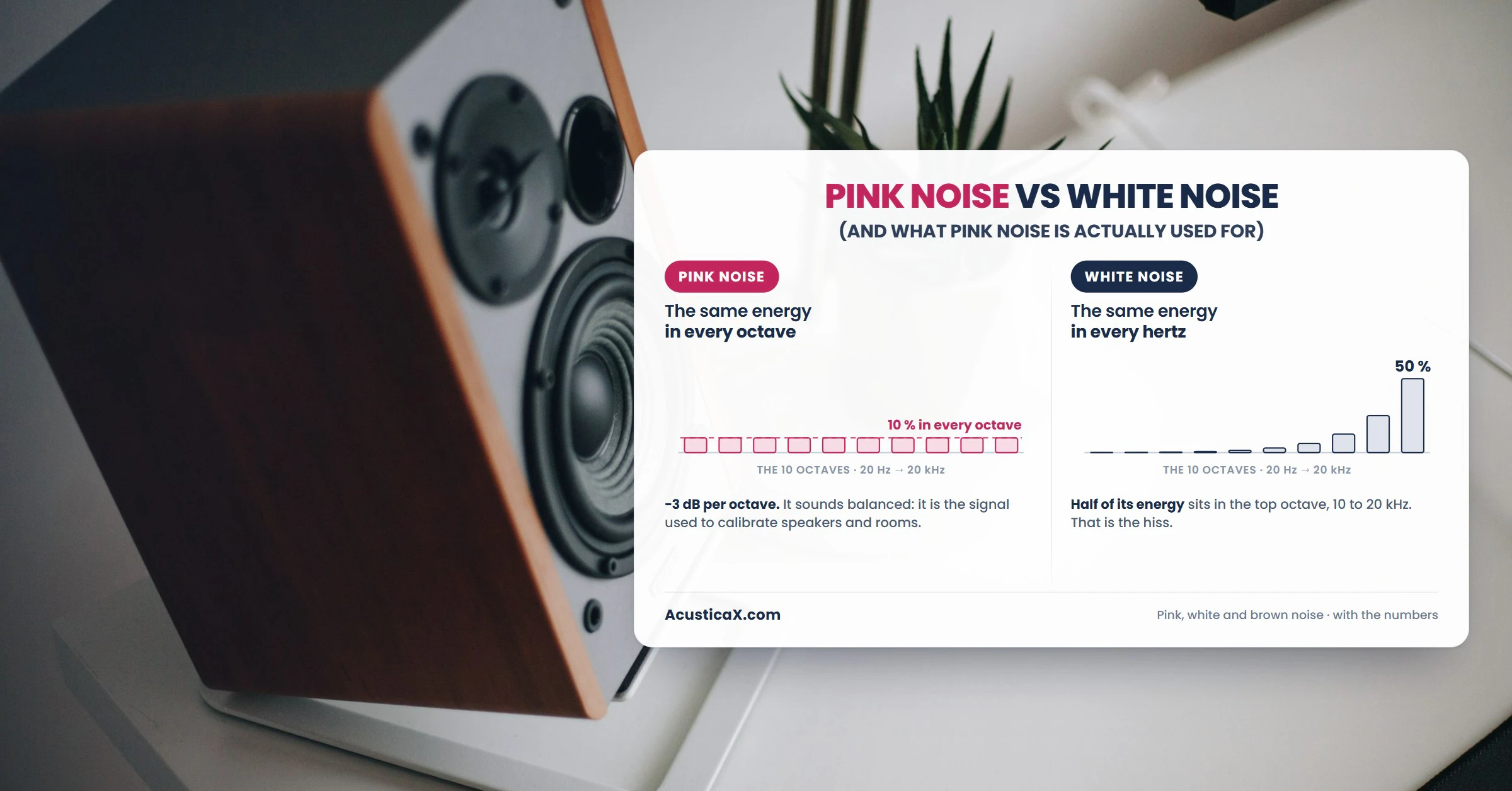
Pink noise vs white noise, settled in one line: pink noise carries the same energy in every octave and therefore rolls off 3 dB per octave, while white noise carries the same energy per hertz – which packs half of its total energy into the top octave alone, from 10 to 20 kHz. That single difference is why pink noise sounds like steady rain and white noise sounds like a hiss, and why every calibration standard in audio uses pink.
This guide has the numbers most articles skip: the exact level Dolby calibrates a studio to (85 dB SPL, C-weighted, using pink noise at -20 dBFS), how IEC 60268-5 and AES2 use pink noise to rate a speaker’s power handling, the octave-by-octave energy split of each noise colour, and – this part is new – what a 2026 polysomnography study from the University of Pennsylvania found about sleeping with pink noise, which is not what the sleep blogs are still repeating.
What pink noise is: equal energy in every octave
Pink noise is random noise whose energy is spread evenly across octaves: the band from 100 to 200 Hz holds as much energy as the band from 5,000 to 10,000 Hz. Counted per hertz, that means its power follows 1/f – it drops 3 dB every time frequency doubles. It sounds like steady rain, wind through trees or distant surf: full, but never harsh.
The name comes from an analogy with light. In the visible spectrum the low frequencies sit at the red end, so a signal that contains every frequency but leans downward would be, in light, a white tinted red – pink. The rest of the colors of noise were named the same way, and it is worth knowing which ones have a real technical definition and which are just a product name.
| Colour | Slope | What it sounds like | What it is actually used for |
|---|---|---|---|
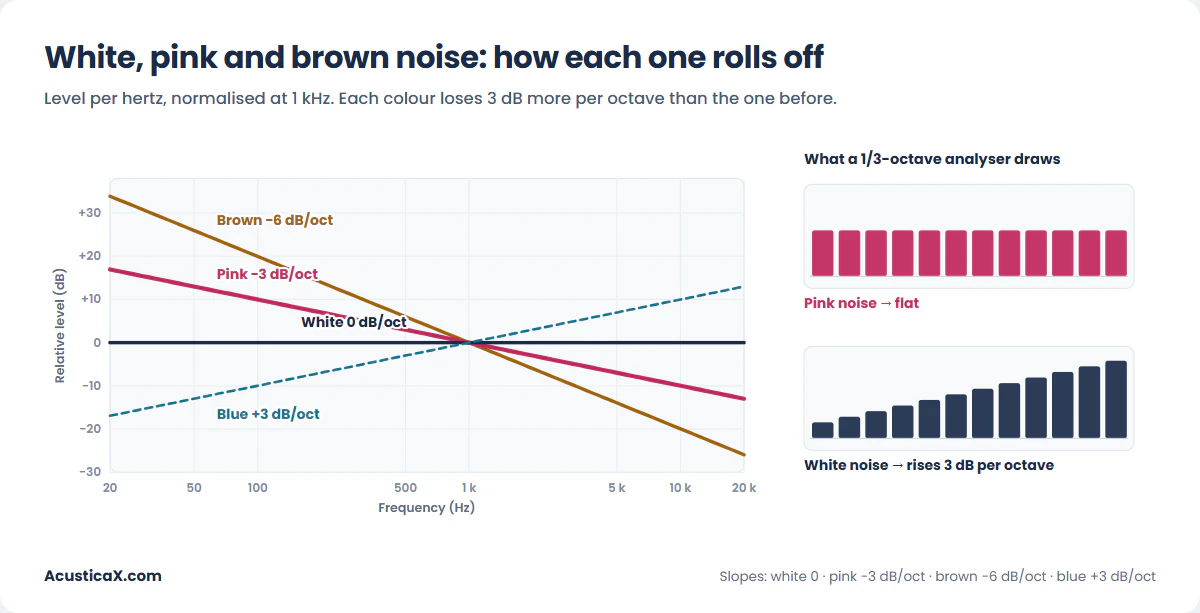
| White | Flat per hertz (+3 dB per octave) | Bright hiss, TV static | Electronics testing and narrow-band measurements |
| Pink | -3 dB/octave (1/f) | Steady rain, distant surf | The reference signal in audio: calibration, room measurement, power handling, sound masking |
| Brown (or red) | -6 dB/octave (1/f²) | Waterfall, distant thunder | Driving subwoofers and masking low-frequency noise; hugely popular for sleep |
| Blue | +3 dB/octave | Sharp hiss, a sustained «ss» | Dithering in audio and imaging |
| Violet (purple) | +6 dB/octave | Escaping air, very bright | Clinical tinnitus therapy and some measurements |
| Grey | Inverted equal-loudness contour (ISO 226) | Equally loud across the range | Audiology: masking with the same perceived loudness in every band |
| Green | No standard definition | Whatever the vendor decides | Nothing technical: it is a marketing label from sleep apps |
Brown noise is not even named after the colour: it comes from Robert Brown and Brownian motion, the random walk of a particle in a fluid, whose spectrum falls at exactly 1/f². That is why technical texts often call it red noise instead; both names are correct.
Pink noise vs white noise vs brown noise, in numbers
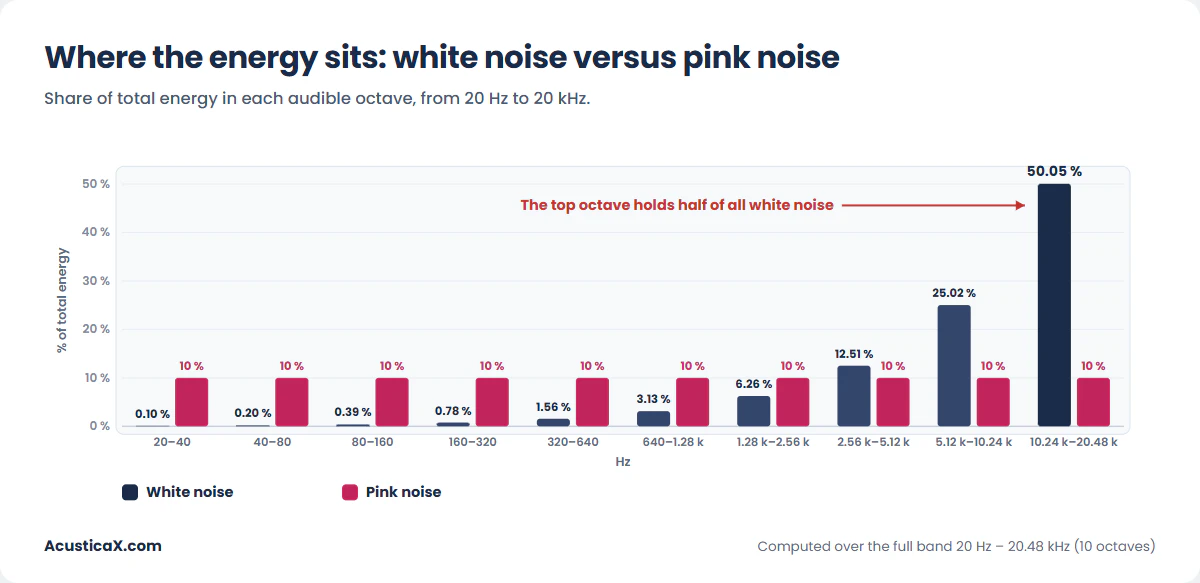
The whole difference is how the energy is counted. White noise has the same energy per hertz; pink noise has the same energy per octave. It sounds like bookkeeping and it is enormous, because a high octave is far wider than a low one: 20 to 40 Hz is 20 Hz wide, while 10,000 to 20,000 Hz is 10,000 Hz wide. With constant energy per hertz, that top octave holds 50 % of everything, and the top two octaves together hold 75 %.
Because hearing works in octaves – a note and its octave read as «the same note» wherever they sit – that split is exactly what you perceive: white noise sounds top-heavy and pink sounds balanced. Nothing is broken in a system that plays white noise and hisses; that is the signal doing its job.
| Octave | Bandwidth | Energy in white noise | Energy in pink noise |
|---|---|---|---|
| 20 – 40 Hz | 20 Hz | 0.10 % | 10 % |
| 40 – 80 Hz | 40 Hz | 0.20 % | 10 % |
| 80 – 160 Hz | 80 Hz | 0.39 % | 10 % |
| 160 – 320 Hz | 160 Hz | 0.78 % | 10 % |
| 320 – 640 Hz | 320 Hz | 1.56 % | 10 % |
| 640 – 1,280 Hz | 640 Hz | 3.13 % | 10 % |
| 1,280 – 2,560 Hz | 1,280 Hz | 6.26 % | 10 % |
| 2,560 – 5,120 Hz | 2,560 Hz | 12.51 % | 10 % |
| 5,120 – 10,240 Hz | 5,120 Hz | 25.02 % | 10 % |
| 10,240 – 20,480 Hz | 10,240 Hz | 50.05 % | 10 % |
That table also explains why you should not test a speaker loudly with white noise: you would be feeding half the power to the tweeter, the most fragile driver and the one that sees the least energy with real music. Brown noise is the opposite case: it falls 6 dB per octave, so 500 Hz carries four times the energy of 1,000 Hz and almost everything audible sits below 500 Hz. It reads as deep and enveloping, and it is the colour short-form video made famous for sleep and focus.
What is pink noise used for in audio: four real jobs
In audio, pink noise does four specific jobs, and three of them are written into a standard or a manufacturer’s guide: matching speaker levels, seeing what the room does to the sound, rating how much power a speaker can take and masking speech in an office. This is not a matter of taste: pink noise is the only continuous signal a fractional-octave analyser draws as a straight line, so every deviation you see belongs to the gear or the room, never to the signal.
1. Matching the level of every speaker
This is the most common use and it comes with official numbers. Dolby‘s guidance for Atmos music studios sets a calibrated monitoring level of 85 dB SPL, C-weighted (79-82 dBC for small single-operator rooms), measured with pink noise: either the noise generated by the Dolby renderer itself or, with any other generator, pink noise at -20 dBFS RMS. The LFE channel carries 10 dB of in-band gain, so in a room calibrated to 85 dBC it should read between 89 and 91.5 dBC.
At home the procedure is identical with a different number: AV receivers play their internal test signal about 10 dB lower, so the usual target when trimming each channel is 75 dB at the listening position, meter set to C-weighting and slow response, pointed at the ceiling at ear height, one speaker at a time. If you do not own a meter, the phone-based online sound level meter is good enough for this particular task: its absolute reading carries a ±10 dB margin, but that error is identical for all five speakers and cancels out when you compare them.
2. Seeing what your room does to the sound
A one-third octave spectrum analyser draws pink noise as a flat line. That is the entire point: if you play pink noise through a speaker and the analyser shows an 8 dB peak at 63 Hz and a hole at 120 Hz, the room put them there. White noise is useless for this because the same analyser draws it rising 3 dB per octave, and you would have to subtract that slope in your head before interpreting anything.
The test that tells you the most in the least time: play pink noise, put the mic at your seat, then move it a metre. Whatever changes as you move is the room – room modes, floor-bounce cancellations; whatever stays locked to the same frequency wherever you stand belongs to the speaker. It is the same reasoning behind finding the right spot for a subwoofer, where moving the box half a metre changes the bass more than any amount of EQ.
3. Rating how much power a speaker can take
When a spec sheet says «120 W continuous», that figure was measured with pink noise. Both industry standards – IEC 60268-5 and AES2 – use filtered pink noise with a 6 dB crest factor (peaks reaching twice the RMS voltage, a worst case compared with most live music), applied for about two hours, the time a voice coil needs to reach a stable temperature.
The AES2 procedure is a staircase: start at low level, measure the speaker’s transfer function with a microphone, and raise the signal in 3 dB steps until any band deviates by more than 1 dB; from there, go up 1 dB at a time until the deviation reaches 3 dB, which is the point where compression and distortion set in. The voltage at that point becomes the published continuous power, and the method is laid out step by step in Yamaha’s note on loudspeaker power specifications. In other words, the number on the box marks where the speaker stops behaving linearly, not where it dies — and that distinction is exactly what separates a speaker that sounds distorted from a broken one.
4. Masking speech in an office
Office sound masking systems emit shaped pink noise, and the engineering is standardised: the spectrum covers 100 to 5,000 Hz (sometimes up to 10 kHz), the level is trimmed zone by zone, and the recommended maximum is 48 dBA, because above that the masking itself becomes intrusive. ASTM E1573 requires it to be verified with A-weighted and one-third octave band measurements, and ASTM E1130 measures the speech privacy that results.
That is the mechanism behind the domestic use as well: masking is not «drowning out» with more volume, it is filling the gaps in the spectrum where your neighbour’s voice leaks through so your hearing stops reconstructing it. That is why it works at lower levels than people expect, and why the speech range – 100 Hz to 5 kHz – is the part that has to be covered.
Pink noise for sleep: what the evidence says, and what it doesn’t
The evidence on pink noise for sleep is thinner than the internet suggests, and 2026 made it messier: a University of Pennsylvania study published in Sleep – 25 healthy adults, seven nights of polysomnography, funded by the US Federal Aviation Administration – found that continuous pink noise at 40 or 50 dBA reduced REM sleep (p < 0.001) compared with a quiet control night, and that adding it on top of environmental noise made sleep structure worse. Foam earplugs, by contrast, undid nearly everything the outside noise had done.
| Study | What it tested | What it measured | Result |
|---|---|---|---|
| Basner et al., Sleep (2026) | Continuous pink noise at 40-50 dBA and earplugs, against aircraft noise | Polysomnography, 25 adults, 7 nights | Pink noise reduced REM sleep; earplugs won on nearly every measure |
| Basner et al., Sleep Health (2026) | Same subjects, looking at awakenings | Arousals and awakenings | Pink noise did cut noise-induced arousals dose-dependently, but was outperformed by earplugs |
| Papalambros et al. (2017) | Bursts of pink noise phase-locked to the brain’s slow wave | 13 adults aged 60-84, EEG and memory | Better word recall; whole-night slow-wave activity did not change |
| Zhou et al. (2012) | Continuous pink noise all night | 40 subjects, cardiopulmonary coupling | A higher percentage of stable sleep |
| 2022 review | Night-time sound in general | Systematic review | Evidence is broad but low quality, and almost all self-reported |
That third row is where the whole misunderstanding starts. When someone says «pink noise is proven to improve memory», they are quoting closed-loop acoustic stimulation: an algorithm predicts the phase of the slow oscillation in deep sleep and fires bursts of pink noise on the upstate, five at a time, with EEG electrodes attached. In the Papalambros study – 13 participants aged 60 to 84 – slow-wave activity across the whole night was no different from the sham night; it only rose during the stimulation intervals. That is nothing like leaving a track looping on a phone.
The honest conclusion: if you live on a noisy street, pink noise may cut the number of times you wake up, but earplugs do it better and without trade-offs; if your bedroom is already quiet, the 2026 evidence says switching it on may cost you REM sleep. And if you sleep well with it, there is no reason to stop: nobody has described harm, only a change in sleep structure under laboratory conditions.
If you use it at night, the level matters more than the colour
The number that decides whether background noise helps or hurts is not the colour – it is the level, and almost nobody measures it. The World Health Organization’s night noise guidance and most national bedroom targets sit around 30 dB(A) indoors at night; Spain’s Royal Decree 1367/2007, for instance, sets exactly that figure for bedrooms. The 2026 study ran pink noise at 40 and 50 dBA: between 10 and 20 dB above that target, which is three to ten times as loud as a quiet bedroom is supposed to be.
With infants the numbers have been on the table for years: a study in Pediatrics (2014) tested 14 infant sleep machines and found that all of them exceeded 50 dB(A) at 30 cm at maximum volume – the limit recommended for neonatal units – and that three went past 85 dB(A), an occupational exposure level if it plays all night. The practical rule that follows: keep the source a couple of metres from the crib or the bed, never on the headboard, and use a timer.
Checking it takes a minute: play the noise exactly as you play it every night, leave the phone on the pillow and read the number. Above 40 dB(A), turn it down. Eight hours straight is not a hearing risk – that starts at very different levels, as covered in our guide to how many decibels are dangerous – but it is more than enough to disturb the sleep you were trying to improve.
Studying, focus and tinnitus: what to expect
For focus, the effect with reasonable support is masking, not cognitive enhancement: a continuous background covers intrusions – a conversation, a door, the lift – and saves you the attention cost each one carries. It is the office principle, with its 48 dBA ceiling. That pink noise makes you smarter, more creative or more productive is not established, and the brown noise craze for ADHD is a short-video phenomenon, not a clinically backed treatment.
With tinnitus there is a rule audiologists repeat that rarely makes it online: the masking sound should sit just below the tinnitus, at the level where it becomes less noticeable without covering it completely. Turning it up until the ringing disappears trains your hearing to demand more level every time. And if the tinnitus is new, one-sided or pulsatile, the priority is a doctor, not a noise track.
How to generate pink noise, and check that it really is pink
Nothing needs installing: a browser-based pink, white and brown noise generator produces the signal, and an analyser confirms that what leaves the speaker is what you think it is. Five steps, in this order:
- Flatten the system first. EQ at zero, loudness, bass boost and sound modes off. If the receiver has a «direct» or «pure» mode, use it.
- Pick pink and raise the level slowly. Full-band noise is harder on a speaker than music, on the tweeter especially. Work at the level of a loud conversation.
- One speaker at a time. To match levels, mute the rest and measure at the listening position, mic at ear height, meter on C-weighting and slow response.
- Look at it in one-third octave bands. On an analyser, pink noise should come out roughly flat. If it rises 3 dB per octave, what you are playing is white.
- Repeat with the mic moved. A metre is enough. What changes is the room; what doesn’t is the speaker.
One detail that trips people up the first time: pink noise does not measure properly with the phone flat on a table. The surface reinforces the midrange through reflection and skews the band readings. Hold it in the air, or better, rest it on a tripod or a cushion at the listening position.
What pink noise does not do
Four things it gets credited with and does not deliver, each with the technical reason:
- It does not «break in» a new speaker. The suspension does loosen slightly with use, but measurable changes are tenths of a decibel and they happen just as well while you listen to music. Leaving pink noise running loud overnight is far more likely to heat the voice coil than to improve anything.
- It does not fix the room. It lets you see the problem, not solve it. An 8 dB modal peak at 60 Hz is fixed by moving the speaker, the seat or the subwoofer, and by adding absorption; EQ only hides it at one spot and makes it worse everywhere else.
- It is no substitute for a sweep when you measure seriously. Pink noise gives the average tonal balance; reverberation time, reflections and exact modal frequencies need a sweep and its impulse response, which is what the tool for measuring RT60 and room modes does.
- It is not the same signal out of a phone speaker. A phone driver radiates almost nothing below 400-500 Hz, so the «pink noise» coming out of it is in practice the top half of the signal. For sleep or masking, a decent mid-size speaker changes the result far more than the colour you pick.
Frequently asked questions
Is pink noise better than white noise?
For anything involving speakers or listening, yes. Pink noise spreads energy evenly across octaves, which is how hearing works, so it reads flat on an analyser and sounds balanced instead of hissy. White noise is still the right choice for narrow-band electronic measurements, where flat-per-hertz is exactly what you want.
Which color noise is best for sleep?
There is no proven winner. Brown and pink are easier to tolerate because they carry less treble, and pink is the most studied. If the noise you want to cover is low-pitched – traffic, roadworks, a neighbour’s subwoofer – brown masks it better; if it is voices, pink does. And if your bedroom is already quiet, the option with the best evidence is still silence, or earplugs.
Is it safe to listen to pink noise every night?
At low level there is no hearing risk: 40 dB(A) for eight hours is nowhere near the exposure that damages hearing. What the 2026 polysomnography study found is different – at 40 to 50 dBA, continuous pink noise reduced REM sleep compared with a quiet night. Keep it below 40 dB(A) at the pillow, put the source a couple of metres away, and use a timer rather than running it until morning.
Which is better, pink or brown noise?
It depends on what you are covering. Brown noise falls 6 dB per octave, so it is heavily weighted to the bass and masks low-frequency intrusions better; pink falls 3 dB per octave and covers the speech range more evenly, which makes it the better choice against conversation and the standard one in audio work.
Why is it called pink noise?
By analogy with light: a signal holding every frequency but weighted towards the low end would be, in visible light, a white shifted towards red – pink. Blue (more energy at the top) and violet were named the same way. Brown noise is the exception: it is not named after a colour but after Robert Brown and Brownian motion.
Is pink noise or white noise better for calibration?
Pink, and every standard agrees. A fractional-octave analyser draws pink noise flat, so any deviation you see comes from the speaker or the room. It also protects the tweeter: with white noise, half the total energy sits in the 10-20 kHz octave, which is a lot of heat in the most fragile driver at calibration levels.
How do you calibrate speakers with pink noise?
Play pink noise through one speaker at a time and trim that channel until the meter reads the same value at the listening position, C-weighted, slow response. In a studio, Dolby’s reference is 85 dBC with the signal at -20 dBFS; on a home receiver, whose internal test signal is 10 dB lower, the usual target is 75 dB. The absolute number matters less than every channel matching.
Is green noise real?
Not as a technical term. White, pink, brown, blue and violet have defined spectral slopes, and grey is defined by an inverted equal-loudness contour. «Green noise» has no accepted definition: each app that sells it shapes it differently, usually as a midrange-heavy variant of pink noise with nature recordings on top.