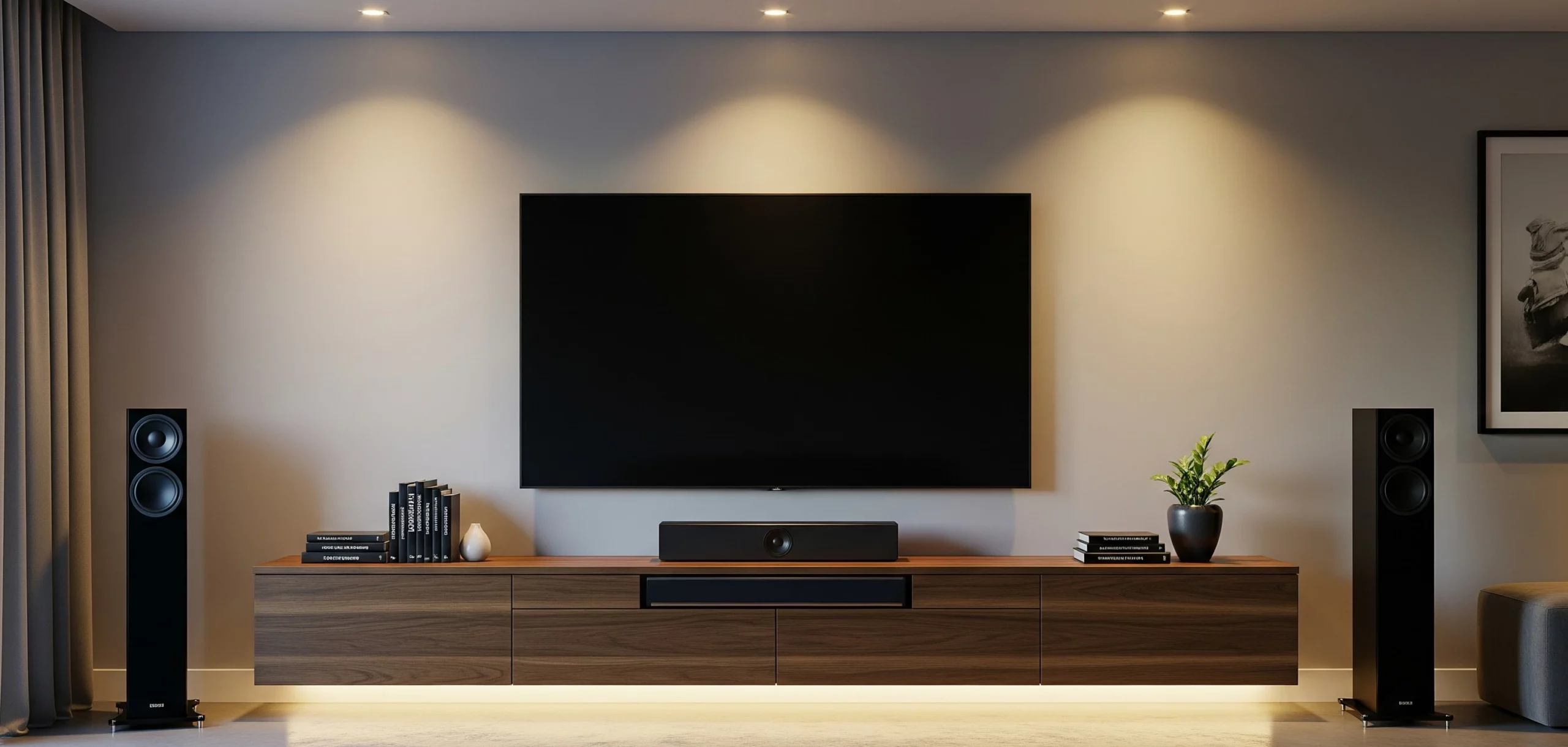
Setting up a home theater is an exciting project. Choosing the front speakers, tuning the subwoofer to deliver precise bass, and configuring the AV receiver all become part of a ritual. However, behind that home theater lies a monumental amount of cables.
Connecting the receiver to the speakers, subwoofer, console, computer, and display can turn the space behind the cabinet into anyone’s worst nightmare. This clutter isn’t just visually unappealing—it can also compromise the equipment’s ventilation and turn any future upgrade into a real nightmare.
Simplification is the first step toward getting organized.
First of all, consider which video and audio sources are truly necessary. Perhaps that old game console or media player—which your new TV has rendered obsolete—can be unplugged for good.
Once you’ve made this selection, it’s time to roll up your sleeves. Use cable ties or, better yet, reusable Velcro strips to group the cables by function. On one side, the power cables; on another, the HDMI cables running from the sources to the receiver; and on yet another, the thick bundle of speaker cables. Here, labeling is your best ally. Marking each speaker cable (front left/right, center, surround, subwoofer) at both ends will save you from future confusion. Do the same with the HDMI inputs on your AV receiver (console, PC, TV).
Furniture and Cooling Solutions for Your AV Receiver
The AV receiver is the heart of the entire system, where all the signals converge. It’s also one of the components that generates the most heat, along with any dedicated audio amplifiers you might have. That’s why you need a stand that can support the weight and provide enough depth for the receiver’s chassis and the bundle of cables that will be connected to its rear panel.
Ventilation is the most important factor. Cramming an AV receiver or amplifier into a closed-off compartment with no airflow is a surefire way to cause it to overheat and shorten its lifespan. So look for a cabinet with an open back, perforated shelves, or even built-in silent fans.
Don’t forget the subwoofer, which—with its own power cable and LFE signal cable running to the receiver—is often located separately from the main system, requiring its own cable route that must also be managed.
Hiding the speaker and screen wiring
One of the biggest challenges in a surround sound setup is figuring out what to do with the cables for the side and rear speakers. Running cables across the living room in plain sight isn’t an option for most people. Fortunately, there are some very neat solutions.
If you’re in the middle of a renovation or aren’t afraid of a small installation job, the neatest option is to use speaker wire certified for in-wall installation (marked CL2 or CL3). For less complicated situations, adhesive cable channels are perfect. They can be discreetly placed along the baseboards and painted the same color as the wall so they practically disappear. There are even flat, adhesive speaker cables that can be stuck to the wall and painted over.
For the main connection between the AV receiver and the TV or projector, the rules are the same as for power cords: never run a power cord through a wall. Always use a recessed power kit for the display to ensure a safe installation that complies with regulations.
Wireless option
Avoid it whenever possible, since any wireless setup experiences signal loss due to the wireless infrastructure itself. But in more complex setups—such as when you have a projector mounted on the ceiling or when the equipment is in an adjacent room—wireless technology can be a godsend.
There are wireless HDMI transmitters that can send the video signal from the AV receiver to the projector without requiring a cable run longer than 10 meters, which can be costly and complicated to install.
In addition, more and more speaker brands are launching wireless surround sound speakers that only need a power outlet and receive the audio signal from a central unit or from the receiver itself. There are also kits that can turn your passive subwoofer into a wireless one, giving you complete freedom to place it in the optimal spot in the room without worrying about the cable.
To manage all these devices (receiver, TV, game console, computer, media player), a programmable universal remote control is ideal. It centralizes control of all functions in a single remote, clearing the table and making daily use of the system much easier.