
In a 270-320 sq ft living room with average-sensitivity speakers (87 dB), about 30 W per channel covers normal listening and about 90 W covers loud listening, with 100 dB peaks at your seat. On average the amp only delivers 0.9 W per channel at normal volume and 2.8 W when it’s loud, and the rest is held in reserve for the peaks in the music. So how many watts per channel you need depends less on the size of the room than on three things hardly anyone checks, which are how loud you listen, what you listen to and your speakers’ sensitivity.
Below you’ll find the table of watts by room size and listening level, worked out with the formula Crown publishes, the step-by-step math to run it for your own system, and what real music actually asks for, which we measured with current pop and a symphony. After that we cover home theater, how to read the power rating on the box without being fooled, and how many watts a party takes. If you’d rather skip the math, the speaker wattage calculator does it with your numbers.
How many watts per channel you need by room size and volume
With 87 dB speakers at normal volume you need about 13 W per channel in a 110 sq ft bedroom and about 80 W in an 800 sq ft open-plan space. If you like it loud, multiply by three; very loud, by ten. The table covers six room sizes and four listening levels.
| Room (listening distance) | Background (70 dB average, 85 dB peaks) | Normal (80 dB, 95 dB peaks) | Loud (85 dB, 100 dB peaks) | Very loud (90 dB, 105 dB peaks) |
|---|---|---|---|---|
| 110-130 sq ft (6.5 ft / 2 m) | 1.3 W | 13 W | 40 W | 126 W |
| 160-215 sq ft (8 ft / 2.5 m) | 2 W | 20 W | 62 W | 197 W |
| 270-320 sq ft (10 ft / 3 m) | 2.8 W | 28 W | 90 W | 284 W |
| 375-430 sq ft (11.5 ft / 3.5 m) | 3.9 W | 39 W | 122 W | 386 W |
| 540 sq ft (13 ft / 4 m) | 5 W | 50 W | 160 W | 505 W |
| 750-860 sq ft (16.5 ft / 5 m) | 7.9 W | 79 W | 249 W | 789 W |
The table errs on the safe side on purpose. It assumes two speakers, peaks 15 dB above the average (the figure Crown uses in its home-stereo example) and free field, as if you were listening outdoors. In a furnished room the reflections add level, 3 to 6 dB by our estimate (Crown puts it at 6 dB in a venue), so in practice half to a quarter of the figure will do.
Per square foot it comes out surprisingly neat with those distances. With 87 dB speakers, normal listening takes about 0.1 W per channel per square foot (roughly 1 W per square meter), loud listening about 0.3 W and very loud about 1 W. There’s also a rule of thumb hiding in the same formula. For 90 dB peaks, the watts per channel equal the distance in meters squared (9 W at 3 m, or 10 ft), and every 10 dB of extra peak level multiplies them by ten.
Why room size tells you so little about the watts you need
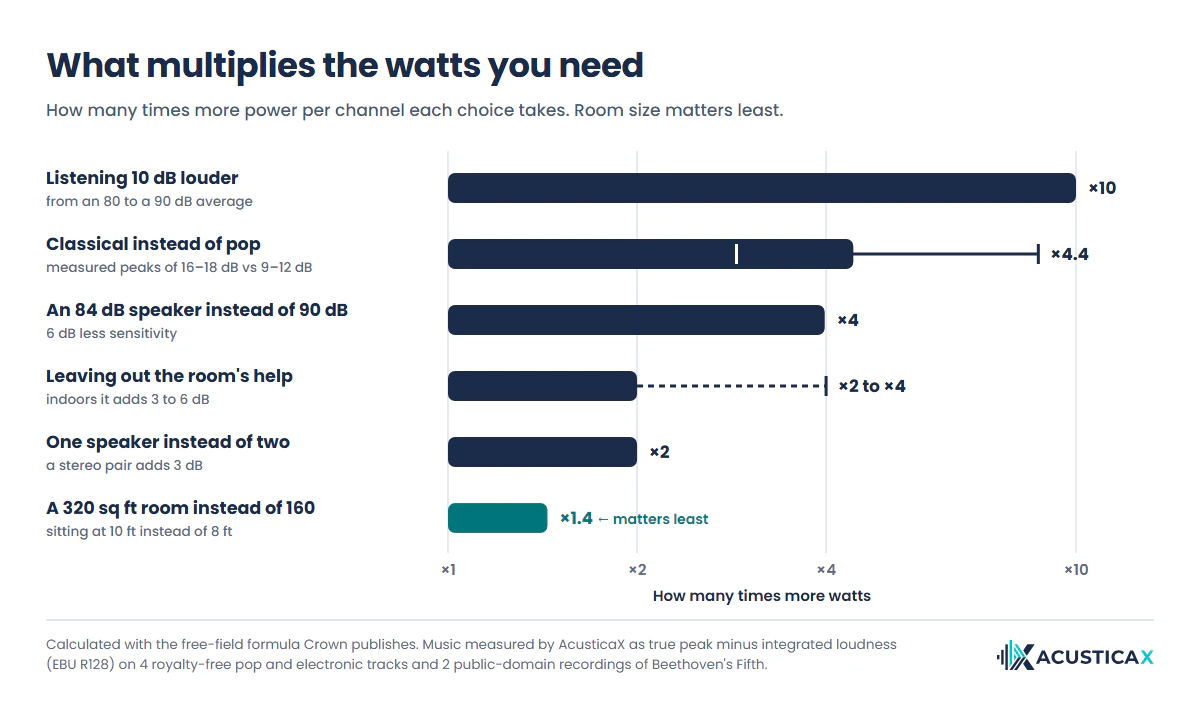
Because, by our math, room size moves the number least. Going from a 160 to a 320 sq ft room (from sitting at 8 ft to sitting at 10 ft) multiplies the watts by 1.4, while listening 10 dB louder multiplies them by ten and swapping a 90 dB speaker for an 84 dB one multiplies them by four. The chart ranks each choice by how much it matters.
The watts-by-room rules that get passed around never ask which speaker you own. Google’s AI Overviews (checked September 23, 2026) list 10-20 W for a bedroom, 30-80 W for a living room and 100 W and up for anything larger. None of them mentions sensitivity, which on its own separates an 84 dB speaker from a 96 dB one by sixteen times the watts.
Two claims that keep coming up, checked
- “A standard home theater system typically requires 300 to 500 watts of total power for a medium-sized living room,” says Google’s AI Overview, citing EcoFlow, a portable power station maker. For average speakers the range is plausible. Movies get 20 dB of headroom and each channel works on its own, so 87 dB speakers at 10 ft, at an 80 dB average, need about 180 W per channel in free field (around 900 W across five channels), and 90 W per channel with 3 dB of room gain or 45 W with 6 dB, 450 or 225 W in total. With 90 dB speakers every figure halves and with 84 dB ones it doubles, so a total with no sensitivity attached tells you very little.
- “Try to make sure your amplifier’s RMS output equals or is very close to what the speakers indicate for RMS rating,” says a car-audio guide from Elite Auto Gear that ranks for this search. Crown recommends 1.6 to 2.5 times the speaker’s continuous rating for music, which leaves 3 to 6 dB of headroom for peaks. Our own reading is that a matched amp runs out of headroom first, and an amp driven into clipping is the bigger risk to a tweeter.
How speaker sensitivity changes the numbers
Sensitivity tells you how many decibels a speaker produces at 1 meter with 1 watt, and every 3 dB of difference doubles or halves the watts you need. An inefficient bookshelf speaker (84 dB) and a small PA box (95 dB, Crown’s typical figure) are 11 dB apart, so the PA box needs thirteen times less power for the same volume.
| Speaker | Sensitivity on the spec sheet | Impedance | Sensitivity at 1 W | Watts per channel for 100 dB peaks at 10 ft (3 m) | Stated max SPL |
|---|---|---|---|---|---|
| Bowers & Wilkins 607 S3 | 84 dB (2.83 V) | 8 Ω | 84 dB | 179 W | Not published |
| KEF LS50 Meta | 85 dB (2.83 V) | 8 Ω | 85 dB | 142 W | 106 dB at 1 m |
| DALI Opticon 6 MK2 | 88 dB (2.83 V) | 4 Ω | 85 dB | 143 W | 110 dB at 1 m |
| Focal Aria Evo X N°4 | 92.5 dB | 8 Ω | 92.5 dB | 25 W | Not published |
| Small PA (Crown’s typical figure) | – | – | 95 dB | 14 W | – |
The DALI Opticon 6 MK2 is the textbook case of the 4-ohm trap. Its spec sheet says 88 dB, but at 1 W it’s 85 dB, so it needs as many watts as the KEF. The last column hides another limit. The KEF LS50 Meta is rated at 106 dB maximum at 1 m, so at 10 ft a pair tops out around 99.5 dB peaks no matter how many watts you feed it, room gain aside. Bowers & Wilkins, for its part, recommends 30 to 100 W into 8 Ω for its 607 S3, “on unclipped programme” in its own words.
Watch the 2.83 V figure on 4-ohm speakers
Most manufacturers quote sensitivity at 2.83 V, which is exactly 1 W into an 8 Ω speaker. Into a 4 Ω speaker those same 2.83 V are 2 W, so the spec sheet gets a free 3 dB. Before you do the math in watts, take 3 dB off a 4 Ω speaker’s sensitivity (1.25 dB for a 6 Ω one).
The watts you use and the watts you keep for peaks
With 87 dB speakers at 10 ft, an amp delivers 0.9 W per channel on average at normal volume and 2.8 W when it’s loud, and the peaks in the music ask for 10 to 100 times more for fractions of a second. How many times more depends on what you play, and it’s the part most people forget.
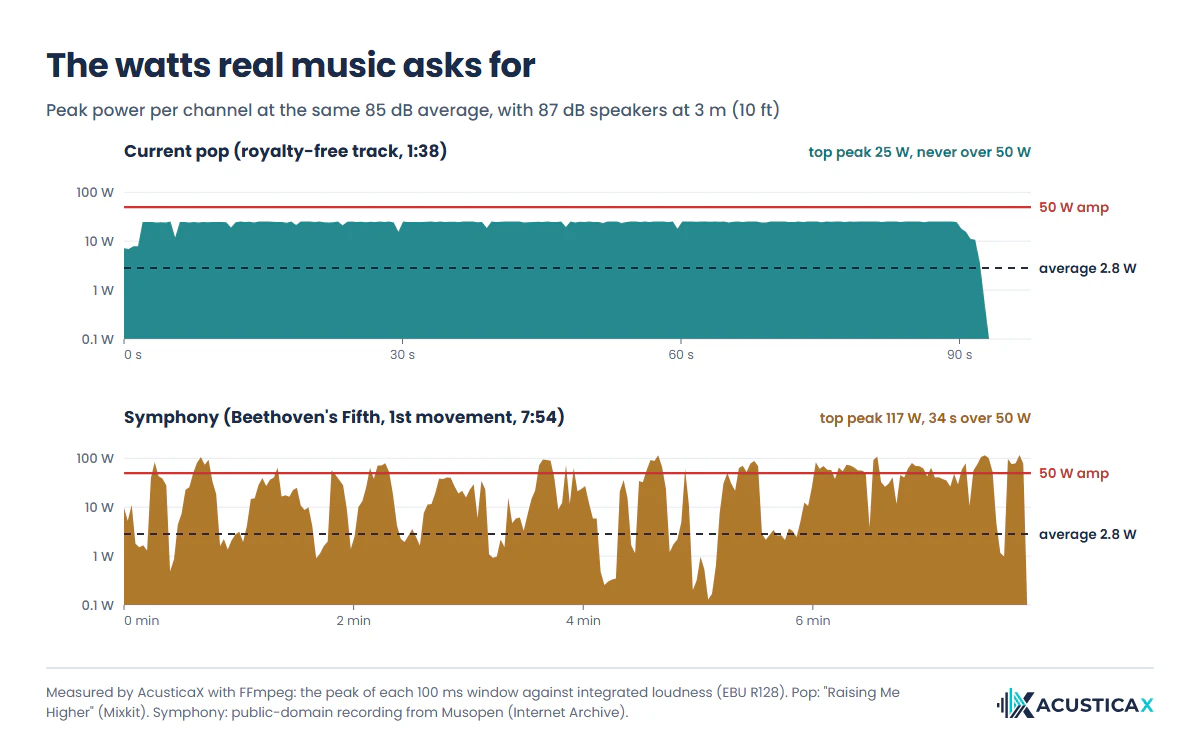
We measured it with FFmpeg, as true peak against integrated loudness (EBU R128). At the same 85 dB average, with 87 dB speakers at 10 ft, a current royalty-free pop track (“Raising Me Higher,” from Mixkit) never goes past 25 W peak per channel. The first movement of Beethoven’s Fifth, in a public-domain recording, hits 117 W and spends 34 seconds of its nearly eight minutes above 50 W. Across the four pop and electronic tracks we measured (two from Mixkit and two from Pixabay), the gap between average and peaks was 8.6 to 11.6 dB, and across two recordings of that same piece, 16.2 and 18.0 dB.
Watch which average you use. Integrated loudness leaves out the very quiet passages; if you set 85 dB with a sound level meter, which does average them in, the same symphony asks for about 300 W on its peaks, and that’s why the calculator uses 20 dB of headroom for classical and movies. The pop tracks we measured are heavily compressed and limited, so their peaks sit close to the average. Crown’s guide to how much amplifier power you need puts music peaks 6 to 25 dB above the average, and gives the example that 100 W of average power takes 1,000 W for 10 dB peaks and 10,000 W for 20 dB peaks.
When an amp runs out of watts on a peak, it clips it. A brief clip is almost inaudible, but sustained clipping sounds harsh, tiring and, over time, is what burns tweeters. We go into it in our guide on why a speaker distorts when you turn it up.
How to calculate the amplifier power you need, step by step
You need four numbers (the peak level you want at your seat, the speaker’s sensitivity, the distance and how many speakers play) and the free-field formula Crown publishes. The formula works in meters, so convert first (10 ft is about 3 m). Here are the steps.
- Decide how loud you listen on average. If you don’t know, measure how loud you actually listen from your seat with a song you like. We treat around 80 dB as normal listening and 85 dB as loud.
- Add the headroom for peaks. We use 10 dB for current pop, as Crown does, 15 dB for rock and jazz and 20 dB for classical and movies.
- Subtract the speaker’s sensitivity referred to 1 W at 1 m (for a 4 Ω speaker, 3 dB less than the 2.83 V figure).
- Add the distance loss, which is 20·log10 of the meters (6 dB at 2 m or 6.5 ft, 9.5 dB at 3 m or 10 ft, and 12 dB at 4 m or 13 ft), and subtract 3 dB if two speakers are playing.
- Divide the result by 10 and raise 10 to that power. That’s your watts per channel.
Here’s a worked example. With 87 dB speakers at 10 ft (3 m), listening at an 80 dB average with 95 dB peaks, you get 95 − 87 + 9.5 − 3 = 14.5 dB, and 10 to the 1.45 is 28 W per channel. If your speaker is 90 dB instead of 87, that’s 14 W; if you want 105 dB peaks, it’s 284 W. The rule worth remembering is that every 3 dB doubles the watts and every 10 dB multiplies them by ten, which is also roughly what it takes to sound twice as loud, as Dynaudio explains.
Home theater at reference level takes far more watts
For cinema reference level, with 105 dB peaks in every channel, 87 dB speakers at 10 ft need about 570 W per channel in free field and about 140 W counting 6 dB of room gain (the math is per channel, without the help of a pair). Hardly anyone listens at that level at home, and the numbers change a lot a few decibels lower.
That level comes from calibrating each screen channel to 85 dB with pink noise at −20 dBFS, as the SMPTE RP 200 standard sets for movie theaters, and leaving 20 dB of headroom for peaks. Dolby asks the same of Atmos music studios and allows 79 to 82 dB in small mix rooms. There’s no standard for living rooms, so we use that 79 dB as the reference for one, and at that level the requirement drops to about 143 W per channel in free field and about 36 W with the room’s help. The LFE channel runs 10 dB hotter, but the subwoofer’s built-in amp drives it.
The subwoofer, in fact, is what takes the most load off the receiver. With the speakers set to “small” and the crossover at 80 Hz, the most demanding bass goes to the sub and the main channels work with far more headroom; how to set it up is in our guide on how to calibrate your AV receiver’s levels. And when comparing receivers, look for the two-channel, 20 Hz–20 kHz, 8 Ω rating, the strictest figure on the spec sheet. Our review of the Onkyo TX-SR3100DAB shows how an entry-level receiver states its power depending on how it’s measured.
How to read the power rating on the box (RMS, peak and PMPO watts)
Amplifier power gets advertised in many ways, and the only useful number is continuous power per channel, what stores call RMS watts, stated with its impedance, frequency range and distortion. Peak, “music” or PMPO power is of little use for comparisons, because every brand measures it its own way. The same receiver can advertise very different numbers.
| Rating | How it’s measured | What it tells you |
|---|---|---|
| 80 W per channel (Denon AVR-X1800H) | 8 Ω, 20 Hz-20 kHz, 0.08% distortion, 2 channels driven | The strictest figure on the sheet, the one to compare |
| 120 W per channel (same Denon) | 6 Ω, 1 kHz, 0.7%, 2 channels | Heavier load and a single frequency, so it comes out higher |
| 145 W per channel (same Denon) | 6 Ω, 1 kHz, one channel, at the distortion Denon writes as “10%->1%” | The showroom number |
| FTC rule (US, revised in 2024) | Continuous per channel with the associated channels driven (in a receiver, at least the two front channels), 20 Hz-20 kHz, ≤1% distortion, 8 Ω | The figure a US spec sheet has to lead with |
| “30 W” (JBL Flip 6) | No test conditions given on the product page | Can’t be compared with another brand |
In the US, the FTC amplifier rule requires the headline rating to be continuous power from 20 Hz to 20 kHz into 8 Ω with the associated channels driven, which in a receiver means at least the two front channels, so no manufacturer has to publish an all-channels-driven figure. Of the three numbers on the Denon AVR-X1800H spec sheet, the 80 W one matches those conditions, and the other two, at 1 kHz and into 6 Ω, come out higher. Bluetooth speakers go the other way. Their “20 W” or “30 W” is usually a total with no test conditions (JBL rates the Flip 6 at 30 W, and it has a woofer and a tweeter), so the maximum level in decibels is a better way to compare them, when the maker publishes it.
How many watts do I need for a party?
For a 30-person party in a 430 sq ft living room, two PA boxes with about 50 real watts each are enough, and for 100 people in a room of around 1,300 sq ft, two well-chosen 12-inch powered speakers. The key is sensitivity, which sits around 95-100 dB for PA against 85-88 dB for a living-room speaker, ten times fewer watts for the same volume.
The math aims at a 95 to 100 dB average on the dance floor with peaks 8 to 10 dB above it, because party music is heavily compressed (we set the targets and crowd sizes ourselves). For 100 people, with 108 dB peaks at the farthest listener, 26 ft (8 m) away, two 97 dB boxes need about 400 real watts each in free field and about 100 W with 6 dB of room gain. A pair of Yamaha DBR12s, rated at 131 dB maximum at 1 m, reaches about 116 dB peaks at 26 ft, plenty. If you already own a speaker, you can test whether your speaker can handle the party by measuring its clean level with your phone.
Past a certain point, more isn’t better. The WHO asks venues and events to stay under a 100 dB average, and at that level NIOSH gives your ears about 15 minutes a day. We’ve gathered the figures in our guide on how many decibels are dangerous, and to put each level in context there’s our decibel chart of everyday sounds.
What about headphones? A few milliwatts will do
Headphones get by on a few milliwatts because they sit about an inch from your ear and are very sensitive (makers quote that sensitivity in dB/mW or dB/V). A 100 dB/mW pair reaches 110 dB peaks with 10 mW. Whether your phone is enough comes down to your source’s voltage against the headphones’ impedance, and our calculator will work out how much power your headphones need.
Frequently asked questions
Is 50 watts per channel enough?
For home use, almost always. A 50 W per channel amp with 87 dB speakers reaches peaks of about 97.5 dB at 10 ft without the room’s help, and about 100 dB in a furnished room that adds 3 dB, enough for an 80–85 dB average, though not for classical or movies at 85 dB. With 84 dB speakers it gets tight, and with 90 dB speakers you have power to spare.
Is 100 watts per channel enough?
For nearly any living room, yes. With 87 dB speakers at 10 ft, 100 W per channel gives about 100.5 dB peaks in free field and 103.5 to 106.5 dB with 3 to 6 dB of room gain, enough to listen loud to rock or jazz, and to classical if the room adds its 6 dB. Only reference-level home theater or very inefficient speakers in a large room ask for more.
What size amp do I need for 1000 watt speakers?
A “1,000 W” speaker rating is usually peak power. Crown notes that a speaker’s peak rating is typically four times its continuous one, so that’s about 250 W continuous, and with Crown’s 1.6 to 2.5 times rule for music it points to an amp of 400 to 625 W per channel. What matters is never driving the amp into sustained clipping.
How many speaker watts for room size?
There’s no fixed ratio, because it depends on the speaker and the volume. With 87 dB speakers and our typical listening distances it comes to about 0.1 W per channel per square foot at normal volume and about 0.3 W loud; with 97 dB PA boxes, ten times less.
Is a 200W speaker loud?
Not necessarily. On party and Bluetooth speakers that figure is usually peak power or the total of several internal amps. The Yamaha DBR12, a 12-inch powered PA box, advertises 1,000 W dynamic and 465 W continuous split between woofer and tweeter, and what actually tells you how loud it plays is its maximum level, 131 dB at 1 m. Wattage also moves loudness less than it seems. Going from 100 to 200 W adds just 3 dB, and sounding twice as loud takes about 10 dB, ten times the power.
How many watts do I need for 100 people?
About 400 real watts per box in free field, or about 100 W with the room’s help, if you use two 97 dB PA boxes and aim for 108 dB peaks at the farthest listener, 26 ft away. With powered speakers, two 12-inch boxes rated at 125 dB or more at 1 m cover 100 people at a 100 dB average (the Yamaha DBR12 is rated at 131 dB). With 87 dB living-room speakers you’d fall short, because they’d need ten times the watts.
Is 4 ohms or 8 ohms louder?
A well-built amp delivers more watts into 4 Ω than into 8 Ω, because the same voltage pushes twice the current. That doesn’t make the 4 Ω speaker louder. At the same 2.83 V sensitivity, a 4 Ω and an 8 Ω speaker play equally loud on the same amp, and the 4 Ω one simply draws more current, so check that your amp is rated for that load.
Can an underpowered amp damage speakers?
Yes, if you turn it up until it clips for long stretches. Clipping creates high-frequency harmonics that end up in the tweeter and heat it. Crown recommends 1.6 to 2.5 times the speaker’s continuous rating for music, to keep 3 to 6 dB in reserve for peaks, and spare watts are safer than pushing a small amp to its limit.
