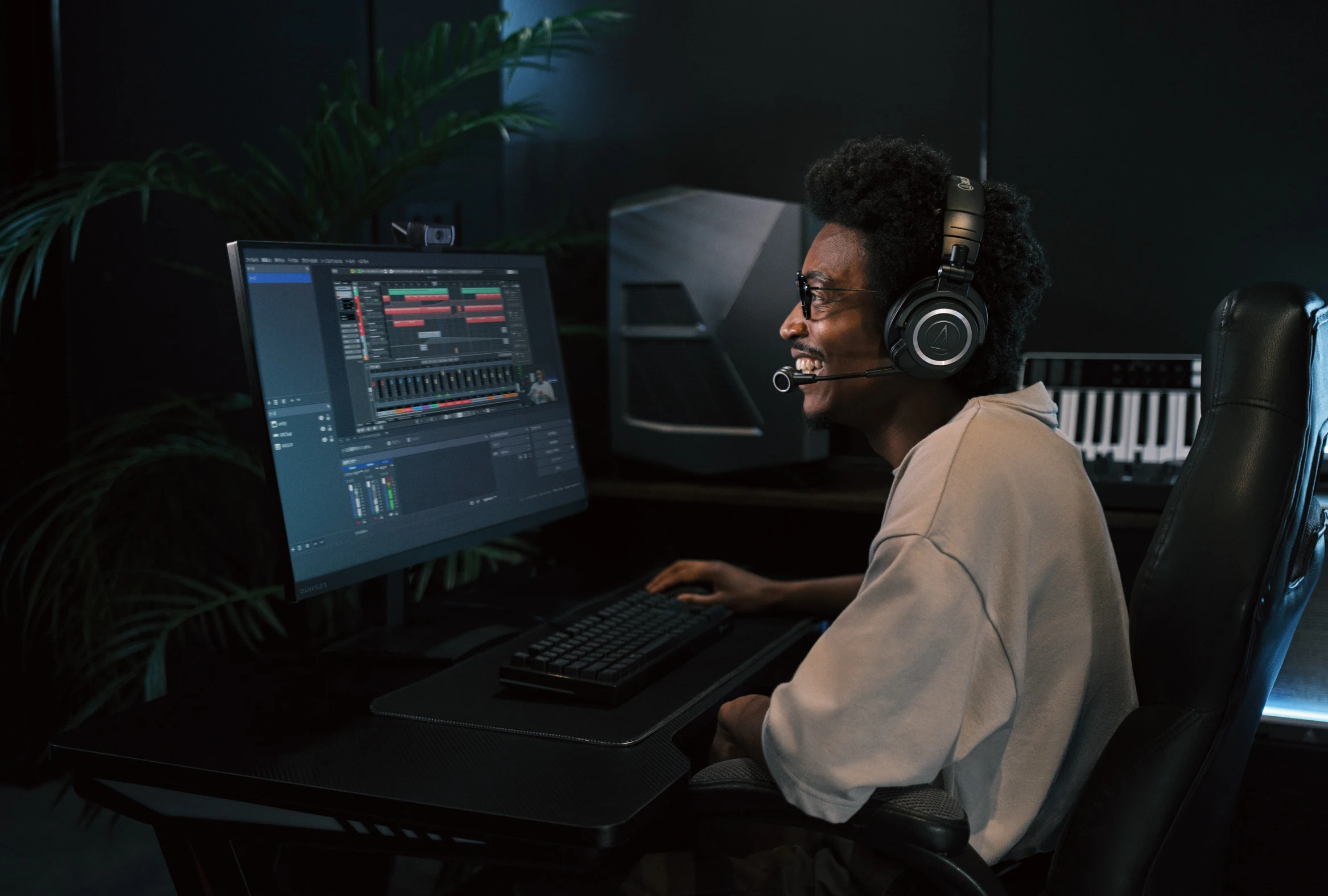
The ATH-M50xSTS-WL is the first wireless streaming headset in Audio-Technica’s StreamSet line, which pairs the brand’s M-Series studio headphones with a condenser mic on a boom arm. This one is built on the ATH-M50x. It went on sale on October 28, 2026, for $299 in the US (£239 in the UK, €279 in Europe), and it connects over 2.4 GHz through a USB transceiver rather than Bluetooth. It also adds two-level noise reduction to the mic, which none of the other StreamSet spec sheets list.
The press release skips several numbers that matter before you buy. Audio output runs at 16-bit/48 kHz, the headset weighs 365 g (13 oz), 80 g more than a pair of ATH-M50x, the spec sheet only lists Windows 11 and macOS, and Audio-Technica mentions “compatible gaming consoles” without naming any. Below are the full specs, what’s known about PS5, Switch and Xbox, how much lag to expect and how it compares with the other three StreamSet models.
ATH-M50xSTS-WL specs the press release leaves out
The official spec sheet adds five things the announcement doesn’t mention. Audio output is 16-bit/48 kHz, frequency response stops at 22 kHz, the headset weighs 365 g, range is about 10 m (33 ft) and the list of supported systems doesn’t include a single console. Here’s the full sheet next to the wired ATH-M50x.
| ATH-M50xSTS-WL | ATH-M50x (wired) | |
|---|---|---|
| Connection | 2.4 GHz wireless via a USB-A transceiver, or a USB cable | 3.5 mm cable |
| Driver | 45 mm, rare-earth magnets, CCAW voice coil | 45 mm, rare-earth magnets, CCAW voice coil |
| Frequency response | 20 to 22,000 Hz | 15 to 28,000 Hz |
| Sensitivity and maximum input | 99 dB/mW, 1,600 mW | 99 dB/mW, 1,600 mW |
| Digital audio | 16-bit/48 kHz output; mic at 24-bit/48 kHz | None (it’s analog) |
| Microphone | Back-electret condenser, unidirectional, 50 to 20,000 Hz (measured at 3 cm) | None |
| Range | About 10 m (33 ft), line of sight | Not applicable |
| Battery | Up to 24 h of continuous use; about 3.5 h to charge | Not applicable |
| Weight | 365 g (13 oz) | 285 g (10 oz) |
| Supported systems | Windows 11, macOS Sequoia and macOS Tahoe | Anything with a headphone output |
| Price (US / UK) | $299 / £239 | $159 / £145 |
Sensitivity and maximum input match the ATH-M50x exactly, which fits with Audio-Technica’s US announcement saying the headset uses “the same 45mm large-aperture drivers found in the ATH-M50x.” Everything upstream of the drivers is different. The headset receives digital audio over the air, converts it internally and powers the drivers from its own battery.
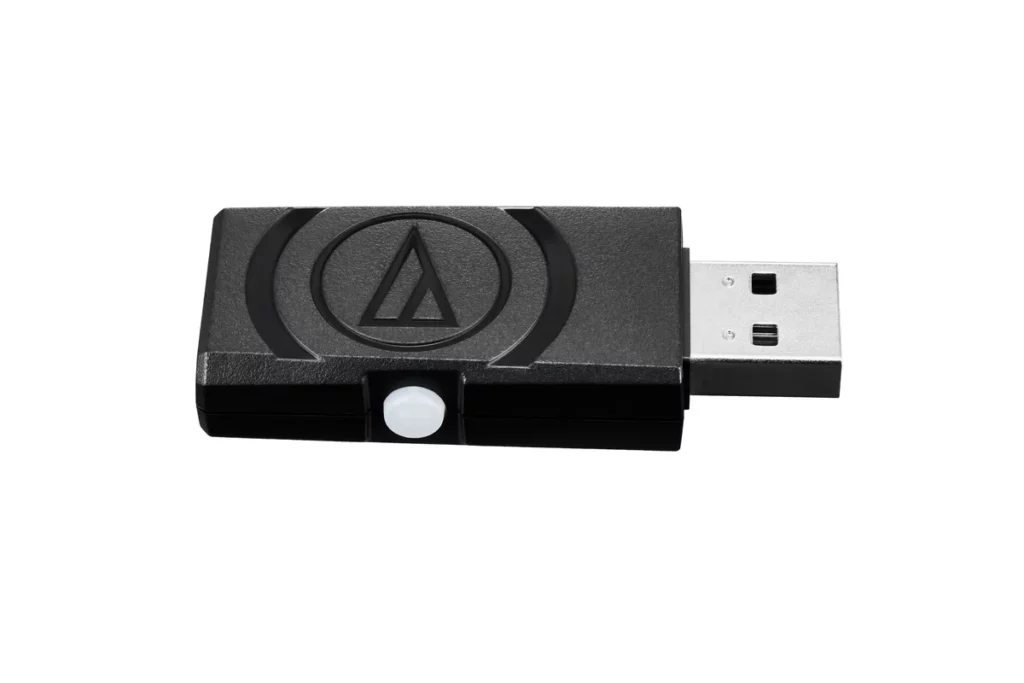
In the box you get the USB-A transceiver (22 × 40 × 11 mm, 7.5 g), a USB-A to USB-C adapter, a 2 m (6.6 ft) USB-C to USB-A cable and a second set of earpads. According to Phile Web, there’s no app to install, since noise reduction and sidetone are switched on the headset itself.

Does it work with PS5, Switch and Xbox?
It works with PS5 and Switch 2 according to the only hands-on we’ve found, and there’s no data for the original Switch or for Xbox. Audio-Technica says the transceiver works with PCs and “compatible gaming consoles” but doesn’t list them, and its spec sheet names only Windows 11, macOS Sequoia and macOS Tahoe.
That hands-on comes from Japanese outlet Phile Web, in a review sponsored by Audio-Technica itself. The writer plugged the transceiver into a PS5’s USB-A port to play Street Fighter 6 and Marvel Rivals, and into a Switch 2, where a rhythm game showed almost no noticeable lag. Neither the brand nor that review mentions Xbox. The only Xbox option documented in the range is the ATH-M20xSTS over its 3.5 mm plug, according to the same site, so if you play on Xbox, confirm compatibility with the retailer before buying the wireless model.
The manual doesn’t help yet either. As of October 29, the WL’s page on Audio-Technica’s website has no downloads section, and the manual filed with the FCC for the headset’s certification stays confidential until December 13, 2026.
Can you use it wired?
Yes, but only over USB. The included USB-C to USB-A cable charges the battery and also carries audio, so on a computer you can keep using the headset while it charges or once the battery runs flat. Nobody has tried it wired on a console, and the spec sheet doesn’t list any. It doesn’t list an analog input either, which means it won’t plug into a controller’s headset jack or a mixer. If that’s what you need, the $99 ATH-M20xSTS does use a 3.5 mm plug, and Phile Web ran it from the PS5 and Switch 2 controllers.
Which StreamSet should you buy?
If you want no cable and noise reduction, only the WL does both, for $299. If you already own an audio interface with phantom power, the XLR version gives you the same driver and the same rated mic response for $80 less. If you’d rather plug straight into a computer, the USB version costs $50 less than the wireless one. And for console gaming, the $99 ATH-M20xSTS is the only one that plugs into a controller’s headset jack.
| ATH-M20xSTS | ATH-M50xSTS (XLR) | ATH-M50xSTS-USB | ATH-M50xSTS-WL | |
|---|---|---|---|---|
| Price (US / UK) | $99 / £89 | $219 / £169 | $249 / £199 | $299 / £239 |
| Connection | 4-pole 3.5 mm plug, with USB-A and USB-C adapters | XLR for the mic, 3.5 mm plug for the headphones | USB-A, with a USB-C adapter | 2.4 GHz wireless via a USB-A transceiver, or a USB cable |
| What else you need | Nothing | An interface or mixer with phantom power (11 to 52 V) | Nothing | Nothing |
| Driver and response | 40 mm, 15 to 20,000 Hz | 45 mm, 15 to 28,000 Hz | 45 mm, 15 to 28,000 Hz | 45 mm, 20 to 22,000 Hz |
| Digital audio | Up to 384 kHz and 32-bit output through the adapter | Whatever your interface does | Up to 96 kHz and 24-bit | 48 kHz; 16-bit out, 24-bit in |
| Sidetone | Not listed | No; depends on the interface | Yes, with a level dial | Yes |
| Noise reduction | Not listed | Not listed | Not listed | Yes, two levels |
| Weight | 236 g | 330 g | 330 g | 365 g |
The three M50x-based StreamSet models share the same driver and list the same mic response (50 to 20,000 Hz at 3 cm), and differ in the signal path and in what you need around them. The ATH-M20xSTS is a different headset altogether, with a 40 mm driver, 236 g of weight and response up to 20 kHz.
Why a 2.4 GHz dongle instead of Bluetooth?
Lag. Gaming headsets with their own wireless dongle measure between 22 and 42 ms in RTINGS’ tests, while over Bluetooth with the basic SBC codec they average 170 ms, and regular headphones about 258 ms, according to the site’s latency research. Audio-Technica doesn’t publish a latency figure for the ATH-M50xSTS-WL, so those numbers are the yardstick until someone measures it.
We’re more forgiving of sound that arrives late than of sound that arrives early. ITU-R Recommendation BT.1359, which broadcasters use for lip-sync, puts the point where the average viewer starts to notice at 125 ms of audio delay and the acceptable limit at 185 ms. For keeping picture and sound together, 20 to 40 ms is well clear of the 125 ms where people start to notice, while the 170 to 260 ms of basic Bluetooth is already past it and close to or beyond the acceptable limit. Rhythm and competitive games are more demanding, because the delay adds to your own reaction time.
Rated range is about 10 m (33 ft) with a clear line of sight. The radio works between 2.404 and 2.476 GHz, the same band as 2.4 GHz Wi-Fi, Bluetooth itself and many wireless mice and keyboards. Compared with Bluetooth, the protocol is different and the transceiver is dedicated to this headset. To steer clear of busy channels, the link uses adaptive frequency hopping (AFH), as Bluetooth itself does.
It’s worth knowing that a USB 3.0 port with a device plugged in radiates noise right in that band. In a 2012 white paper, Intel measured an external USB 3.0 hard drive raising the noise floor at 2.4 GHz by nearly 20 dB, then tested a wireless mouse receiver. Plugged into a USB 2.0 port stacked right above a USB 3.0 port with a flash drive in it, the mouse didn’t respond even at 2 ft. Moved to the other side of the laptop on a USB 2.0 extension cable, it worked fine out to 5 ft. If the audio drops out just a few feet away, move the transceiver away from busy USB 3.0 ports before you suspect a fault.
What the mic is and what its noise reduction does
It’s a back-electret condenser with a unidirectional pattern, a rated response of 50 to 20,000 Hz measured at 3 cm (about an inch), and it records at 24-bit/48 kHz. Audio-Technica calls it a “large-diaphragm” mic in its European and Japanese material, but the spec sheet gives no size.
Back-electret is a very common way to build an electret capsule, from the AT2020 in the 20 Series to many headset mics, so on its own it says nothing about quality. The 50 to 20,000 Hz response at 3 cm is exactly what the other three StreamSet models list.
Distance does most of the work against noise. At about 3 cm, your voice reaches the mic roughly 30 dB louder than it would from a meter away, where a fan might sit. That’s our own rough estimate (level drops about 6 dB each time distance doubles, and at 3 cm your mouth doesn’t behave quite like a point source), and room reflections eat into the margin a little.
The boom also mutes the mic when you flip it up, which Phile Web, in its Audio-Technica-sponsored hands-on, found handy for stepping away mid-stream.
What noise does the noise reduction remove?
The examples Audio-Technica gives are steady noises, such as PC fans and air conditioners, and its product page adds “other ambient sound.” It’s adaptive (it keeps monitoring the input to put your voice first), it has two levels and it switches off from a button on the earcup. The brand says nothing about keyboard clatter, mouse clicks or other voices, all of which change from moment to moment.
Before you pick a level, you can see what kind of noise your room has with an online spectrum analyzer and your computer’s mic. That tells you whether it’s steady, like the noise the brand says it removes, or something that comes and goes.
What is sidetone for?
It lets you hear yourself while you talk. Closed-back headphones muffle your own voice, and without realizing it you end up talking louder. Sidetone feeds part of what the mic picks up back into the headphones, and Audio-Technica Japan pitches it exactly that way, as a way to ease the plugged-up feeling and stop you from raising your voice more than you need to.
It isn’t new to the range. The USB StreamSet already has it through a “Monitor” dial that you press to turn on and rotate to set the level of your voice, as Audio-Technica’s support page explains. The XLR model doesn’t, because hearing your own voice depends on the interface you plug it into. The wireless model adds noise reduction.
It ships with the mesh earpads fitted
It ships wearing the mesh pads (HP-M50xSTS), designed to stay cool over long sessions, with the ATH-M50x pads (HP-M50x) packed alongside, according to the Japanese ATH-M50xSTS-WL product page. Audio-Technica says the M50x pads isolate better and favor sound quality, so for the “M50x sound” the brand talks about, those are the ones to fit.
Swapping them changes what you hear, especially in the bass. Audio-Technica’s US product page describes the StreamSet pads as mesh/leatherette, and a pad alone can shift the sound a lot. The Sennheiser HD 490 PRO also ships with two sets, and the same headphone reaches 20 Hz with its velour pads but only 40 Hz with the fabric ones, as we cover in our guide on when to replace headphone earpads.
In Japan, Audio-Technica sells both pad sets as spare parts, along with the transceiver and the cable. That’s worth knowing, because losing the dongle leaves the headset with no wireless connection at all.
It weighs 365 g and the battery lasts all day
At 365 g it’s 80 g heavier than an ATH-M50x and 35 g heavier than the wired M50x StreamSet models, and Phile Web weighed its sample at 361 g. The built-in battery is rated for up to 24 hours of continuous use and takes about 3.5 hours to charge. When it runs out, the USB cable keeps you going.
In Phile Web’s hands-on, sponsored by Audio-Technica, the weight wasn’t a problem, since clamping force felt right and the fit was secure. How it feels after several hours straight, the length of a long stream, is still unknown.
A battery that lasts all day doesn’t mean your ears should. For long gaming or streaming sessions, the simplest guide is the 60/60 rule for headphone listening, which means listening at no more than 60% of maximum volume and taking a break every 60 minutes.
Does it sound the same as an ATH-M50x?
It may sound very close, but you can’t take it for granted. It shares the 45 mm driver, yet its own electronics drive it at 16-bit/48 kHz, it ships with different pads fitted, and Audio-Technica hasn’t published a frequency response graph for the wireless model.
The ATH-M50x is the studio headphone that Audio-Technica’s Spanish release and Japanese website say has sold more than 3 million units, though its European English-language release says 2.5 million. Its sound is the main selling point of the M50x StreamSet models.
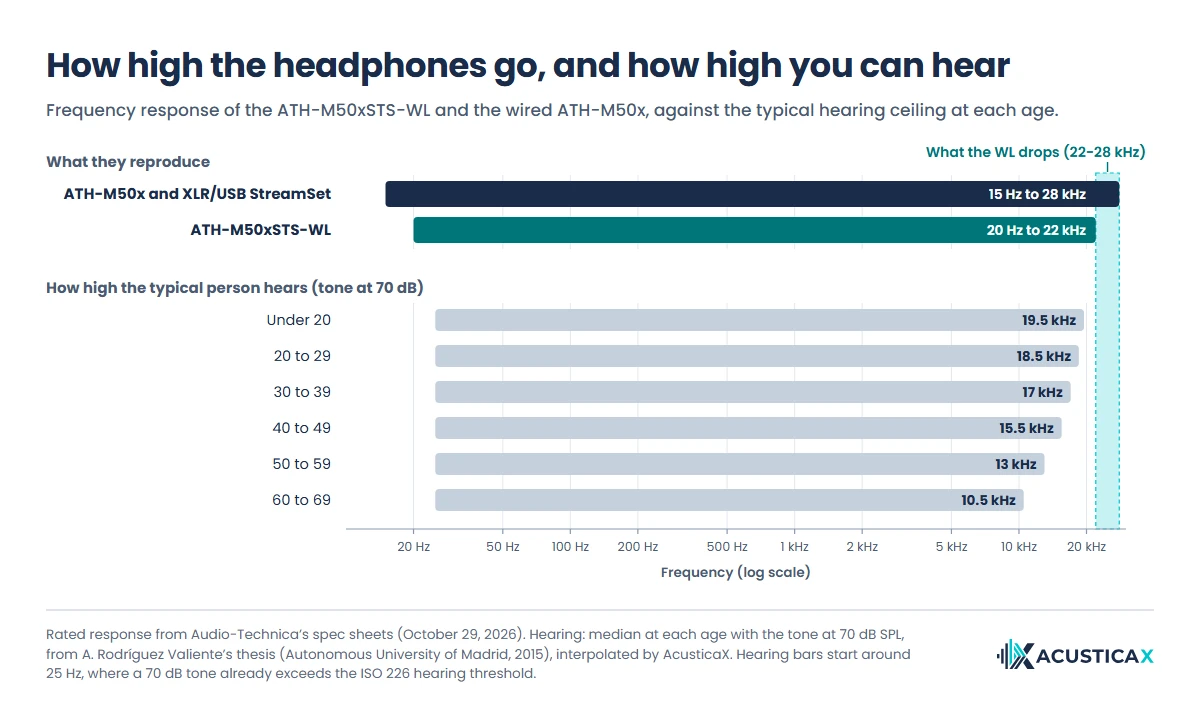
The 16-bit/48 kHz output shouldn’t be a downgrade you can hear, although Audio-Technica doesn’t say whether the radio link compresses the audio. Sixteen bits give about 96 dB between the loudest sound and the noise floor (6 dB per bit), and at 48 kHz the theoretical limit is 24 kHz, which matches the transmission band on the spec sheet (20 to 24,000 Hz). A response that ends at 22 kHz, rather than at the 28 kHz of the wired M50x, fits that sample rate, because the filter in a 48 kHz converter starts rolling off a little before the limit. That part is our inference. At the bottom, response starts at 20 Hz, where the transmission band starts too, against 15 Hz for the wired M50x.
Hardly anyone hears the 6 kHz lost at the top at normal listening levels. With the data from 645 people tested in Madrid that we use in our guide to hearing frequency by age, the typical person under 20 hears up to 19.5 kHz with the tone at 70 dB, someone aged 40 to 49 tops out at 15.5 kHz and someone aged 60 to 69 at 10.5 kHz. For the same reason, the 96 kHz of the USB StreamSet or the 384 kHz of the ATH-M20xSTS adapter add nothing you can actually hear.
If you want a rough idea of where your own ceiling is, our online hearing test gives you an estimate in your browser, with tones from 8 to 20 kHz and one ear at a time.
How much is it and where can you buy it?
It costs $299 in the US, where it went on sale on October 28, 2026, and you can order it from Audio-Technica’s US store. In the UK it costs £239.
In Europe it sells for €279, and in Japan it goes on sale on October 30 for ¥49,500 including tax.
What we’d measure if we tested it
There are six things the spec sheet leaves open that we’d want to check with a review unit:
- Transceiver latency against the USB cable, using a recording loop like the one RTINGS uses.
- Real battery life with the volume fixed at a known level.
- Range through one and two walls, with busy 2.4 GHz Wi-Fi around.
- What each noise reduction level removes with a fan running, comparing the spectrum of the recordings.
- The noise floor of a recording made in silence, and the sidetone delay.
- Comfort after three hours straight.
This article wasn’t written with a unit in hand. Everything above comes from Audio-Technica’s documentation, Phile Web’s hands-on and the sources linked.
FAQ
Does the ATH-M50xSTS-WL work with PS5, Switch and Xbox?
It works with PS5 and Switch 2 with the USB transceiver plugged into the console, according to a hands-on by Japanese site Phile Web, sponsored by Audio-Technica. There’s nothing on the original Switch. Audio-Technica mentions “compatible gaming consoles” without listing them and doesn’t mention Xbox, so there’s no confirmation for Xbox.
Can you use the ATH-M50xSTS-WL wired?
Yes, on a computer, with the included USB-C to USB-A cable, which charges the battery and carries audio at the same time. Nobody has tried it wired on a console, and the spec sheet lists no analog input, so it won’t plug into a controller or any analog gear.
Does it have Bluetooth?
No. The spec sheet lists only the 2.4 GHz transceiver and the wired USB connection. The transceiver comes with a USB-C adapter, but Audio-Technica doesn’t list phones or tablets among supported systems. If you want M50x headphones with Bluetooth, Audio-Technica makes the ATH-M50xBT2 ($219, with LDAC and up to 50 hours of battery), though its mic is built into the earcup, with no boom, and omnidirectional.
What’s the difference between the ATH-M50xSTS, the ATH-M50xSTS-USB and the ATH-M50xSTS-WL?
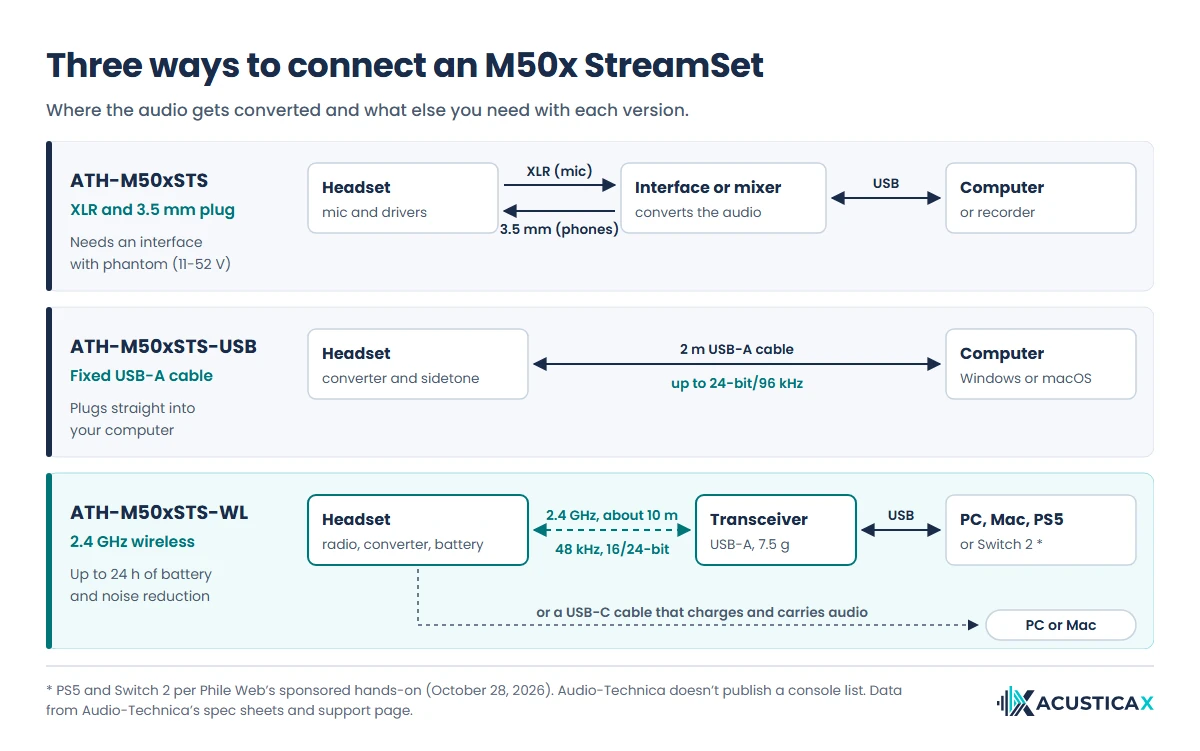
The connection. The ATH-M50xSTS has an XLR plug for the mic and a 3.5 mm plug for the headphones, and needs an interface with phantom power. The USB version plugs into a computer and handles up to 24-bit/96 kHz. The WL connects over 2.4 GHz with its transceiver, at 16-bit/48 kHz output, and it’s the only one with a battery and with noise reduction on its spec sheet. Audio-Technica’s US store sells them for $219, $249 and $299.
What is sidetone on a headset?
It’s the feature that plays your own voice back into the headphones as you speak, the way the mic picks it up. It stops you from straining your voice behind closed-back headphones, which block your ears, and lets you confirm by ear that the mic is working.
Is the ATH-M50xSTS-WL comfortable?
It weighs 365 g, more than the ATH-M50x (285 g) and the wired M50x StreamSet models (330 g), and ships with mesh earpads built for breathability over long sessions. In Phile Web’s hands-on, sponsored by Audio-Technica, clamping force and fit felt good despite the weight.
How long does the battery last, and can you replace it?
Up to 24 hours of continuous use, with about 3.5 hours to charge. The lithium-ion battery is built in, according to the Japanese spec sheet, and it isn’t among the spare parts Audio-Technica sells in Japan. When it runs out, the headset keeps working over the USB cable.