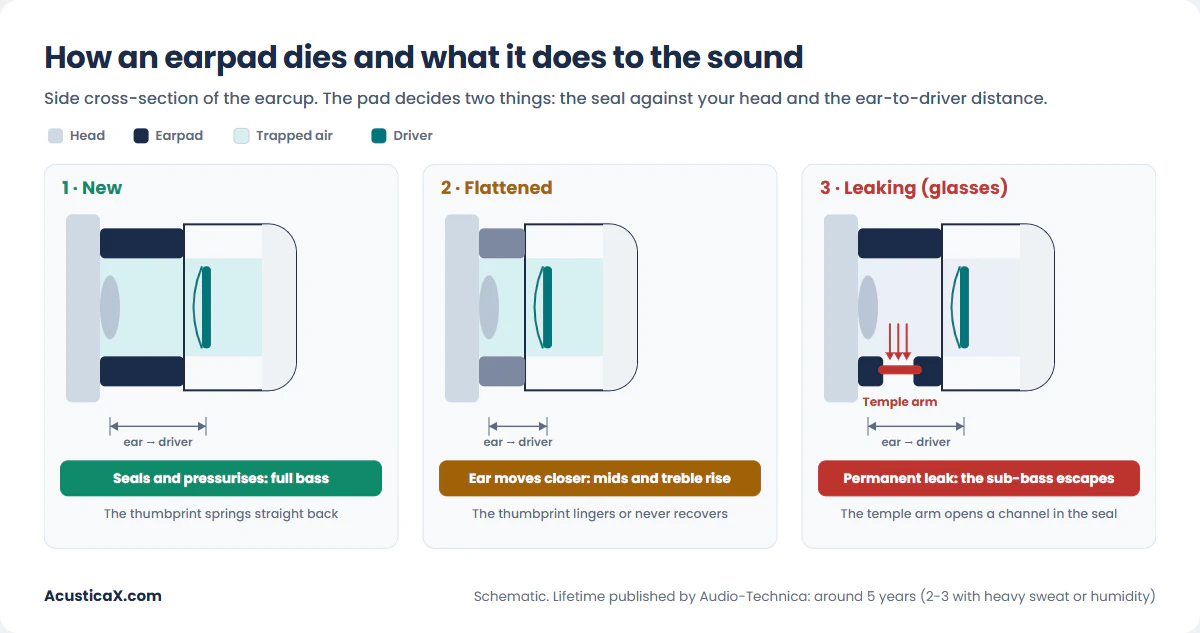
When to replace earpads is not a question of months on a calendar. It comes down to six signs: the foam no longer springs back when you press it, the surface cracks or flakes, bass sounds weaker than it used to, more outside noise gets in, you can feel the hard ring against your ear, and one channel sounds different from the other. Audio-Technica, which runs a hydrolysis test on its headphones, classes earpads as perishable items and gives them around 5 years of normal life, or 2 to 3 years if you sweat a lot or live somewhere humid. Not six months, not 350 hours: those numbers do not come from any manufacturer.
The part almost nobody spells out is that an earpad is not a comfort accessory, it is part of the acoustic circuit. Sennheiser ships the HD 490 PRO with two sets, and measured at ±3 dB the very same headphone reaches 20 Hz with the velour pads and only 40 Hz with the fabric ones. A full octave of bass, with nothing else touched: same driver, same cable, same file. This guide covers when earpads are due, exactly what they do to the sound, how to clean earpads without wrecking them, and how to buy the right replacement.
When to replace earpads: six signs that beat any calendar
Replace them when any one of these six signs shows up, even if the other five look fine. None of them can be cleaned away: once the foam stops recovering or the polyurethane skin starts breaking down, the process only runs one way. The first column is what you notice; the second is what is actually happening inside the pad.
| What you notice | What is happening inside | What to do |
|---|---|---|
| Your thumbprint stays in the pad | The foam has lost its elastic recovery – it has gone flat | Replace them. This is the earliest sign and the one that moves the sound most |
| The surface cracks, peels or sheds black flakes | Hydrolysis of the polyurethane skin: the coating turns brittle | Replace them now; flakes end up on your face, hair and collar |
| You can feel the hard ring or the grille on your ear | There is no loft left and your ear is touching the cup structure | Replace them. It sounds different and it hurts on long sessions |
| Less bass and more outside noise leaking in | The seal is broken, and a leak works as an acoustic high-pass filter | Confirm it with the seal test below before you buy anything |
| They smell, feel sticky or have gone stiff | Sweat, skin oil and cosmetics the material can no longer release | Replace them: this is the only part you wear against your skin |
| One channel sounds different from the other | One pad is more compressed than the other, usually the side you rest them on | Replace the pair, never a single pad |
The thumb test: ten seconds and you know
Press the middle of the pad all the way down with your thumb, hold for five seconds and let go. A healthy pad springs back almost instantly; a worn one keeps the dent and takes its time, or never recovers at all. Do it on both sides and compare: the pad on the side you rest the headphones on, or the side you sweat through most, is nearly always ahead of the other.
It is the single most useful check because it catches the problem before you can see it. A pad can look immaculate from the outside and have already lost several millimetres of effective loft, and that loft is exactly what sets the distance between your ear and the driver.
The seal test: cup your hands over the earcups
Play a steady 50 Hz tone from a tone generator at a moderate level, wear the headphones the way you normally do, and listen. Now cup your hands over the earcups and press them gently against your head without repositioning them. If the bass jumps up and gains body, the seal was not closing: there was a leak, and your hands have just plugged it.
Two honest caveats. First, on open-back headphones you will barely hear a change, because they are designed not to seal in the first place – there the thumb test is the reliable one, not this. Second, run it twice, with and without your glasses on. If the difference only appears with glasses, the pad is not the culprit, the temple arm is, and that has a different fix.
Earpad lifespan: the maker says five years, the internet says six months
Audio-Technica is one of the few brands that publishes an actual figure, and publishes the reasoning with it: every pair of its headphones goes through a hydrolysis test, earpads and head pads are classed as perishable items because they break down when exposed to humidity, water, perspiration and friction, and the normal lifetime is around 5 years. Where humidity is higher or the headphones get very heavy use, the company still expects “a healthy 2-3 years of life before beginning to show any signs”. It also names a cause you would not guess: cosmetics and hair products can trigger chemical reactions that accelerate the damage.
Now compare that with what Google summarises. Checked on 2026, its two AI Overviews on this topic contradict each other: the English one says every “1 to 3 years, or roughly 1,000 hours of use”, sourced from a Reddit thread, while the Spanish one says “every 6 months or after 350 hours of frequent use”, sourced from YouTube videos. Neither cites the manufacturer, even though the Audio-Technica page ranks on the first page of both searches.
Here is our own read, and why hour counts never line up: earpads are not measured in hours, they are measured in conditions. A turntable stylus wears mechanically, so counting groove hours makes sense. An earpad fails through chemistry – hydrolysis of the polyurethane – plus foam fatigue, and neither one waits for you to press play: a pad degrades in the drawer too. That is why an office pair used eight hours a day in a dry room outlasts a gym pair used for two.
What earpads do to the sound: two pads, one octave apart
Swapping the pad changes the frequency response, and not by a little. The cleanest case to verify is the Sennheiser HD 490 PRO, because the manufacturer sells it with two interchangeable earpad sets and states on its own product page that each one has “a unique sound signature”. Measured with both sets, the same headphone gives 20 Hz – 22 kHz (±3 dB) with the velour pads and 40 Hz – 22 kHz (±3 dB) with the fabric ones.
And it is not only the bottom end that moves. The tilt of the curve between 50 Hz and 1 kHz – the band where nearly all music lives – flips sign: it slopes 2 dB down with the velour pads, which sound full, and 2 dB up with the fabric ones, which sound clearer with tighter bass. That is 4 dB of tilt difference between two accessories that came in the same box.
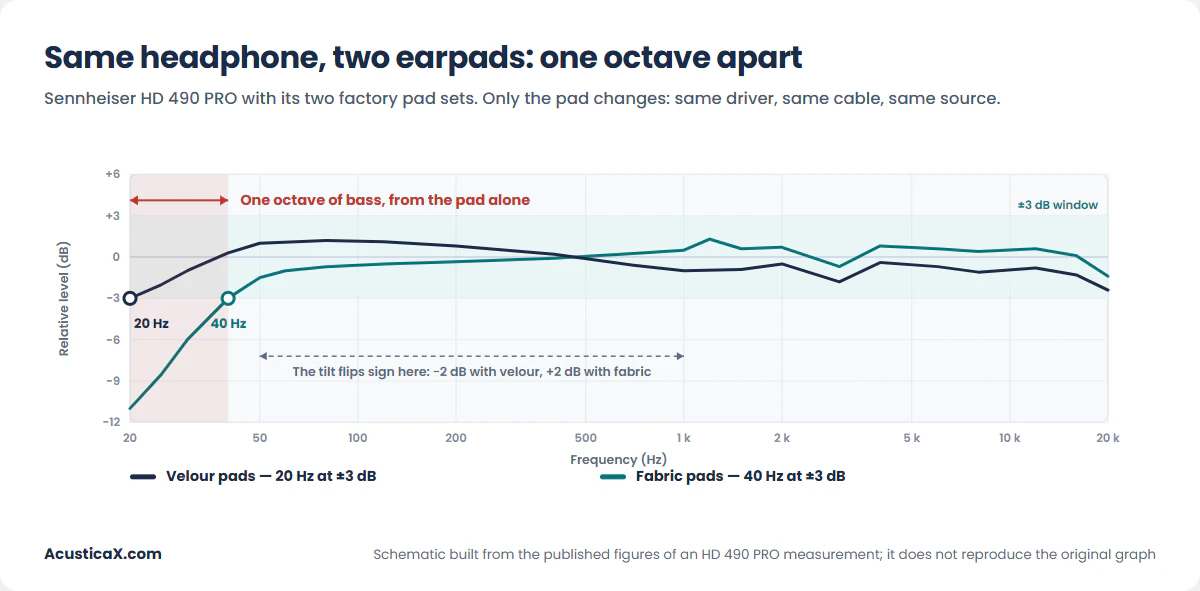
For scale: that is more than any DAC or cable swap will ever move. If you have ever wondered whether you can really hear the difference between two boxes, that is precisely the territory where a blind ABX test settles the argument. A pad swap does not need statistics – you hear it straight away.
There is a side effect worth knowing about too: your headphones’ spec sheet may only be valid with one of the pad sets. Sennheiser quotes 5 Hz – 35 kHz (at -10 dB) for the HD 490 PRO, and that figure only holds with the velour pads on. With the fabric pads fitted, the same unit no longer gets there.
The seal rules the bass
Below roughly 200 Hz, the cup, the pad and the side of your head form a sealed cavity, and the driver is not launching waves into it: it is pressurising that pocket of air. A bass wavelength is far longer than the cavity, so what reaches your eardrum is a pressure change, not a travelling wave. Add a leak and the pressure escapes before the cycle finishes, which is the textbook definition of an acoustic high-pass filter: the lower the note, the longer the cycle, the more air bleeds out and the less you hear.
It matters enough that labs measure it separately. RTINGS measures frequency response consistency on a Brüel & Kjær 5128 head-and-torso rig with five passes, removing and re-seating the headphones each time, then repeats the measurement on five people with small, medium and large heads, one who wears glasses and one with long hair, evaluating from 20 Hz to 2 kHz. Their methodology puts it plainly: a poor seal produces “an uneven or dramatic drop in the frequency response’s bass”.
One nuance the round numbers online skip: you will read that breaking the seal costs 10 to 20 dB of bass, and that is true for closed-backs and in-ears. On an open-back the effect is small by design – the HD 490 PRO measured with different degrees of seal barely shifts unless you lift the pad and open a substantial gap. Check which kind of headphone you own before you panic.
Pad thickness rules the mids and treble
The second variable is the distance between your ear and the driver, and the pad’s thickness sets it: somewhere between one and three centimetres depending on the model. As the foam flattens, that distance shortens and the trapped air volume shrinks, so the cavity resonances move – and those live in the upper mids and treble, not in the bass.
The pad also resonates in its own right. The HD 490 PRO measurement shows a small amount of pad bounce – a resonance in the pad itself – around 110 Hz. That is normal, and the designer voiced the headphone with that pad in place; fit a different one and the resonance moves somewhere else, no longer where the engineer put it.
The practical consequence is counter-intuitive: if your headphones sound brighter or shoutier than they did two years ago and you have changed nothing in the chain, check the pads before blaming the source or the streaming service. A collapsed pad pulls your ear closer to the driver and lifts the 2-5 kHz region, which is where hearing is most sensitive.
Velour vs leather earpads, fabric and hybrids
The material decides two things at once: how well it seals – and therefore how much bass survives – and how well it breathes, which decides how long you can keep them on. There is no outright winner here, only a trade-off, and it is worth choosing it deliberately.
| Material | Bass and isolation | Comfort | Durability | Cleaning |
|---|---|---|---|---|
| Faux leather (pleather, protein leather) | Seals best: most bass and most isolation | Runs hot and traps sweat; sticks to skin in summer | First to crack (hydrolysis) | Barely damp cloth. Never alcohol |
| Velour | Porous: slightly less bass pressure, gentler treble | Coolest option for long sessions | Holds up well, but collects dust and lint | Lint roller; many are washable |
| Fabric or mesh | In between, with tighter bass and more forward mids | Cool and light | Good | Easy, dry cleaning |
| Hybrids (leather outside, fabric inside) | Seal almost like leather | Less synthetic surface against your skin | Medium | Medium: two materials, two routines |
| Memory foam | Moulds to your face: the best seal if you wear glasses | Very comfortable, but holds heat | Flattens sooner than the rest | Delicate: the foam cannot be soaked |
| Real leather | Seals like faux leather | Warm to the touch and breathes a little better | Longest lasting if looked after | Dry cloth and the occasional leather conditioner |
If you wear glasses, this one is about you
The temple arm of a pair of glasses opens an air channel exactly where the pad is supposed to seal, and that channel never closes: it is a permanent leak in the most sensitive spot. This is not forum folklore. Sennheiser fixed it in hardware – the HD 490 PRO uses grooved ear pads for eyeglasses, which the brand lists as a patented accessibility feature alongside the braille-guided left and right earcups. And RTINGS deliberately includes a subject who wears glasses in its five-person panel.
What to do about it: the thinnest temple arms you can live with, memory foam pads (they mould around the arm instead of folding over it) or, if you are buying, a model with the groove built in. And the obvious rule everyone forgets: fit and adjust the headphones with your glasses on, because that is how you are going to wear them.
If you would rather see it on a graph than guess at it, you can overlay frequency response curves and compare two measurements of the same headphones: it is the clearest way to see where the loss happens and how deep it goes.
How to clean earpads without ruining them
The manufacturer boils it down to one sentence: a clean, dry cloth after every use, so perspiration never dries on the material. That ten-second habit does more for pad life than anything else, because it goes after the cause – salty water drying on polyurethane – instead of the symptom. Everything beyond that is rescue cleaning, and each material tolerates a different treatment.
| Material | Do | Don’t | Drying |
|---|---|---|---|
| Faux leather and leather | Barely damp microfibre with warm water and mild soap, dried immediately | Alcohol, acetone, disinfectant wipes, bleach, stain removers | Air dry, in the shade |
| Velour and fabric | Lint roller or tape for surface dust; hand wash in warm water with mild soap if the maker allows it | Washing machine, tumble dryer, hard scrubbing | Air dry 24 h; never a hairdryer or direct sun |
| Bare foam (no cover) | Replace it: foam cannot be cleaned on the inside | Soaking it if it is glued to a plastic ring | – |
| Silicone tips (in-ears) | Warm water and soap, off the earphone | Refitting them while still damp | Bone dry before they go back on |
When the manufacturer says the pads are washable, they are: Sennheiser states it explicitly for both HD 490 PRO sets. When nobody says so anywhere, assume they are not.
Why alcohol destroys faux leather
Faux leather is a polyurethane skin over a fabric backing, and its declared enemy is hydrolysis: water slowly breaks the polymer chains until the coating turns brittle and sheds in flakes. That is why manufacturers run hydrolysis tests, and why sweat – salty water at body temperature – is considerably worse than plain water.
Alcohol stacks a second problem on top of the first: it strips the plasticisers that keep the skin flexible. One wipe changes nothing; a routine of cleaning with alcohol wipes leaves you with cracked pads within months. And the third cause is the one nobody expects: Audio-Technica specifically names cosmetics and hair products – hairspray, hair oils, sunscreen – among the things that speed up degradation and sit “outside of our manufacturing control”.
Hygiene: what actually grows on a pad
An earpad is the only part of your headphones in permanent contact with skin, at body temperature and with moisture. A study published in 2008 with 50 volunteers aged 18 to 25 compared two groups by earphone use: in the frequent-and-constant group, bacteria grew in 92 % of ears and 68 % of the earphones, against 80 % and 56 % in the occasional group, and with heavier growth on top of that.
The limits, stated up front: the sample is small, it only included men, and it tested in-ear earphones rather than over-ear pads. It does not prove that dirty pads will give you an ear infection. What is well established is the mechanism behind otitis externa – heat, retained moisture and maceration of the skin – which is precisely what a non-breathing faux leather pad creates over a three-hour session. Three practical rules follow: dry cloth when you finish, never lend them unwiped, and stop leaving them to fester inside a gym bag.
Buying replacements without losing the sound you like
If your goal is to get back the sound you had, buy the manufacturer’s own pads for your exact model and stop thinking about it: same material, same thickness and same mounting ring means returning to the point where the designer voiced the headphone. Anything else is a tuning decision rather than a repair, and it is worth making it on purpose.
OEM, third-party or “universal”
There are specialist makers of headphone earpads offering several materials for the same model and declaring which way each one shifts the sound. That is a perfectly legitimate route and sometimes better than the original, as long as you know what you are buying: leather pads on an already dark headphone will make it darker still.
“Universal” pads are a different matter. The ring does not fit the same way, the depth is different and the seal depends on an elastic band, so they change all three variables that decide the sound at once: trapped air volume, distance to the driver and airtightness. It is not that they always sound worse; it is that there is no way to know which direction they will go. As an emergency stopgap they are fine; as the replacement for headphones you actually like, they are not.
And one rule with no exceptions: always replace them in pairs, even if only one has collapsed. Two pads of different thickness are two different responses, one per ear, and that shifts the stereo image off centre.
What headphone earpads cost
Less than people assume. Checked on 2026 at B&H, manufacturer replacements sit mostly between $27 and $60 a pair: Audio-Technica’s HP-EP pads for the M-Series – the ATH-M50x among them – are $26.99; either of the two HD 490 PRO pad sets is $44.95; Beyerdynamic’s EDT velour pads for the DT series run $59.99. Third-party pads start around $15, and at the top end Audeze’s LCD pads reach $90, or $130 for the LCD-5.
Put that in context: $20 to $35 to return a $100-250 headphone to its original condition is probably the best money-to-improvement ratio in all of home audio. And this is the one part of your headphones designed to be used up – wearing it out is not a sign they were badly made, it is a sign they worked as intended.
When replacing them is not worth it
Four cases where the maths stops working. When the pad is glued to the cup and pulling it off takes the driver grille with it, which is common on budget and entry-level wireless models. When the replacement costs more than a third of an equivalent new pair. When the pad is not the fault: if one channel plays quieter, crackles or cuts out when you move the cable, no pad will fix that. And on wireless models, when the battery no longer lasts a session – new pads do not buy runtime.
After the swap: don’t turn the volume up to compensate
New pads spring one of two surprises: more bass, because they finally seal, or less, because the material is not what came in the box. In the second case the temptation is to reach for the volume, and that is the most expensive mistake in this whole article: what you are missing sits between 40 and 80 Hz, and raising the dial drags everything else up with it, including the 2-5 kHz band that does the actual damage to your hearing.
The right fix is to correct at the bottom and only at the bottom: a few decibels in the band you lost, using the equalizer settings, and always cutting the rest before boosting the bass so you keep some headroom. If it still feels underpowered after that, check first whether you actually need an amplifier for those headphones: most 32-ohm models do not, and the real problem was the seal.
And the line worth not crossing while you experiment: how many decibels are dangerous and how long you can safely be exposed to them. Pads that isolate properly let you listen quieter; worn ones nudge you into turning up without noticing, and that is the silent cost of not replacing them in time.
Everything else that makes headphones last
Earpads are the consumable, but they are not the only thing that fails. The rest of a headphone’s working life is decided in three very specific places: where you store them, how you coil the cable and what you do about the headband.
Heat, humidity and sunlight: the three that work while you aren’t looking
The manufacturer’s own long-term storage advice is short and specific: a well-ventilated place, without high temperatures or humidity. And if they do get wet, wipe them with a dry cloth and let them dry in the shade, because excessive exposure to UV or heat also shortens the life of a perishable material.
Translated into real places: a car dashboard in summer is the worst spot on earth for headphones, and leaving them hanging next to a sunny window is the same damage in slow motion. A drawer, an interior shelf or a case – hard if they travel in a backpack, soft if they don’t – solves 90 % of it. And if your model carries an IP rating, that covers splashes or immersion depending on the number, but it does not cover daily sweat: perspiration is corrosive even on a headphone rated water resistant.
Cables always break in the same two places
The failure is almost never in the middle of the cable: it is at both ends, right where the conductor leaves the plug or enters the cup, because that is where all the flexing concentrates. Coil it in wide loops over itself, letting each turn fall into its natural curve, and never wrap it tightly around a phone or cinch it into a figure of eight. If the cable is detachable, unplug it before storing them: that single habit removes most accidental yanks, and a replacement cable always costs less than a soldering job.
The headband pad is not a DIY job
This one changes your maintenance priorities. Audio-Technica explains that earpads are easily replaceable and can be bought from any of its offices, but headband pads – because of their position and the structural integrity of the headphone – require sending the unit to an authorised service centre. In other words, the dry cloth you run over the headband is worth more than the one you run over the cups, because there is no $15 spare waiting for you there.
And if you think the treble has gone missing
Before you change anything, rule out that the change is in you. Age-related treble loss starts earlier than most people assume and creeps in gradually, so it is easily mistaken for “dull” headphones. A hearing test tells you how high you still hear: if the roll-off is similar in both ears and matches your age, the pads are not to blame. If it only happens in one ear, then do look at the pad on that side – it is usually the more collapsed of the two.
Frequently asked questions
How long should headphone ear pads last?
Around five years under normal conditions, and two to three if you sweat heavily or live somewhere humid – those are Audio-Technica’s published figures, and it classes pads as perishable items. The hour counts you see quoted online (350 hours, 1,000 hours) trace back to videos and forum threads, not to manufacturers. Pads fail through chemistry and foam fatigue rather than playing time, so they age in the drawer as well.
Does changing ear pads affect sound quality?
Yes, and more than most upgrades. Measured on the Sennheiser HD 490 PRO, the same headphone extends to 20 Hz with velour pads and only 40 Hz with fabric pads at ±3 dB, and the tilt between 50 Hz and 1 kHz flips from 2 dB down to 2 dB up. Pads set the seal, which rules the bass, and the ear-to-driver distance, which rules the upper mids and treble.
Can headphones last 20 years?
Wired ones can, provided the parts that wear are replaceable. Drivers last decades if you never drive them into distortion; pads and cables are consumables you swap every few years. What kills a 20-year run is a glued-in pad, a hard-wired cable or, on wireless models, a battery rated for roughly 500 charge cycles that cannot be changed. Serviceability, not build quality, is what decides longevity.
What is the 60 rule for headphones?
It is the 60/60 guideline: listen at no more than 60 % of maximum volume, for no more than 60 minutes at a stretch. It is a rough rule of thumb rather than a measurement, because 60 % means a different SPL on every device. It matters here because worn pads that no longer isolate push you to raise the volume without noticing, which is exactly the habit the rule tries to prevent.
Are velour or leather ear pads better?
Neither is better outright – they trade different things. Leather and faux leather seal harder, so you keep more bass and more isolation, but they run hot and crack first. Velour breathes, stays cool over long sessions and softens the treble, at the cost of a little bass pressure and more dust. If you wear glasses or listen for hours, velour or memory foam usually wins; for commuting and isolation, leather.
What is the best material for headphone earpads?
The one the manufacturer used, if you want the sound the headphone was voiced for. Beyond that it depends on the priority: faux leather or leather for maximum bass and isolation, velour or fabric for heat and comfort over long sessions, memory foam for the best seal around glasses, hybrids as a compromise. Material and thickness travel together, so changing either one changes the frequency response.
Is leather or fabric better for headphones?
Leather for closed-backs used out of the house, fabric for anything you wear for hours indoors. Leather’s airtight seal is what a closed-back needs to deliver its bass and block noise; fabric lets a little pressure out, which costs some low end but keeps your ears from cooking. On open-backs the seal barely matters acoustically, so fabric or velour is almost always the better call.
Why do headphones use fake leather?
Because it seals better than fabric, costs a fraction of real leather, wipes clean and can be moulded into consistent shapes at scale – which matters when the pad is part of the acoustic tuning. The trade-off is lifespan: the polyurethane skin breaks down by hydrolysis when exposed to sweat and humidity, which is why faux leather pads are always the first part of a headphone to look old.