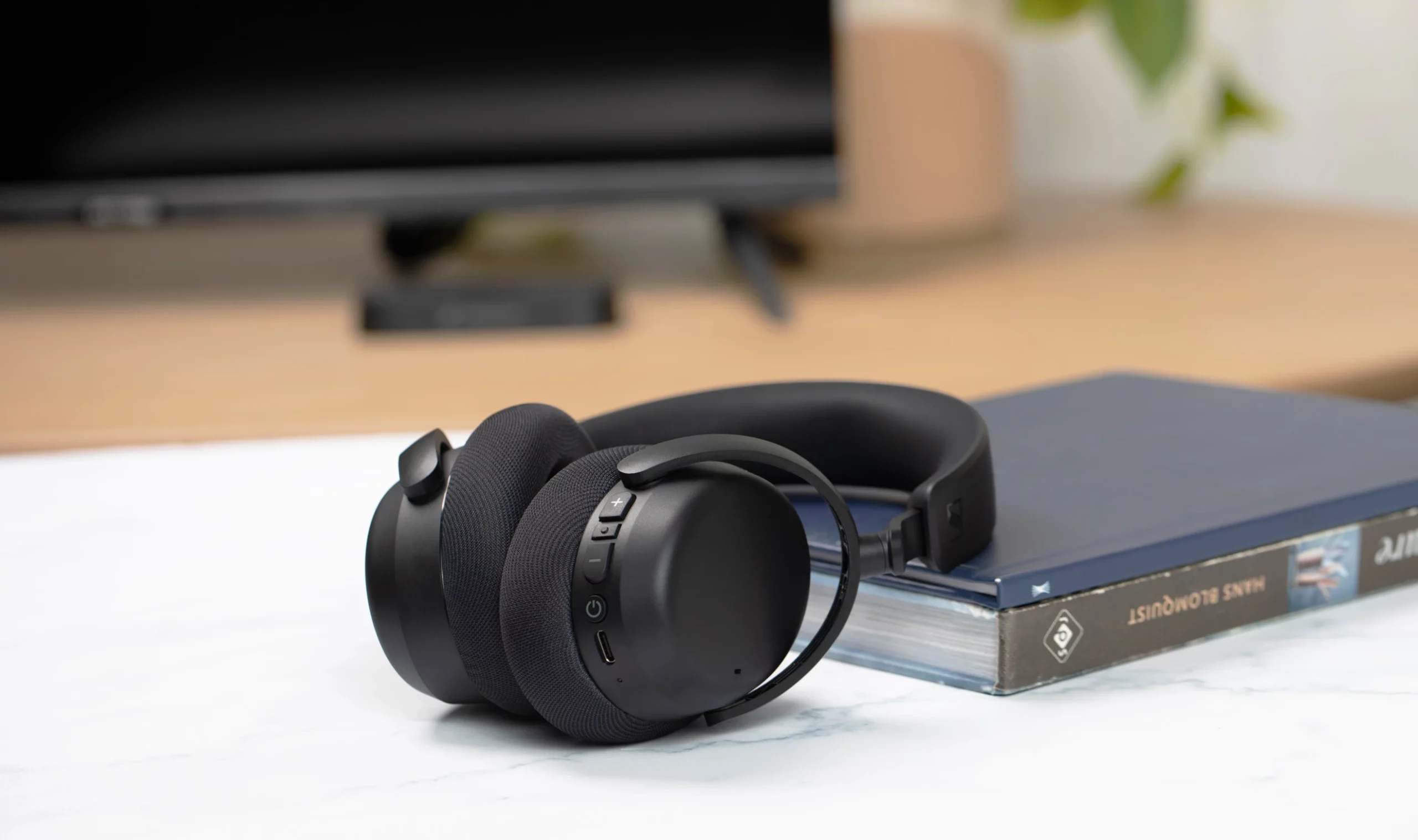
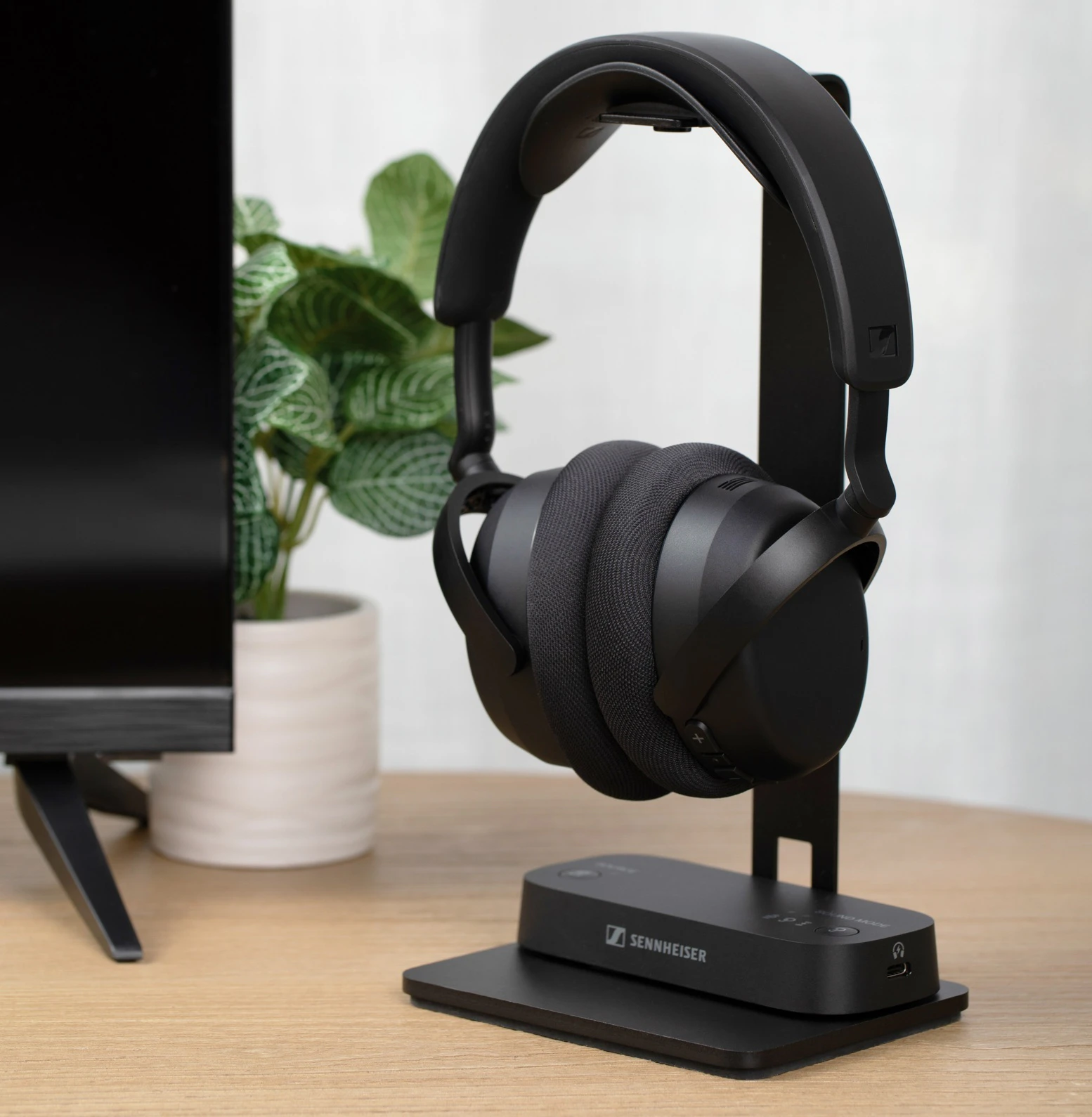
The Sennheiser HDR 275 is the headset from the Sennheiser RS 275 TV system, now sold on its own (€149.90 in Europe) so a second person can join in. It picks up the bundle’s BTA1 transmitter over Auracast, the Bluetooth LE Audio broadcast that reaches every nearby receiver at once, and each listener sets their own volume and hearing settings without touching anyone else’s.
Sound mode and Normalize Volume are set on the transmitter and apply to everyone, the BTA1 broadcasts in the open until you set a password, and the audio arrives about 50 ms late. The transmitter also accepts any Auracast receiver, so the second listener can use Auracast headphones or hearing aids they already own, minus the 106 dB and the HDR 275 settings.
What the Sennheiser HDR 275 is, and what each bundle includes
It’s a closed-back, over-ear headband headphone weighing 195 g (6.9 oz), with 37 mm dynamic drivers and a 420 mAh battery you can swap at home. The same headphone ships in both of Sennheiser’s TV bundles. The RS 275 adds the BTA1 transmitter and the HZS 1 stand, and the RS 255 is identical minus the stand, according to Sennheiser’s FAQ. The system has been on sale since February 2026, and these are the figures from the RS 275 user manual.
| HDR 275 (headphones) | BTA1 (transmitter) | |
|---|---|---|
| Type | Closed-back, over-ear, headband | Transmitter that broadcasts TV audio over Auracast |
| Connections | Bluetooth 5.4 with LE Audio and Auracast; USB-C | Optical (mini-Toslink), HDMI ARC, 3.5 mm and USB-C |
| Formats | LC3, aptX, aptX Adaptive, AAC and SBC | Input: stereo PCM up to 48 kHz/24-bit and Dolby Digital up to 640 kbps. Broadcast: LC3 |
| Driver | 37 mm dynamic; 6 Hz to 22 kHz (−10 dB); under 0.3% distortion | Not applicable |
| Sound settings | Four hearing profiles, Speech Clarity, noise suppression, balance, mono, volume limit and EQ | Neutral, virtual surround, Speech Clarity or the last two combined; Normalize Volume (Slow, Fast or Off) |
| Maximum volume | 100 dB over regular Bluetooth; 106 dB with the BTA1; 104 dB SPL on the spec sheet | Lets the HDR 275 reach 106 dB |
| Range, delay and receivers | Up to 50 m (164 ft) with the BTA1 and 25 m (82 ft) over regular Bluetooth | Up to 50 m and about 50 ms of delay; fewer than 250 receivers recommended (200 to 500, per the FAQ) |
| Power | Swappable 420 mAh battery (BA 275); up to 50 h; about 2 h to charge | 5 V, 1 A over USB, from the TV or a charger |
| Weight | 195 g (6.9 oz) | 100 g (3.5 oz) |
| Price | €149.90 (Europe) | £114.99 / $79.99 |
The press release talks about “SYS32” drivers, and the manual gives them as 37 mm. There are two fine-print details. The 50-hour battery figure was measured over Bluetooth with the AAC codec at medium volume, not with the BTA1. And a full charge takes about 2 hours according to the spec sheet and the FAQ, but “approx. 3 hours” in the body of the manual, so expect something in between.
How to connect two headphones to one TV
There are three ways to hear the TV on two headsets at once. The TV or streaming box can do it, as Samsung TVs from 2022 on do with Multi Connect and Apple TV 4K does with Share Audio for two pairs of AirPods or Beats. A dual-link Bluetooth transmitter is the second option, and an Auracast transmitter such as the BTA1 is the third. The first two stop at two headsets, because each one is a separate connection, while Auracast has no practical limit. Sennheiser’s own RS 175 and RS 195 stop at two as well, and on the RS 195 the transmitter’s settings apply to both, according to Sennheiser support.
Auracast works like a radio station. The BTA1 sends a single Bluetooth LE Audio stream with the LC3 codec, and every receiver in range picks it up without pairing, so each person sets the volume on their own headset. Sennheiser’s FAQ says the number of headsets is unlimited in theory and 200 to 500 in practice, while the transmitter’s spec sheet recommends staying under 250. For a living room, that’s plenty.
The HDR 275 in each bundle comes pre-paired. An extra one connects by itself in about 8 seconds if you switch it on within roughly 3 m (10 ft) of the transmitter, unless the broadcast already has a password, in which case you add it in the Smart Control Plus app for iPhone and Android. Other Auracast headphones, your phone and all the settings go through the app too.
The BTA1 broadcasts in the open until you set a password
It ships unencrypted, and the manual warns that anyone nearby can tune in. With up to 50 m of range, in an apartment building that can include the upstairs neighbor with Auracast earbuds. The app lets you name the broadcast and set a password, which the FAQ admits “is not unbreakable” against offline brute-force attacks, so make it a long one (the app can generate a random password). It’s the first thing we’d do after plugging it in.
What each listener controls and what applies to everyone
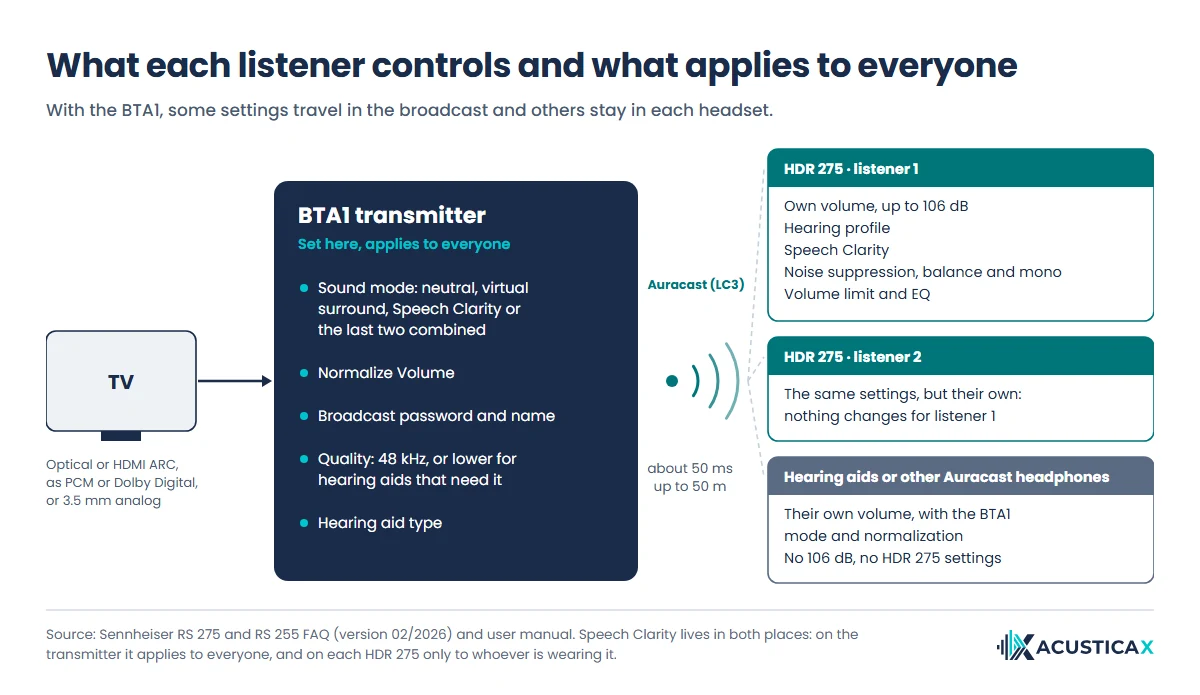
Volume and hearing settings belong to each headset, while sound mode and Normalize Volume are set on the transmitter and reach everyone. The official RS 275 FAQ puts it in those terms. The transmitter’s sound modes “adjust the sound for all connected devices”, and the headphone modes let each listener customize their own sound “without affecting others”.
On the BTA1 you choose, with a button or in the app, one of four sound modes (neutral, virtual surround, Speech Clarity, or the last two combined), plus Normalize Volume, the password, broadcast quality and hearing aid type. On each HDR 275, in the app, you get a hearing profile, its own Speech Clarity, noise suppression, left/right balance, mono, a volume limit and an EQ.
If one person wants virtual surround and the other doesn’t, someone gives in, because the mode lives on the transmitter. Speech Clarity, on the other hand, exists in both places, so whoever needs it can switch it on in their own headset while the BTA1 stays neutral. If you connect the BTA1 to a computer over USB-C, the modes stop working, because Sennheiser turns off all processing in that case.
Can you hear the TV speakers and the headphones at the same time?
Yes, if your TV keeps its optical output active with the speakers on, as many TVs do. Sennheiser recommends optical for this and points to TV settings such as “TV speakers + optical out”. If your TV has nothing like it, you may not be able to have both at once. With the headphone jack it depends on the model, because some TVs mute their speakers when something is plugged in and others let you turn that off in the menu.
With both playing, you get an echo. The headphones run about 50 ms behind, and if the wearer also hears the TV, every line arrives twice. The FAQ suggests muting the TV, and the manual suggests setting any delay on the TV’s digital output to zero.
Before any of that comes the format. Over optical and HDMI ARC, the BTA1 only takes stereo PCM up to 48 kHz/24-bit or Dolby Digital up to 640 kbps. If the TV sends anything else, such as Dolby Digital Plus, DTS or passthrough audio, the source LED turns red and you get no sound. The fix is to set the TV’s digital output to PCM or Dolby Digital, and our guide on what to do when surround sound isn’t working explains what each of those options does.
If a soundbar already sits on HDMI ARC, the FAQ suggests moving the BTA1 to ARC and the soundbar to optical, because some TVs give ARC priority and switch outputs on their own.
Will you notice the 50 ms delay on screen?
You shouldn’t. Sennheiser rates the system at about 50 ms, and ITU recommendation BT.1359, on the relative timing of sound and vision in TV, puts the point where the average viewer starts to notice late audio at 125 ms. It sets 185 ms as the acceptable maximum.
For scale, 50 ms is how long sound takes to travel about 17 m (56 ft) at 20 °C (68 °F), like watching a film 17 m from a cinema screen. If you still notice it, many TVs let you adjust audio sync, and Sennheiser lets you change the latency in the app. To check by ear, open our surround sound test with a lip-sync check on the TV, or on a computer connected to it, which fires a flash and a click at the same time.
The 50 ms is Sennheiser’s own figure and none of the published reviews has measured it; if a review unit comes our way, we’ll measure it in the living room and test the headset properly, as we did with the Sennheiser AMBEO Soundbar Mini.
Why you turn the TV up to follow the dialogue
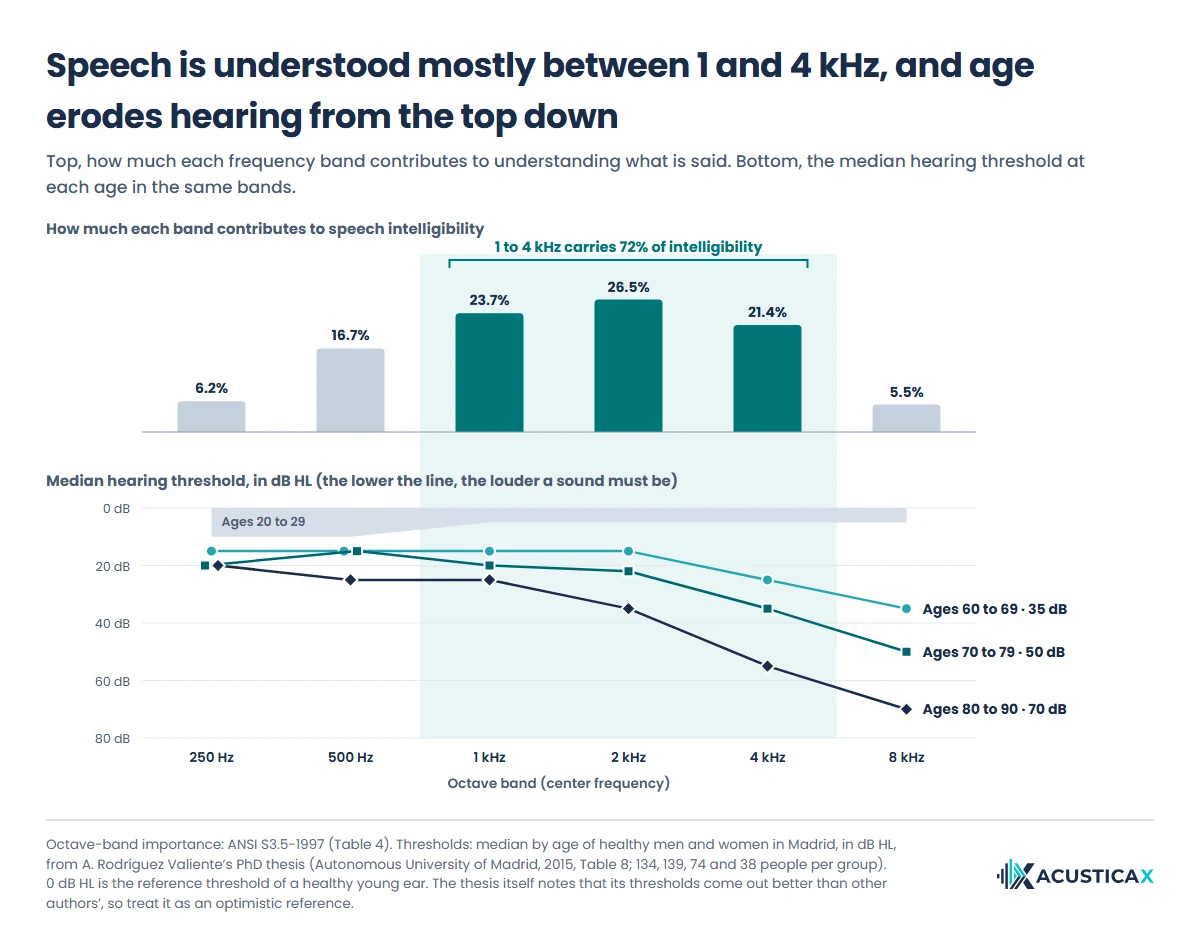
Because speech is understood mostly between 1 and 4 kHz, and age takes the highs first and works its way down toward that range. Under ANSI S3.5, the standard that estimates how much of a message gets through, the 1, 2 and 4 kHz bands carry 72% of speech intelligibility, and that’s where many consonants sit. Vowels are lower and carry more energy, so they still come through, and you hear people talking without catching what they say.
Using the thesis data from our guide on hearing frequency by age, the typical person aged 20 to 29 hears down to 5 dB HL from 1 to 8 kHz. At 4 kHz, the typical person in their 60s needs 25 dB, 20 more than someone in their 20s; in their 70s, 35 dB, and from 80 to 90, 55 dB. At 250 Hz, all three stay between 15 and 20 dB. The thesis itself notes that its thresholds come out better than other authors’, so treat it as an optimistic reference. In the US, about one in three people aged 65 to 74 has hearing loss, according to the NIDCD.
Turning up the master volume only half works, because the music and effects go up too. That’s the problem TV headphones for hearing loss try to solve, and it’s what Sennheiser’s settings target. Speech Clarity is an EQ that lifts the speech bands, according to the FAQ, and the four hearing profiles target common difficulties, such as struggling with soft voices, losing the highs or needing loud sounds turned down. Balance helps when one ear hears less than the other, and mono when one ear doesn’t hear at all. Our online hearing test checks each ear separately and gives you a first idea of whether there’s a difference.
There’s no active noise cancellation on the spec sheet, so don’t mistake noise suppression for the active noise cancelling on travel headphones. The FAQ describes it two ways, as blending stereo into mono so background noise bothers you less and as reducing “humming, fan noise, or ambient noise”, and Sennheiser’s US press release pitches it as a mode for older recordings. Our reading is that it most likely works on the broadcast sound. None of this replaces a hearing aid or a proper hearing check.
How long can your ears take 106 dB?
Not long. At 106 dB, the NIOSH criterion allows less than 4 minutes a day, versus 15 minutes at 100 dB. Sennheiser gives three maximum-volume figures: 100 dB over regular Bluetooth, which its FAQ calls “the standard Bluetooth output limit”, 106 dB with the BTA1, and 104 dB SPL on the spec sheet, measured at 1 kHz with a full-scale signal.
NIOSH, the US occupational health institute, recommends a limit of 85 dBA for 8 hours, halving the time for every 3 dB above that. Six more decibels means double the sound pressure and four times the energy, so the time drops to a quarter. It’s an occupational criterion, and with headphones it’s only a guide because the real level depends on the scene and the volume you pick, but it shows why 106 dB is headroom for people who hear poorly rather than a target.
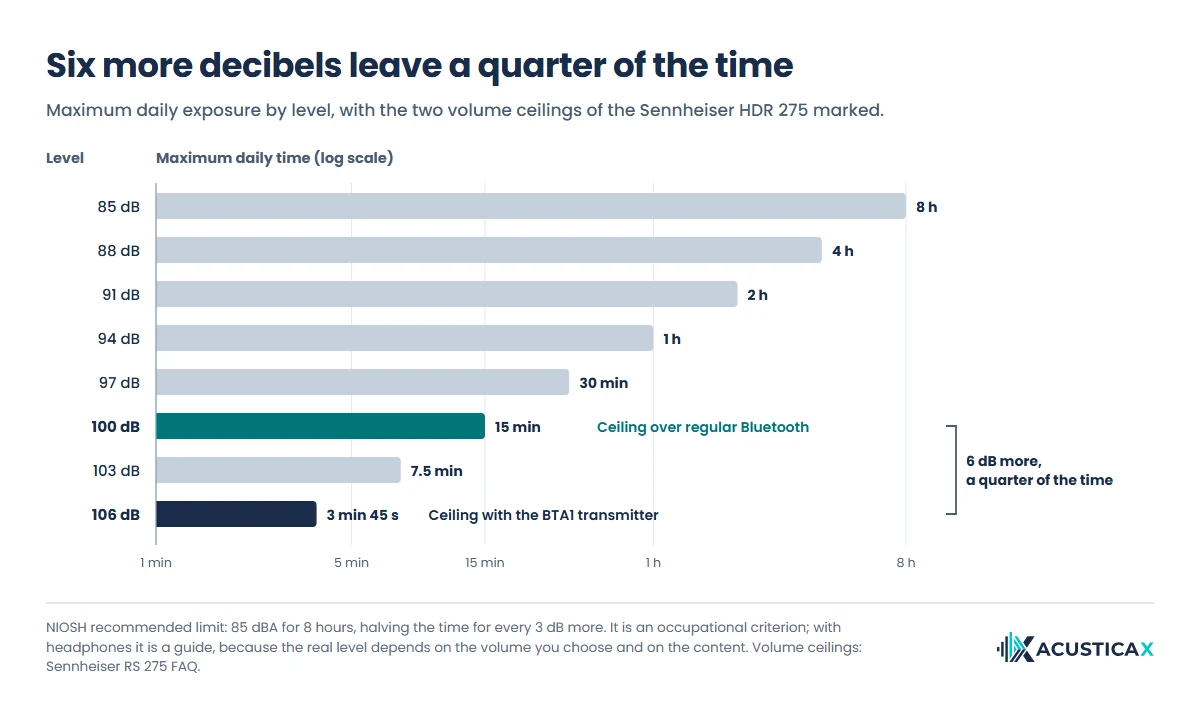
That’s what the per-headset volume limit in the app is for, and it’s worth setting if the headphones go to someone who tends to crank them. Our guide on how many decibels are dangerous has the numbers in more detail.
Do they work with hearing aids, other Auracast headphones or an Auracast TV?
Yes, with caveats. The BTA1 broadcasts standard Auracast and works with any Auracast receiver, but not with regular Bluetooth headphones. The HDR 275 can also pick up other Auracast broadcasts, such as one from a TV that already has it. Each option comes with its own trade-offs.
With hearing aids
If your hearing aids support Auracast, they hear the BTA1 directly. The broadcast defaults to 48 kHz, which some hearing aids don’t support, so the FAQ suggests lowering the quality in the app, where you also pick the hearing aid type. The Bluetooth SIG, which runs the standard, expects Auracast to become the next generation of assistive listening technology.
With other Auracast headphones, and what you lose
They work, minus the 106 dB and the per-headset HDR 275 settings. Sennheiser sells the BTA1 on its own precisely for people who already own Auracast headphones, and they get TV sound with whatever mode and normalization is set on the transmitter, each at their own volume. Sennheiser’s own comparison only lists the 106 dB with its headphones.
If your TV already broadcasts Auracast
The HDR 275 can join it without the BTA1, and you pick the broadcast in the app. The catch is that you lose the transmitter’s modes, its normalization and the 106 dB, and some TVs mute their own speakers while broadcasting. This is what manufacturers and the Bluetooth SIG say as of October 29, 2026.
| Brand | TVs that broadcast Auracast | Source |
|---|---|---|
| Samsung | 2023 Neo QLED 8K and Micro LED, and the 2024 Neo QLED 8K QND800 and QND900 | Samsung support (August 2026) |
| LG | All 2025 OLED TVs, plus the QNED85A series and above | LG to Tom’s Guide, which found no mention on the C5’s spec sheet |
| Panasonic | Via a December 2025 update. UK models from 2024, Z95A, Z93A, Z90A, Z85A, W95A and W90A; from 2025, Z95B, Z90B and W95B | Panasonic UK notes, 2024 firmware and 2025 firmware |
| Philips | 2026 Titan OS models (7801, 8001, 8501, 86×1, 90×1, OLED761, OLED811, OLED851 and OLED911). They mute their speakers while broadcasting | Philips support (August 2026) |
| Hisense, TCL and Xiaomi | Already include it or are enabling it, according to the Bluetooth SIG, but don’t publish which models | Bluetooth SIG (June 2026) |
| Sony | Doesn’t document it on its TVs; it does on headphones such as the WH-1000XM6 | Sony help guide |
An iPhone is fine too, even without built-in Auracast, because the headset is what receives the broadcast and the app just tells it which one to play. What won’t work are the headsets from the RS 120-W, RS 175 and RS 195, since they aren’t Auracast receivers, and Sennheiser doesn’t list the HDR 275 as compatible with those systems’ transmitters.
At venues, only if they broadcast Auracast
To hear a museum, theater or conference sound system, the HDR 275 needs the venue to broadcast Auracast, so it’s worth asking before you take it along. Assistive listening in venues has long relied on hearing loops, which reach hearing aids through their telecoil, and on FM or infrared systems, and the HDR 275 can receive none of them. The press release mentions museums, care homes, theaters and conferences with Auracast, which is where the Bluetooth SIG expects things to go.
Which parts you can replace, and what the stand doesn’t do
You can swap the battery at home with a precision screwdriver. Per the manual, you remove the ear pad and three PH000 Phillips screws on the left earcup, unplug the connector and fit the new BA 275, a 420 mAh cell. The FAQ lists ear pads, the battery, the stand and the HDR 275 itself as spare parts, although Sennheiser’s UK and US stores don’t carry the headset yet.
In the EU, that’s what the law will soon require. Article 11 of the EU Batteries Regulation (2023/1542) requires from February 18, 2027 that portable batteries be “readily removable and replaceable by the end-user at any time during the lifetime of the product”, using commercially available tools and without heat or solvents. A delegated regulation from July 2026 widened the exemptions to wearables that are too small or rely on a sealed enclosure, and a full-size headband headphone like this one doesn’t fit any of them, in our reading.
What the HZS 1 stand doesn’t do is charge. The FAQ says it’s for storage only, and charging goes through the USB-C cable, from the BTA1 itself (0.5 A), a charger or a computer. Ten minutes of quick charging gives about 7 hours of use.
What does a second listener cost?
In Europe the HDR 275 lists at €149.90, and Sennheiser’s UK and US stores don’t sell it on its own yet (October 29). It isn’t the only way to add a listener, though.
If you already own an RS 275 or RS 255, the second listener can use the HDR 275, Auracast headphones or hearing aids they already have (free, but without the 106 dB or the HDR settings), or a second bundle, with another BTA1 for a second TV. As of October 29, 2026, the RS 275 is on offer at $219.99 in the US (down from $299.95) and costs £219.99 in the UK, where the RS 255, which lacks the stand, is cheaper at £199.99 (it’s $279.95 in the US). The BTA1 on its own costs £114.99 and $79.99.
| System | Bundle price | Extra headset | How many at once | Auracast |
|---|---|---|---|---|
| RS 120-W | £129.99 | HDR 120-W, £89.90 | Several | No |
| RS 175-U | £239.99 | HDR 175, £149 | Two | No |
| RS 195 | £384.99 | HDR 195, £119 | Two, sharing the transmitter’s settings | No |
| RS 255 | £199.99 | HDR 275, not yet in the UK store (€149.90 in Europe) | Hundreds | Yes |
| RS 275 | £219.99 | HDR 275, not yet in the UK store | Hundreds | Yes |
Against the older range, the RS 275 now costs less than the RS 175 and the RS 195 in the UK, and its headphones also work with a phone over Bluetooth and with other Auracast broadcasts.
FAQ
What are the key differences between the Sennheiser RS 275 and RS 195 headphones?
The RS 275 broadcasts over Auracast to hundreds of headsets, each with its own volume and hearing settings, and its headphones also work with a phone over Bluetooth. The RS 195 takes two headsets at most, and its transmitter’s settings apply to both. In Sennheiser’s UK store, the RS 275 costs £219.99 and the RS 195 £384.99.
Which headphones work with Auracast?
Those listed as Auracast receivers, meaning Bluetooth LE Audio with broadcast support (the Public Broadcast Profile), such as the Sennheiser HDR 275 or the Sony WH-1000XM6, plus hearing aids that advertise it. Regular Bluetooth headphones can’t receive Auracast, however new they are.
How do I get sound from the TV speakers and the headphones at the same time?
Connect the BTA1 to the optical output and look in the TV’s sound settings for an option such as “TV speakers + optical out”, which many TVs have. If you hear both at once you’ll notice some echo, because the headphones run about 50 ms behind.
What is the difference between the RS 275 and the RS 255?
Only the stand. Both include the same HDR 275 headphones and the same BTA1 transmitter, and the RS 275 adds the HZS 1 stand for storing them, which doesn’t charge them. In the UK the RS 255 is £20 cheaper (£199.99), while in the US the RS 275 is currently the cheaper one ($219.99 against $279.95).
Can you use the HDR 275 with a phone or a computer?
Yes. It connects over regular Bluetooth to two devices at once, with AAC, aptX or aptX Adaptive, and has microphones for calls. It also works as a USB headset on a computer with the USB-C cable.
RS 275 or Momentum 4 for watching TV?
For TV, the RS 275. In Sennheiser’s own comparison, the Momentum 4 connects over regular Bluetooth, for one listener and about 10 m of range, without the volume boost above 100 dB. With active noise cancellation, the Momentum 4 makes more sense as an everyday headphone for out and about.
What are the best TV headphones for people with hearing loss?
Light ones with big buttons (the press release highlights them), long battery life, left/right balance and volume headroom, which the HDR 275 offers on paper. If the person already wears hearing aids, streaming the TV straight to them, through an Auracast transmitter or the accessory their audiologist recommends, may work better.