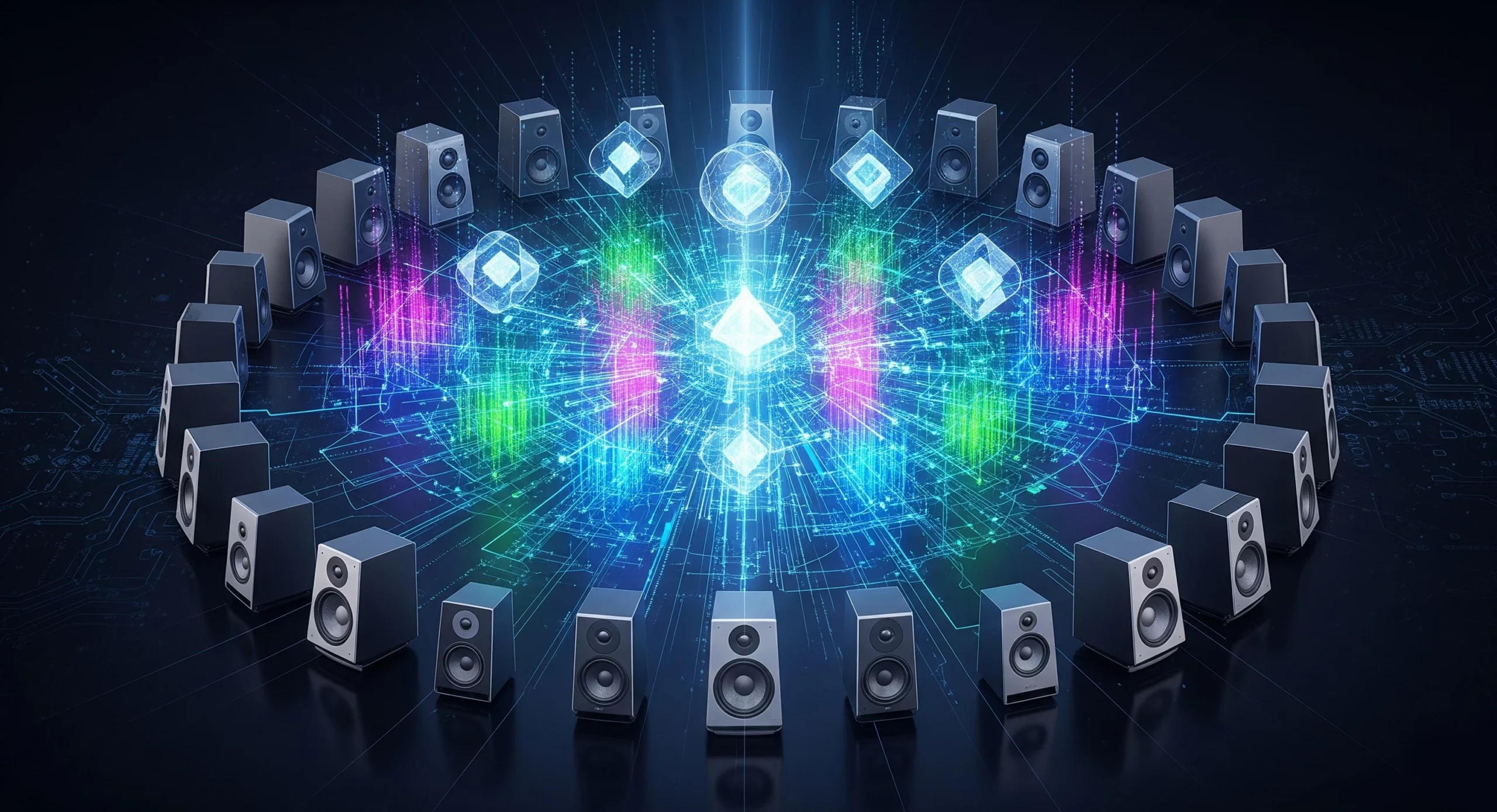
Dolby Atmos and DTS:X were based on the same technical principle: no longer tying each sound to a fixed channel, but instead treating it as an object with metadata that indicates its position within a three-dimensional sound field. This approach makes it possible to place a car, a voice, or footsteps anywhere in the room—including vertically—creating a sense of surround sound that previous systems could not achieve with the same precision.
The real difference between the two systems lies in how they package the signal, how they distribute it to the speakers, and what requirements they establish to ensure that the mix is reproduced faithfully.
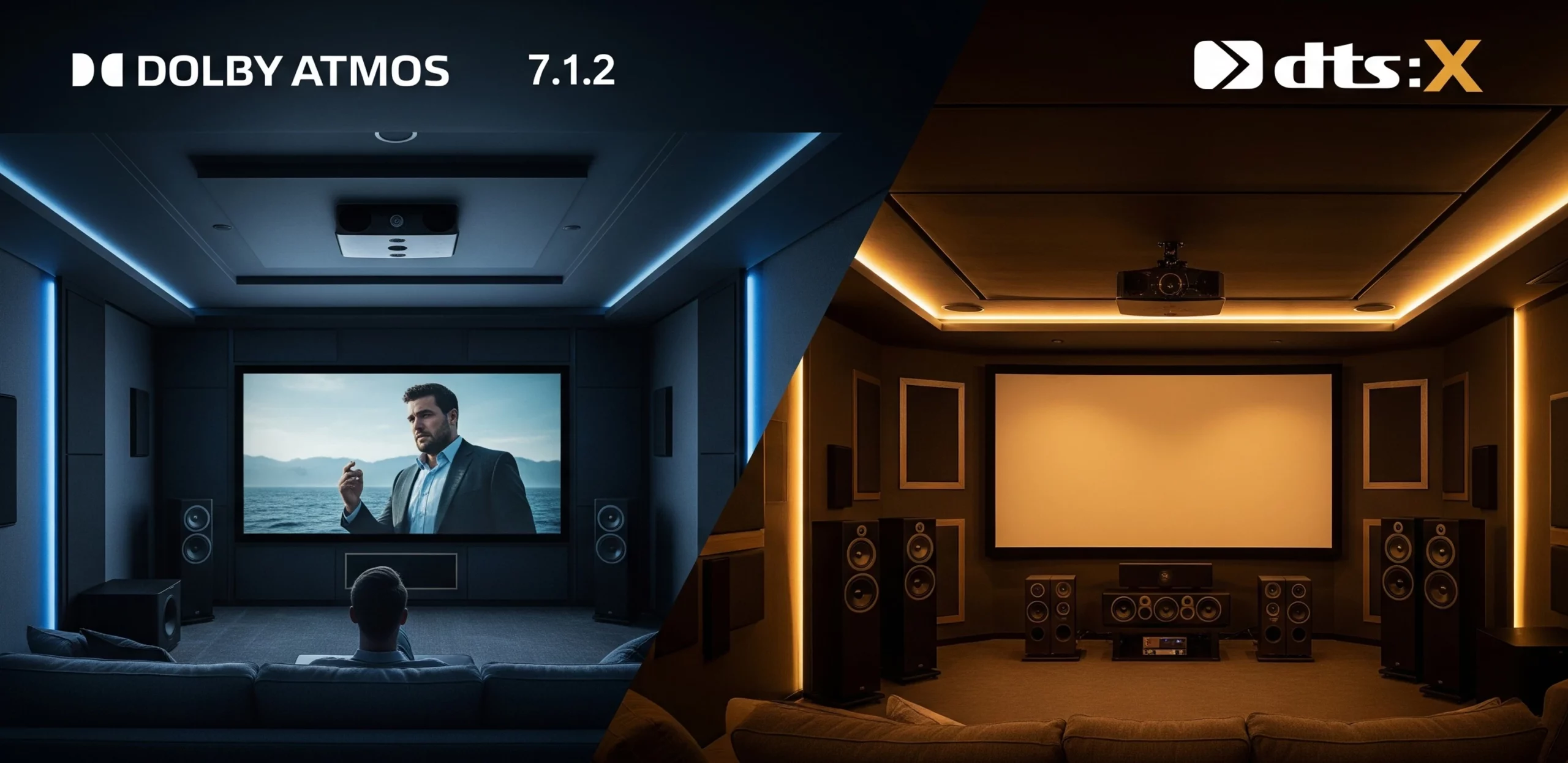
Atmos has gained traction in movie theaters, on Blu-ray discs, and on certain streaming services such as Netflix and Disney+, while DTS:X has emerged as a more flexible alternative that does not require a fixed speaker layout and works well in home theaters.
Coding, Bit Rates, and Joint Object Coding
The encoding method affects both the audio quality and the required bandwidth. Dolby Atmos is delivered losslessly via Dolby TrueHD at bitrates of up to 18 Mbps on Blu-ray, or via Dolby Digital Plus for streaming, with bitrates of up to 768 kbps for streaming and around 1.5 Mbps on Blu-ray when using DD+.
To make Atmos viable on networks with limited bandwidth, Joint Object Coding (JOC) is used, which groups related objects and encodes a mix of channels (for example, 5.1 or 7.1) along with metadata that allows the scene to be reconstructed at the receiver. JOC reduces the data load and maintains compatibility with 5.1/7.1 systems, although at the cost of reduced separation between objects and less spatial precision than lossless Atmos (TrueHD).
DTS:X uses DTS-HD Master Audio for lossless tracks and DTS Core (lossy) for other cases; on Blu-ray, DTS-HD MA can reach up to 24.5 Mbps, and its bitrate scheme is typically adaptive to prioritize the essential elements of the mix when necessary.
Object Management, Limits, and Speaker Mapping
In terms of the number of elements it can handle, Atmos supports up to 128 objects with metadata describing their location in three-dimensional space, and in professional environments, those objects can be assigned to up to 64 outputs.
For home use, Dolby recommends reference configurations such as 5.1.2 or 7.1.4 to accurately reproduce height. DTS:X, on the other hand, does not set a strict limit on the number of objects, and in home environments, it typically supports up to 32 outputs; its distinctive features include adaptive speaker reassignment and so-called neural mapping.
This mapping analyzes how many speakers there are, what type they are, and where they are located, and—based on the metadata for each object (position vectors)—redistributes the sounds to the available outputs using vector panning and psychoacoustic modeling to preserve the intent of the mix.
If there are no overhead channels, both systems offer virtualization: DTS:X supports simulation using HRTF to create a sense of height from speakers at ear level, and Atmos also features virtualization techniques.
In practice, DTS:X is more flexible for rooms that don’t follow a standard layout, while Atmos tends to offer a more structured sound when the speaker system is set up according to the recommended positions.
Processing, Sampling, Normalization, and Upmixers
Both Atmos and DTS:X support high-resolution audio, with lossless tracks up to 24-bit/96 kHz and, in some specific cases with DTS:X, material reaching 192 kHz.
In terms of processing, Atmos applies loudness normalization and dialogue normalization to maintain consistent levels across different content; in contrast, DTS:X allows you to adjust the dialogue level without altering the rest of the mix.
When the material is not mixed for object-based audio, both systems include mixers. The Dolby Surround upmixer is the tool that converts non-Atmos signals to an Atmos-like playback, and DTS Neural:X performs that function for signals that are not DTS:X. These upmixers enhance the three-dimensionality in home systems, although they do not match the fidelity of a native object-based mix.
New formats and codecs, hardware for creators
In recent years, a number of standards and technical options have been introduced that are worth knowing about:
- Dolby AC-4 is a codec designed for broadcast, streaming, and mobile devices that supports both channel-based and object-based audio, offers greater compression efficiency than its predecessor, and is suitable for rendering in configurations such as quadraphonic sound.
- MPEG-H 3D Audio, developed under the ISO/IEC framework, supports channel-based, object-based, and higher-order ambisonic audio; It supports up to 64 speaker channels and 128 codec core channels, and enables interactive features such as adjusting dialogue levels or selecting a language, which is why it has already been used in UHD broadcasts in certain countries.
- Eclipsa Audio, based on IAMF and promoted by Google and Samsung as a royalty-free, open-source alternative, with initial support on select TVs and soundbars; this codec aims to provide control over location, intensity, and spatial reflections, and to enable configurations of four channels or more.
- Sony offers a dedicated music service called 360 Reality Audio, which uses object-based positioning and relies on techniques derived from MPEG-H to play back 360-degree mixes.
- For creators, manufacturers have expanded their lineups of input and conversion equipment: for example, Universal Audio introduced 4-channel USB-C models with 24-bit/192 kHz conversion, designed for recording and mixing in multichannel formats.