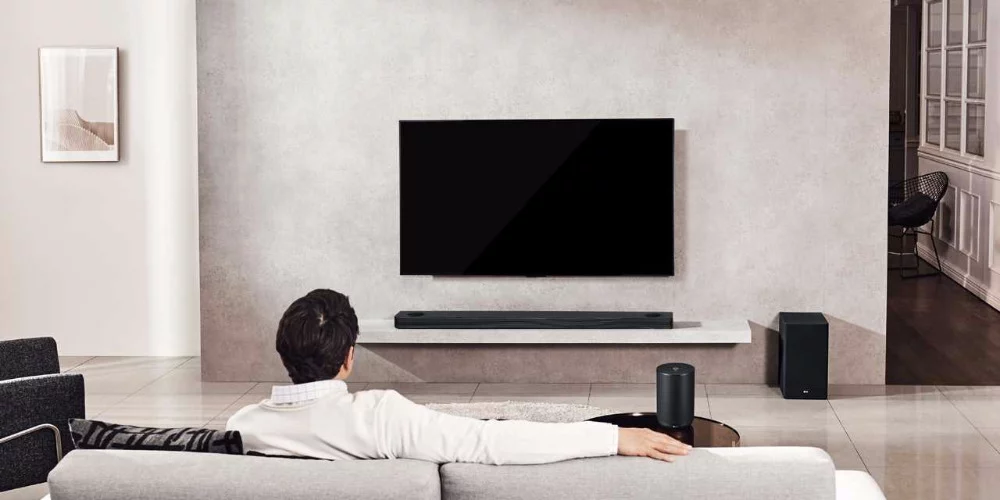
I paid quite a bit for a soundbar, and for weeks I thought it was a mediocre product. The dialogue sounded muffled, the bass was a dull rumble, and I kept turning up the volume just to make out the conversations. The problem wasn’t the device. It was the piece of furniture I’d put it in. It turns out that the cabinet and the soundbar make for a much more dangerous combination than it seems, and most people are completely unaware of it.
What’s Inside a Soundbar Cabinet
Every piece of furniture has its own resonance frequency. When you place a soundbar inside an enclosed space, the cabinet begins to vibrate along with the audio and adds its own coloration to everything you hear. This effect comes across as a muffled, muddy tone, especially in scenes with a lot of dialogue or deep bass. It’s not that the soundbar sounds bad. It’s just that the cabinet is acting as an unwanted second speaker.
There’s another problem that’s just as serious. Soundbars are designed to project audio upward and to the sides, so that the sound bounces off the walls and ceiling to create a surround-sound effect. If the device is tucked into a niche, those sound paths are blocked. The sound waves bounce off the interior walls of the cabinet instead of traveling throughout the room, resulting in a compressed sound that loses all detail in the high frequencies—precisely the frequencies you need to clearly understand voices.
Furthermore, when the soundbar is recessed inside a piece of furniture, the sound waves hit the edges of the opening and create diffraction points that scatter the sound before it reaches your ears. If there’s also a shelf protruding above it, this creates what’s called an acoustic shadow, which physically blocks high-frequency detail. The result is that you turn up the volume and still can’t quite make out what the characters are saying.
Heavy furniture also absorbs sound
The soundbar doesn’t have to be completely enclosed for the furniture to interfere with the audio. As Sound Review Hub explains, thick wooden furniture absorbs some of the sound, while reflective surfaces cause it to bounce unpredictably and create echoes. Both of these factors reduce clarity. The sofa can also be an obstacle if the soundbar is positioned behind it. The back of the sofa acts as a barrier, causing the sound to arrive muffled.
This issue typically affects soundbars with Dolby Atmos drivers or side speakers the most. Those drivers need a clear line of sight to the ceiling and walls to create the immersive effect. If they’re blocked by furniture, you’re paying for technology you’ll never actually hear. For those with a Sennheiser soundbar or another model with a separate subwoofer, the problem is compounded if the subwoofer is also enclosed in a niche.
How to Put It On Properly
The most effective solution is to remove the rod from the opening and place it on the front edge of the shelf, with nothing above or to the sides to block it. If you can’t modify the cabinet, at least make sure there’s about eight centimeters of clear space around the device in all directions. This reduces cabinet resonance and allows the sound to project forward.
Height also matters more than it seems. High-frequency drivers are directional. If the soundbar is too low, the sound will be directed toward the floor instead of toward your ears. Ideally, it should be at ear level when you’re seated. If that’s not possible, tilt it slightly upward to aim directly at your listening position. The difference in clarity is usually immediate—and it costs nothing.
The best option is to mount the speakers on the wall, right below the TV. The sound travels freely into the room, without nearby surfaces to absorb or deflect it. If you rent and can’t drill holes, there are screwless mounts that work well. It doesn’t make sense to invest in a good audio system only to muffle it inside a piece of furniture.